
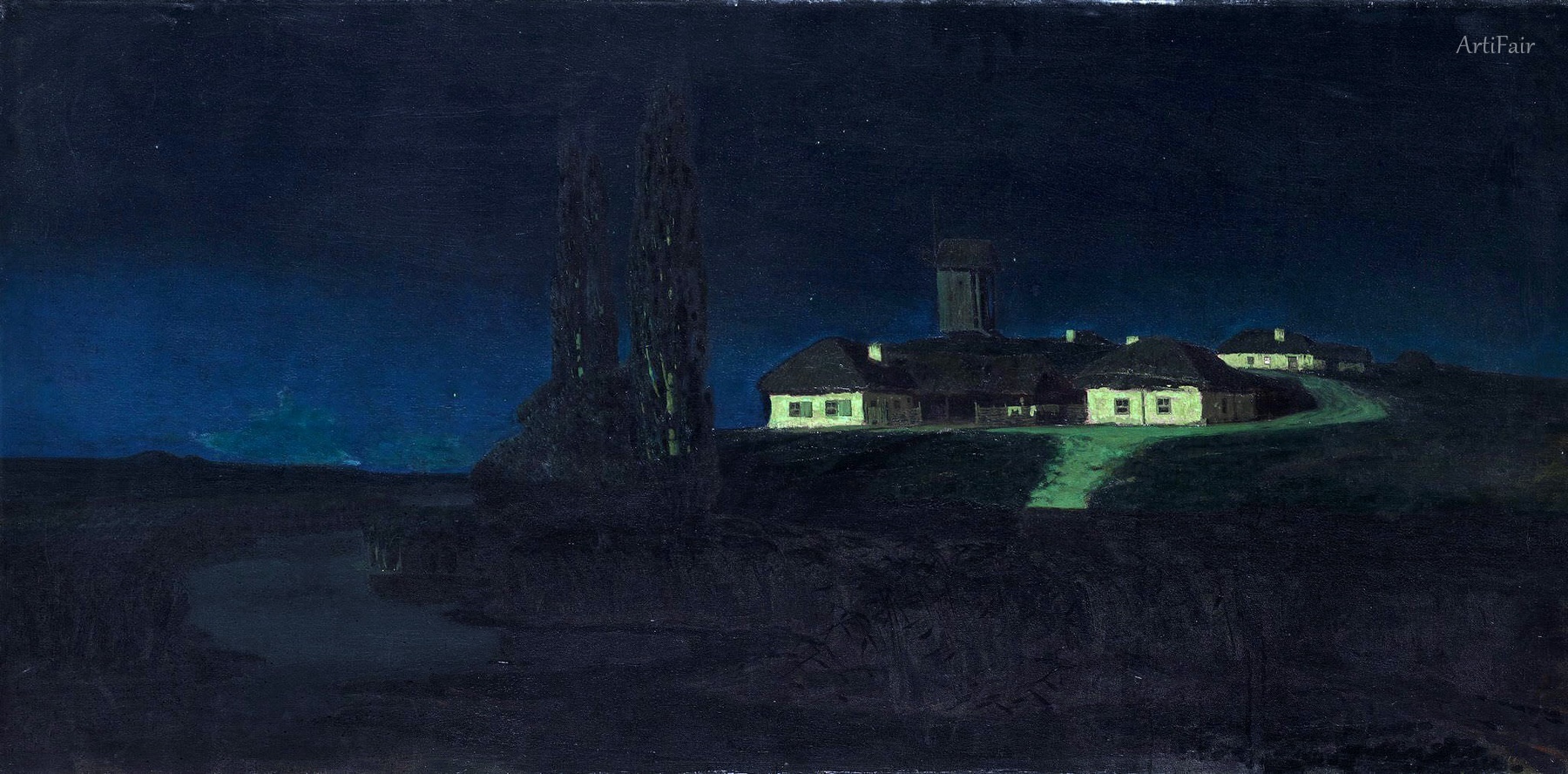
Ukrainian Night
Category:
Created:
1876
Likes:
1
Dimensions:
Download:
New users get 4 free credits. 2K costs 1 credit; 4K and Ultra HD are priced by resolution. Public domain artworks can be used commercially.
Dominant colors
Public domain download summary
This artwork is provided as a public domain image resource. The 2K file costs 1 credit for everyday creative work, while 4K and Ultra HD files are priced by resolution.
Art Appreciation
Ukrainian Night is an oil on canvas painted in 1876 by the Russian landscape painter Arkhip Kuindzhi; it is in the State Tretyakov Gallery, Moscow (inventory Zh-879).
Kuindzhi (1841–1910), who grew up poor in Mariupol and Taganrog and worked as a photo retoucher before moving to Saint Petersburg, had joined the Peredvizhniki (Society for Travelling Art Exhibitions) in 1875. Ukrainian Night, shown at the society's fifth exhibition in March 1876, was a resounding success and is regarded as the turning point of his career: with it he left behind the academic romanticism of his early pictures and an exotic, strongly heightened treatment of light and colour became a hallmark of his work. His biographer Mikhail Nevedomsky dated the start of the painter's mature period from this work.
The canvas, 79 by 162 cm, is painted almost entirely in deep, velvety blue-blacks. Only the whitewashed walls of the clay-built village houses on the hill at right catch the moonlight, together with a pale strip of path leading down from them; two tall pyramidal poplars rise in silhouette, and a reed-fringed pond glints faintly at lower left. The art historian Vladimir Petrov likened the effect to the descriptions of the Ukrainian night by Pushkin and Gogol. The Russian Museum holds a small oil sketch for the composition, 17.5 by 33.2 cm.
The painting was later sent to the Russian section of the 1878 Exposition Universelle in Paris. That same year the Academy of Arts awarded Kuindzhi the title of artist of the first class for this work together with On the Island of Valaam, The Chumak Road in Mariupol and The Steppe. Two years later he followed it with Evening in Ukraine, which repeats a similar composition in the light of sunset.