
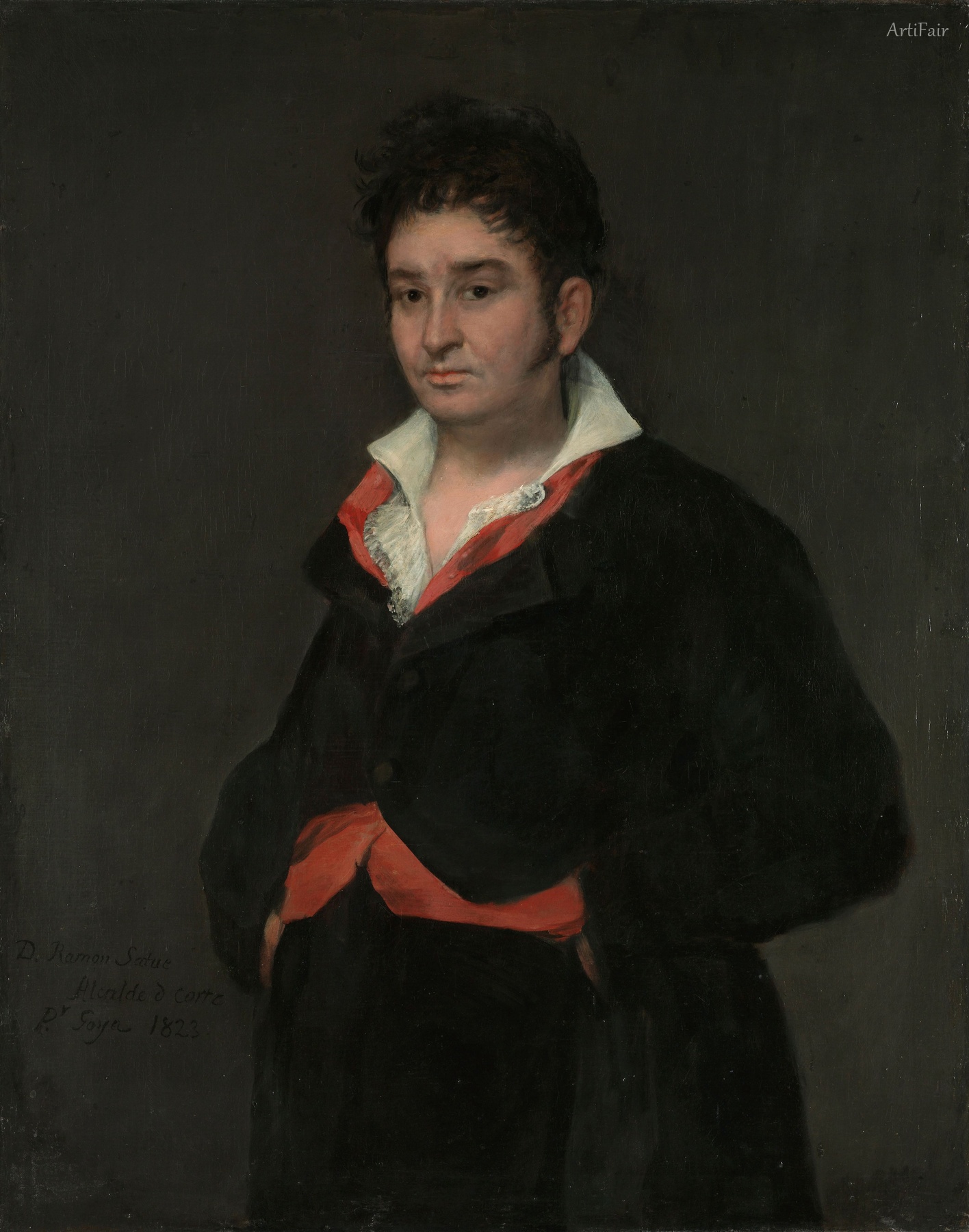
Portrait of Don Ramón Satué
Category:
Created:
1823
Likes:
0
Dimensions:
Download:
New users get 4 free credits. 2K costs 1 credit; 4K and Ultra HD are priced by resolution. Public domain artworks can be used commercially.
Dominant colors
Public domain download summary
This artwork is provided as a public domain image resource. The 2K file costs 1 credit for everyday creative work, while 4K and Ultra HD files are priced by resolution.
Art Appreciation
Portrait of Don Ramón Satué is an oil on canvas by Francisco Goya, signed and dated 1823, in the Rijksmuseum, Amsterdam (SK-A-2963). It measures 107 × 83.5 cm and is the only painting by Goya in a public collection in the Netherlands.
Goya was 76 and living in Madrid, shortly before he left Spain for France, when he painted Ramón Satué y Allué (1765–1824), an Aragonese magistrate who served as an alcalde de casa y corte, a judge of the court tribunal in Madrid, until 1820. The inscription at lower left reads 'D. Ramon Satue / Alcalde d corte / Pr Goya 1823'. Because Satué no longer held that office in 1823, and because the picture closely resembles Goya's 1820 portrait of Tiburcio Pérez, some critics suspected the last digit had been altered from 0 to 3, but the inscription is now accepted as original. Satué was related to the cleric José Duaso y Latre, who sheltered Goya during the anti-liberal repression of early 1824 and whom Goya also portrayed.
Satué stands at half length against a flat grey ground, in a black suit with a red waistcoat and sash and a white shirt open at the neck, his hair dishevelled and his hands in his trouser pockets. The Rijksmuseum notes that such a casual pose was something Goya usually reserved for his closest friends. The restricted colour, enlivened only by the red, keeps attention on the direct, almost challenging gaze. X-ray research published in 2011 by Joris Dik and Koen Janssens revealed another portrait beneath the surface: a man in French dress uniform with medals, perhaps a general or Joseph Bonaparte himself, probably painted around 1810 and covered once such an image had become politically dangerous.
According to the museum, Goya gave the portrait to the sitter, and after Satué's death it was sent to his family home at Fanlo, near Huesca, in 1825. It later belonged to the Marquis of Heredia in Madrid, was auctioned at the Hôtel Drouot in Paris in 1890 and 1902, and hung in Dr Joachim Carvallo's Château de Villandry. Duveen Brothers acquired it in 1919, and the Rijksmuseum bought it in 1922 with the support of the Vereniging Rembrandt.