
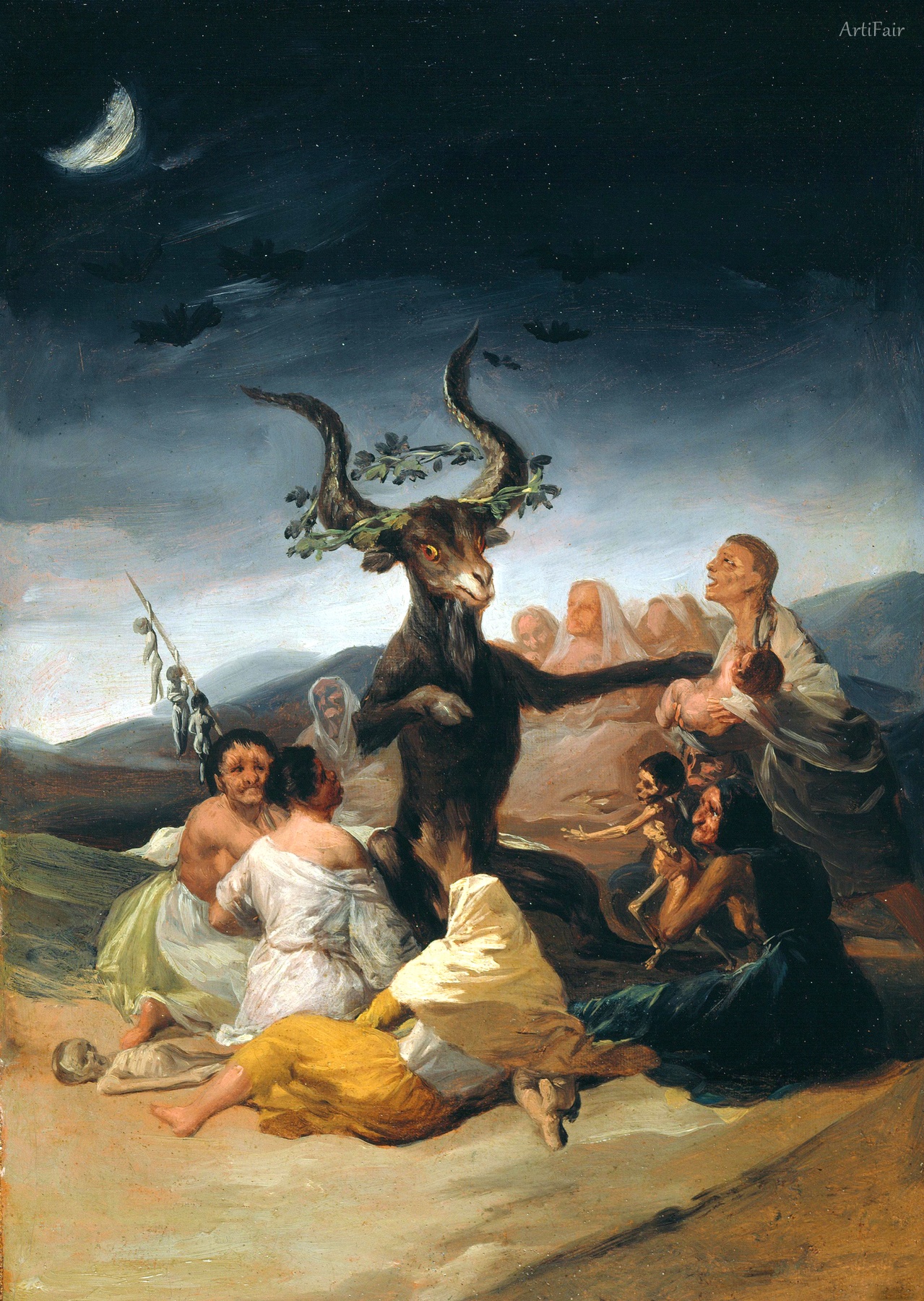
Witches' Sabbath
Category:
Created:
1798
Likes:
3
Dimensions:
Download:
New users get 4 free credits. 2K costs 1 credit; 4K and Ultra HD are priced by resolution. Public domain artworks can be used commercially.
Dominant colors
Public domain download summary
This artwork is provided as a public domain image resource. The 2K file costs 1 credit for everyday creative work, while 4K and Ultra HD files are priced by resolution.
Art Appreciation
Witches' Sabbath (El aquelarre) is a small oil-on-canvas painting by Francisco Goya, made in 1797–1798 for the Duke and Duchess of Osuna and now in the Museo Lázaro Galdiano, Madrid (inv. 2006).
It is one of six pictures on witchcraft of similar size that the Osunas paid for in 1798 to decorate their country retreat, the Alameda de Osuna, outside Madrid; the purchase is usually credited to the duchess. The others are Witches' Flight (Prado), The Spell (also Lázaro Galdiano), The Witches' Kitchen (private collection, Mexico), The Bewitched Man (National Gallery, London) and a lost Don Juan and the Commander. Goya was working on Los Caprichos at the same time, and witchcraft was a lively topic among his enlightened friends, above all Leandro Fernández de Moratín, who wrote a mocking commentary on the 1610 auto-da-fé of Logroño, where the Inquisition condemned witches from Zugarramurdi.
Under a crescent moon, the Devil in the form of a great he-goat, crowned with vine leaves like Bacchus, sits at the centre of a circle of young and old witches. One woman offers him a newborn child and an old hag holds up a skeletal one; a woman nearby carries a pole hung with tiny bodies, and dead infants lie on the ground. Bats fly overhead, and paler figures in white robes gather behind. Symbols are inverted, as in witchcraft imagery: the goat stretches out his left hoof, not his right. The museum reads the series as a satire on superstition by the enlightened circle to which both Goya and the duke belonged.
The canvas measures 43 × 30 cm. After the Osunas it belonged to the Duke of Tovar, and in the 20th century José Lázaro Galdiano bought it; his collection passed to the Spanish state on his death. Goya returned to the subject in the much larger Black Painting of the same name around 1820–1823.