
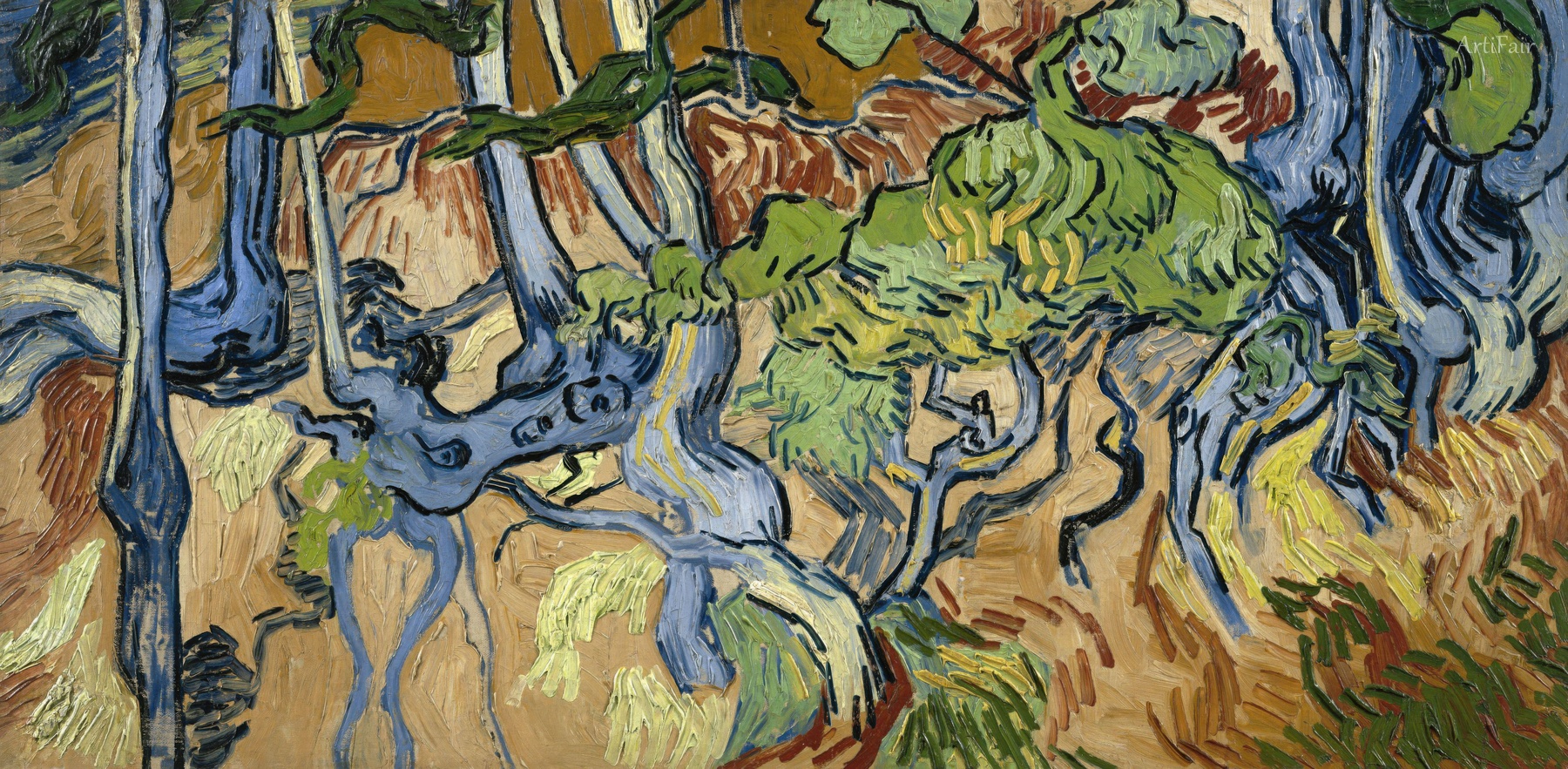
Tree Roots
Category:
Created:
1890
Likes:
0
Dimensions:
Download:
New users get 4 free credits. 2K costs 1 credit; 4K and Ultra HD are priced by resolution. Public domain artworks can be used commercially.
Dominant colors
Public domain download summary
This artwork is provided as a public domain image resource. The 2K file costs 1 credit for everyday creative work, while 4K and Ultra HD files are priced by resolution.
Art Appreciation
Tree Roots is an oil-on-canvas painting by Vincent van Gogh, made in Auvers-sur-Oise in July 1890 and probably his last painting; it is in the Van Gogh Museum, Amsterdam (Vincent van Gogh Foundation).
Van Gogh moved to Auvers, a small town north of Paris, in May 1890 after leaving the asylum at Saint-Rémy, and died there at the end of July. In his last weeks he often used elongated double-square canvases for landscapes, and this is one of them, 50.3 × 100.1 cm. Andries Bonger, Theo van Gogh's brother-in-law, wrote that on the morning before his death Vincent had painted a sous-bois, a woodland scene, full of sun and life; the museum takes this to refer to Tree Roots. The picture was not entirely completed, which explains its unfinished look.
At first the canvas reads as a jumble of bright colours and loose shapes, and only gradually does it resolve into a slope with tree trunks and exposed roots. According to the museum these are timber trees growing in a marl quarry, a kind of site found around Auvers. The catalogue author Jan Hulsker considered it the most original of the double-square canvases, and Wouter van der Veen and Peter Knapp have argued that here the painting itself counts for more than the subject, pointing ahead to abstraction and German Expressionism. In 1882 in The Hague Van Gogh had drawn tree roots as an image of life's struggle, but nothing in his letters shows whether he had the same idea in 1890.
In 2020 Van der Veen, scientific director of the Institut Van Gogh, used an old postcard to locate the probable site on the rue Daubigny, about 150 metres from the Auberge Ravoux where Van Gogh lodged, and a photograph of around 1907 confirmed it in 2021. The painting stayed with Theo and then Jo van Gogh-Bonger and their son, and has hung in the Van Gogh Museum since it opened in 1973. It was among 20 paintings stolen from the museum on 14 April 1991, and was later recovered.