
The Death of Seneca
Category:
Created:
1773
Likes:
1
Dimensions:
Download:
New users get 4 free credits. 2K costs 1 credit; 4K and Ultra HD are priced by resolution. Public domain artworks can be used commercially.
Dominant colors
Public domain download summary
This artwork is provided as a public domain image resource. The 2K file costs 1 credit for everyday creative work, while 4K and Ultra HD files are priced by resolution.
Art Appreciation
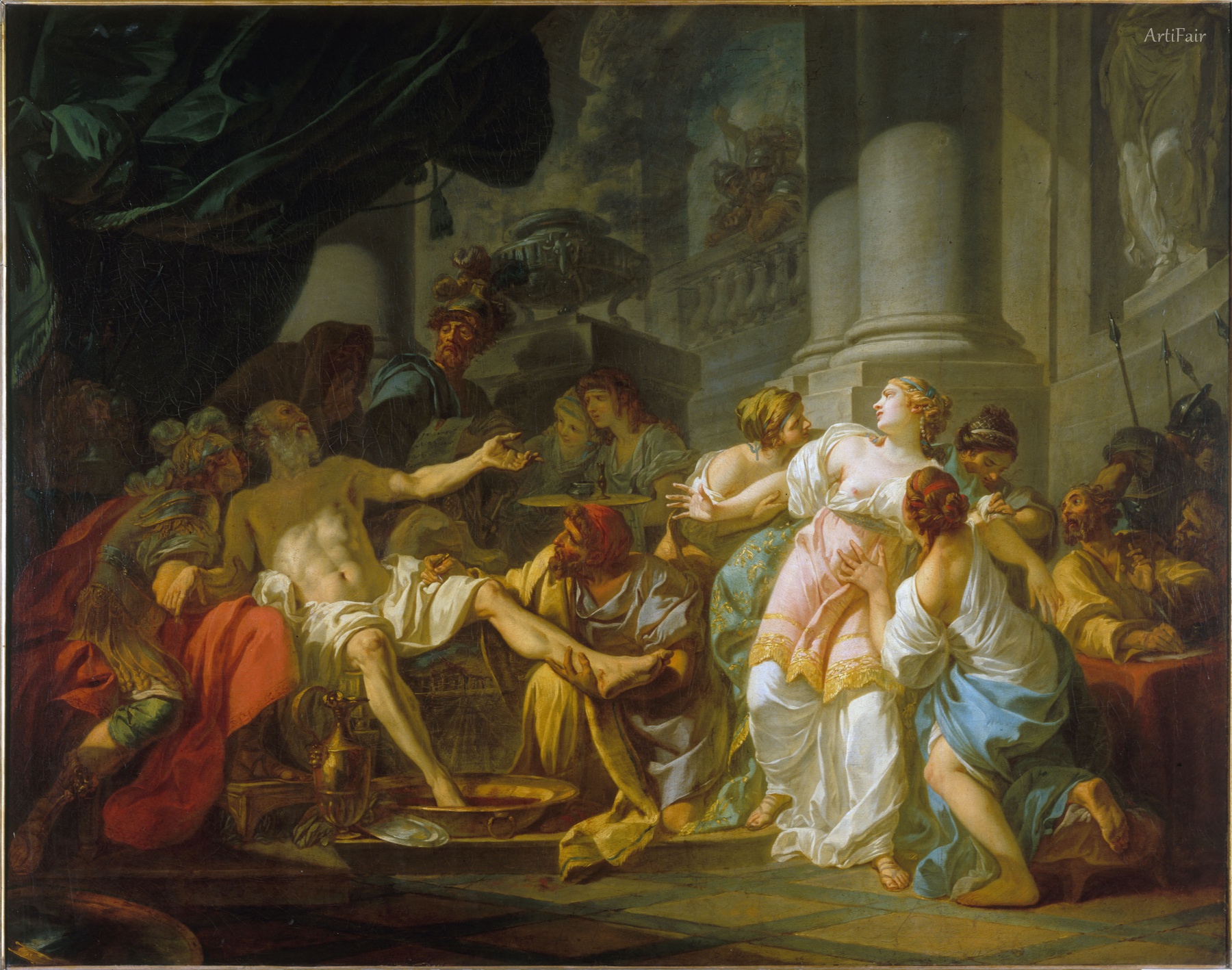
The Death of Seneca (La Mort de Sénèque) is an oil-on-canvas painting by Jacques-Louis David made in 1773 for the Prix de Rome competition of the Royal Academy; it measures 123 × 160 cm and belongs to the Petit Palais, Musée des Beaux-Arts de la Ville de Paris (PDUT1154).
The Academy set the subject, the death of Seneca as told by Tacitus, for the Grand Prix of 1773. According to the Petit Palais it was David's third attempt at the prize, and once more the jury was unconvinced: the prize went to Pierre Peyron, whose version was sparer and closer to the antique. David finally won in 1774 with Erasistratus Discovering the Cause of Antiochus' Disease, and it was in Rome that he left the Rococo behind and became the leading Neoclassical painter.
Accused of joining a conspiracy against Nero, the Stoic philosopher Seneca has been ordered to kill himself. He and his wife Paulina have opened their veins, but death is slow, so he asks the servants to lead her away so that neither will weaken at the sight of the other's suffering; at Nero's order she was saved. At the left a doctor cuts the philosopher's ankles to hasten the bleeding and a slave offers poison. Behind, a centurion sent by Nero watches over the sentence, and at the right a disciple writes down Seneca's last words.
The Petit Palais describes the result as a decorative composition in the Rococo taste: draperies wound round tall columns and monumental statues suggest an opera set rather than a Stoic's sober house, the gestures are theatrical, the women's ornaments elegant and the colours cheerful pinks and blues, all ill-suited to the austere subject. That mismatch is what cost David the prize. The canvas was bought for the Petit Palais in 1913 with income from a bequest, and the museum also owns an oil sketch for the composition, acquired in 1969.