
Sappho and Alcaeus
Category:
Created:
1881
Likes:
0
Dimensions:
Download:
New users get 4 free credits. 2K costs 1 credit; 4K and Ultra HD are priced by resolution. Public domain artworks can be used commercially.
Dominant colors
Public domain download summary
This artwork is provided as a public domain image resource. The 2K file costs 1 credit for everyday creative work, while 4K and Ultra HD files are priced by resolution.
Art Appreciation
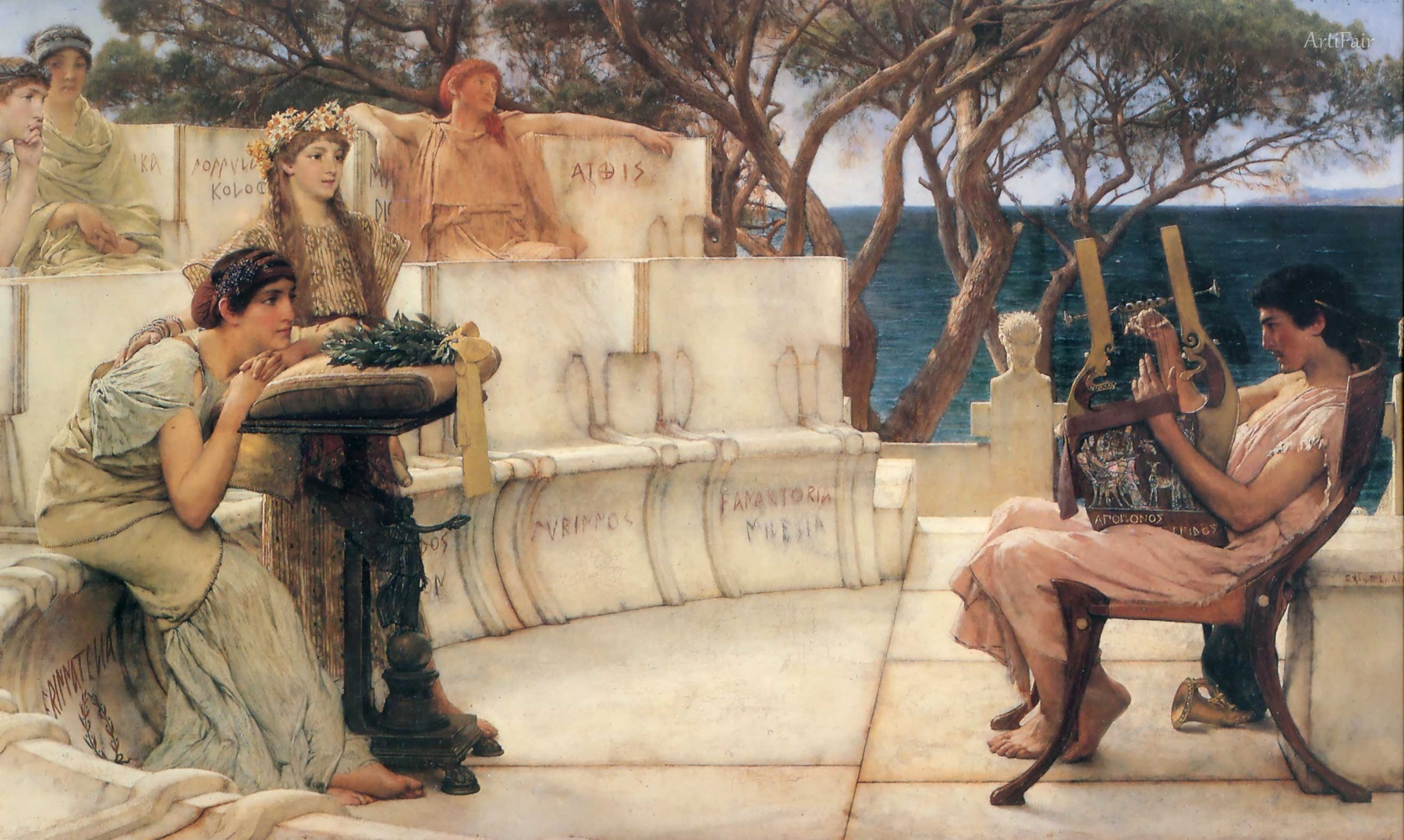
Sappho and Alcaeus is an oil-on-panel painting by Lawrence Alma-Tadema, dated 1881 and held by the Walters Art Museum in Baltimore (accession 37.159); it measures 66 × 122 cm.
Alma-Tadema had settled in London in 1870 and built his success on scenes of everyday life in imperial Rome. Here he turned instead to archaic Greece. The picture illustrates a passage by the Hellenistic poet Hermesianax, preserved in Athenaeus's Deipnosophistae (The Learned Banquet), and imagines a performance on Lesbos in the late seventh century BC. The poet Alcaeus of Mytilene, seated at the right, plays the kithara, while Sappho leans forward on a stand to listen, a laurel wreath, presumably meant for the performer, resting beside her arm. Several of her female companions watch from the benches behind.
The setting shows the painter's archaeological care. He based the curved tiers of white marble seating on the Theatre of Dionysus in Athens, but replaced the names of Athenian officials carved on the original seats with the names of women from Sappho's circle. Through the trees beyond, the Aegean Sea fills the background. The panel is signed lower right 'L. Alma Tadema' and inscribed with the opus number CCXXIII, part of the numbering system with which he catalogued his own works.
The painting was exhibited at the Royal Academy in 1881 and was well received by critics; Punch punned that it was 'marbellous'. William Powell Frith included it in his painting A Private View at the Royal Academy, 1881, where it hangs at the far right and is being examined by John Everett Millais. The Baltimore collector William T. Walters bought it, through the agent Deschamps, after 1881. On his death in 1894 it passed to his son Henry Walters, who bequeathed it to the museum in 1931.