
Ophelia
Category:
Created:
1894
Likes:
2
Dimensions:
Download:
New users get 4 free credits. 2K costs 1 credit; 4K and Ultra HD are priced by resolution. Public domain artworks can be used commercially.
Dominant colors
Public domain download summary
This artwork is provided as a public domain image resource. The 2K file costs 1 credit for everyday creative work, while 4K and Ultra HD files are priced by resolution.
Art Appreciation
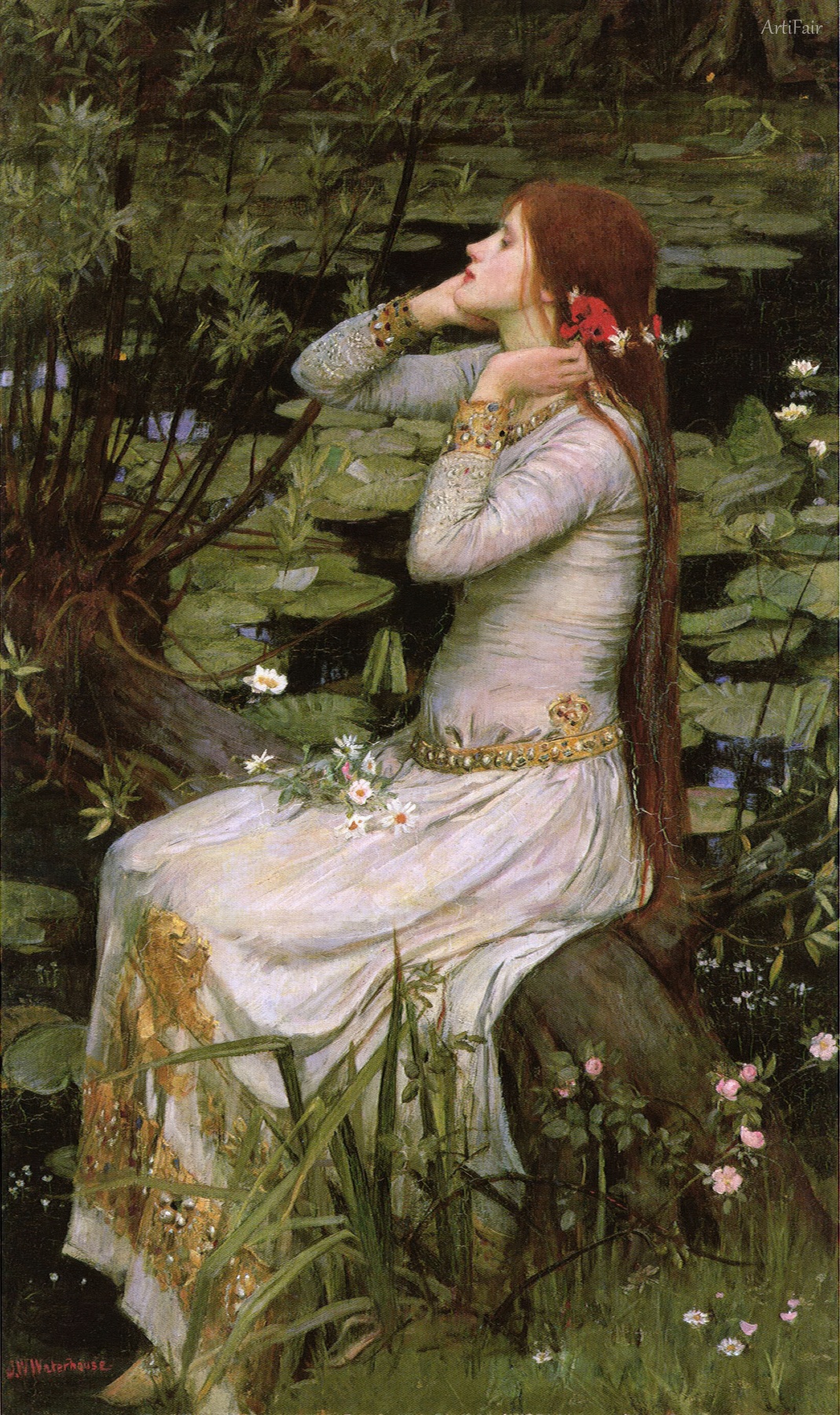
Ophelia is an oil painting on canvas by John William Waterhouse, signed and painted in 1894, the second of his three versions of the subject; it measures 124.4 by 73.6 cm and is in a private collection.
Ophelia is the young Danish noblewoman of Shakespeare's Hamlet who, driven mad by Hamlet's neglect and the killing of her father Polonius, drowns in a brook after a willow branch breaks beneath her. Queen Gertrude's speech in Act IV, scene 7 describes her garlands of crow-flowers, nettles, daisies and long purples. Painters from Delacroix to Millais and Rossetti had taken up the theme, and Waterhouse returned to it three times: in 1889 Ophelia lies in a meadow near the brook, here she sits on the slanting willow bough moments before her death, and in 1910 she makes her way to the water.
In this version she perches over a pond of water lilies, fixing flowers into her hair while more lie in her lap. Her rich dress, with a jewelled girdle worn low on the hips and a lion rampant on the hem, contrasts with the natural setting. Angus Trumble points out details that hint at death: poppies in her hair, half-closed eyes, pallor and lank hair. Reviewing the painting in the Athenaeum, F. G. Stephens complained that it showed little of Ophelia's madness or sorrow but praised the weed-strewn, sun-flecked pool, and A. L. Baldry in the Studio credited much of its charm to the treatment of leaves and branches.
It was exhibited at the New Gallery and at the Liverpool Autumn Exhibition in 1894. After his election as a full Royal Academician in 1895, Waterhouse apparently offered it as a temporary diploma work until A Mermaid was finished. It then belonged to the collector George McCulloch, whose sale at Christie's in 1913 brought 450 guineas, and later to H. W. Henderson. The water-lily motif reappeared in Hylas and the Nymphs, shown at the Royal Academy in 1897.