
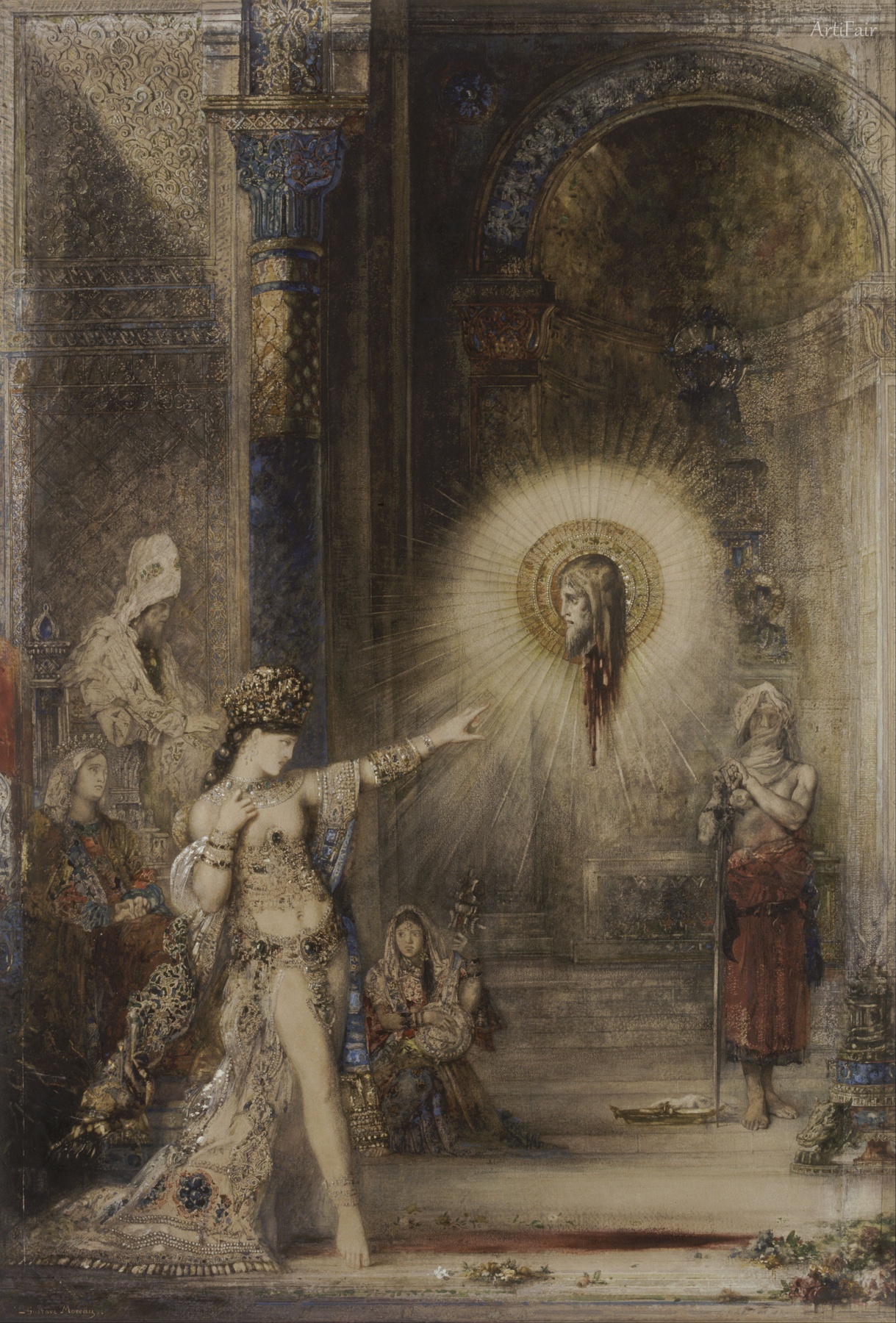
The Apparition
Category:
Created:
1876
Likes:
0
Dimensions:
Download:
New users get 4 free credits. 2K costs 1 credit; 4K and Ultra HD are priced by resolution. Public domain artworks can be used commercially.
Dominant colors
Public domain download summary
This artwork is provided as a public domain image resource. The 2K file costs 1 credit for everyday creative work, while 4K and Ultra HD files are priced by resolution.
Art Appreciation
The Apparition (L'Apparition) is a watercolour by Gustave Moreau, dated 1876 and measuring 106 × 72.2 cm; it belongs to the Musée d'Orsay and is kept in the Département des Arts graphiques of the Louvre, Paris (RF 2130).
The subject comes from the Gospels of Matthew and Mark. At Herod Antipas's birthday feast, Salome dances so well that the king promises her anything she asks; prompted by her mother Herodias, whom John the Baptist had condemned for her marriage to Herod, she demands John's head on a charger. Moreau treated the theme in 19 paintings, 6 watercolours and more than 150 drawings. Here he imagines a moment the Bible does not describe: the severed head, ringed by a blazing halo and dripping blood, hangs in the air before Salome, who points at it with her bare arm. Herod, Herodias and a lute player sit in shadow at the left, the executioner stands at the right with the empty silver charger at his feet, and the palace behind is modelled on the Alhambra. No one but Salome seems to see the vision, leaving open whether it is real or imagined. According to the Louvre, the model Marie Gay posed for Salome.
Shown at the Salon of 1876 with the oils Salome Dancing before Herod and Hercules and the Lernaean Hydra, the watercolour caused a sensation. Moreau sold it on 31 May 1876 to the Belgian dealer Léon Gauchez for 8,000 francs, and in 1877 Gauchez lent it to the Grosvenor Gallery in London, where it hung with the oil paintings rather than among the watercolours. Joris-Karl Huysmans described the glowing, bleeding head in his novel À rebours (1884), and Oscar Wilde saw the work at the Louvre in 1884 before writing his play Salome (1893).
The collector Charles Hayem acquired it and gave it to the state in 1879 for the Musée du Luxembourg, which received it in 1898; it passed to the Louvre in 1929 and is now part of the Orsay collection. Moreau painted several related versions, including an oil in the Musée Gustave Moreau and another in the Fogg Museum at Harvard.