
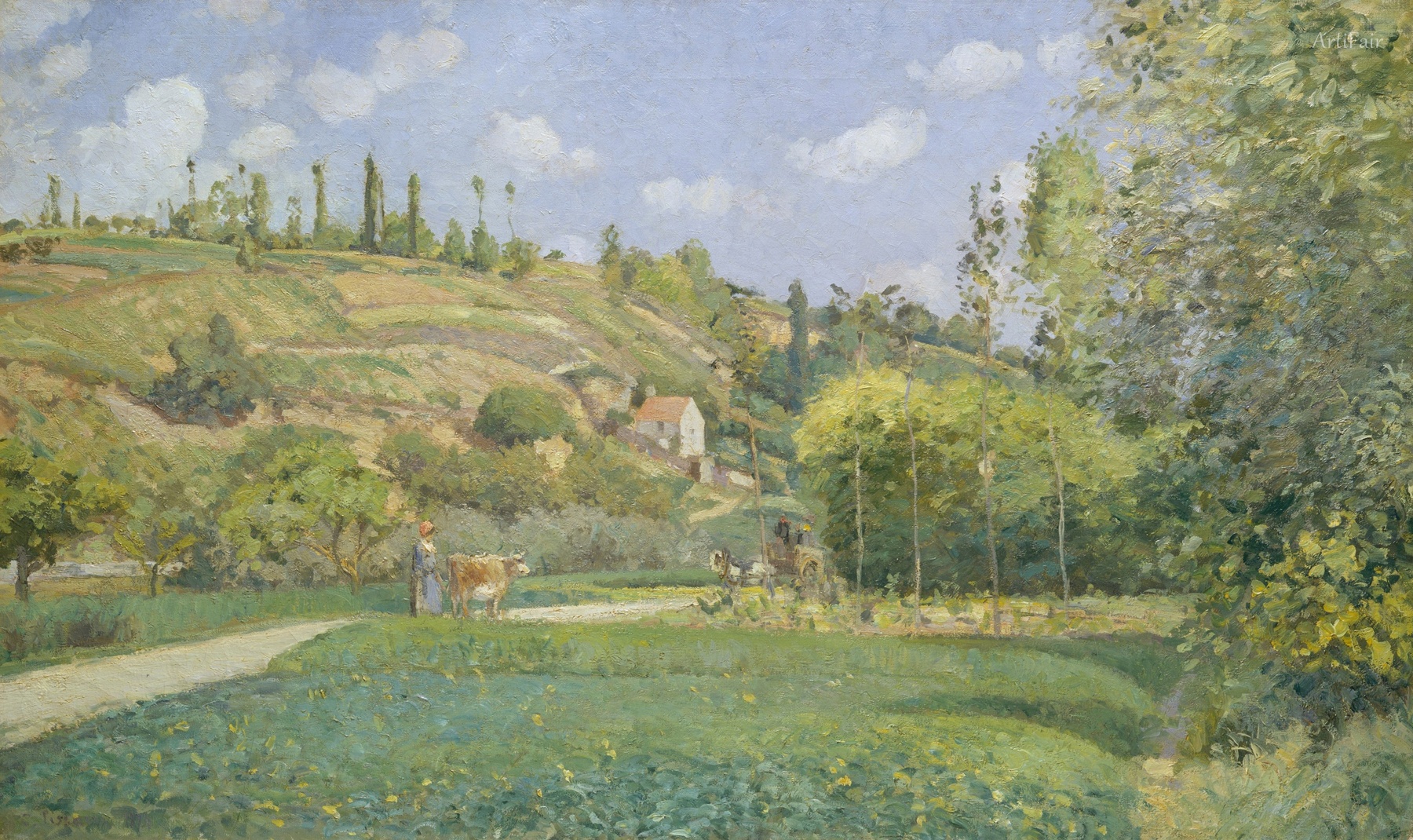
A Cowherd at Valhermeil, Auvers-sur-Oise
Category:
Created:
1874
Likes:
1
Dimensions:
Download:
New users get 4 free credits. 2K costs 1 credit; 4K and Ultra HD are priced by resolution. Public domain artworks can be used commercially.
Dominant colors
Public domain download summary
This artwork is provided as a public domain image resource. The 2K file costs 1 credit for everyday creative work, while 4K and Ultra HD files are priced by resolution.
Art Appreciation
A Cowherd at Valhermeil, Auvers-sur-Oise is an oil on canvas painted by Camille Pissarro in 1874, the year of the first Impressionist exhibition; it is in the Metropolitan Museum of Art, New York.
Pissarro had discovered Pontoise in 1866, after a new railway line put it less than an hour from Paris, and settled there in 1872, following his wartime stay in London and the looting of his studio at Louveciennes by Prussian troops. Between 1873 and 1882 he made more than 350 works around Pontoise and neighbouring Auvers-sur-Oise, about twenty of them in this particular stretch of country. Cézanne had moved to Auvers in 1872, and the two painted the surrounding countryside together; the light, clear touch of this canvas reflects that closeness.
A woman leads a cow along the lower road from Pontoise towards the hamlet of Valhermeil, while a cart moves along the track beyond. The river Oise, which runs alongside the road, is out of sight. Behind rises the hillside of Valhermeil, where the first house, with its red roof, marks the edge of Auvers; the same house appears in several other Pissarro paintings. Seven years later, in 1881, he painted the hillside again from a slightly different angle.
The painting has carried several titles. Ludovic-Rodo Pissarro's 1939 catalogue raisonné called it a cowherd on the route du Chou, but the editors of the Wildenstein Institute's critical catalogue of 2005 judged that wrong and retitled it after the Côte du Valhermeil. It belonged to the collector Jean-Baptiste Faure and later passed through Durand-Ruel, Paul Rosenberg and Wildenstein before Edna H. Sachs gave it to the Met in 1956. It measures 54.9 by 92.1 cm.