
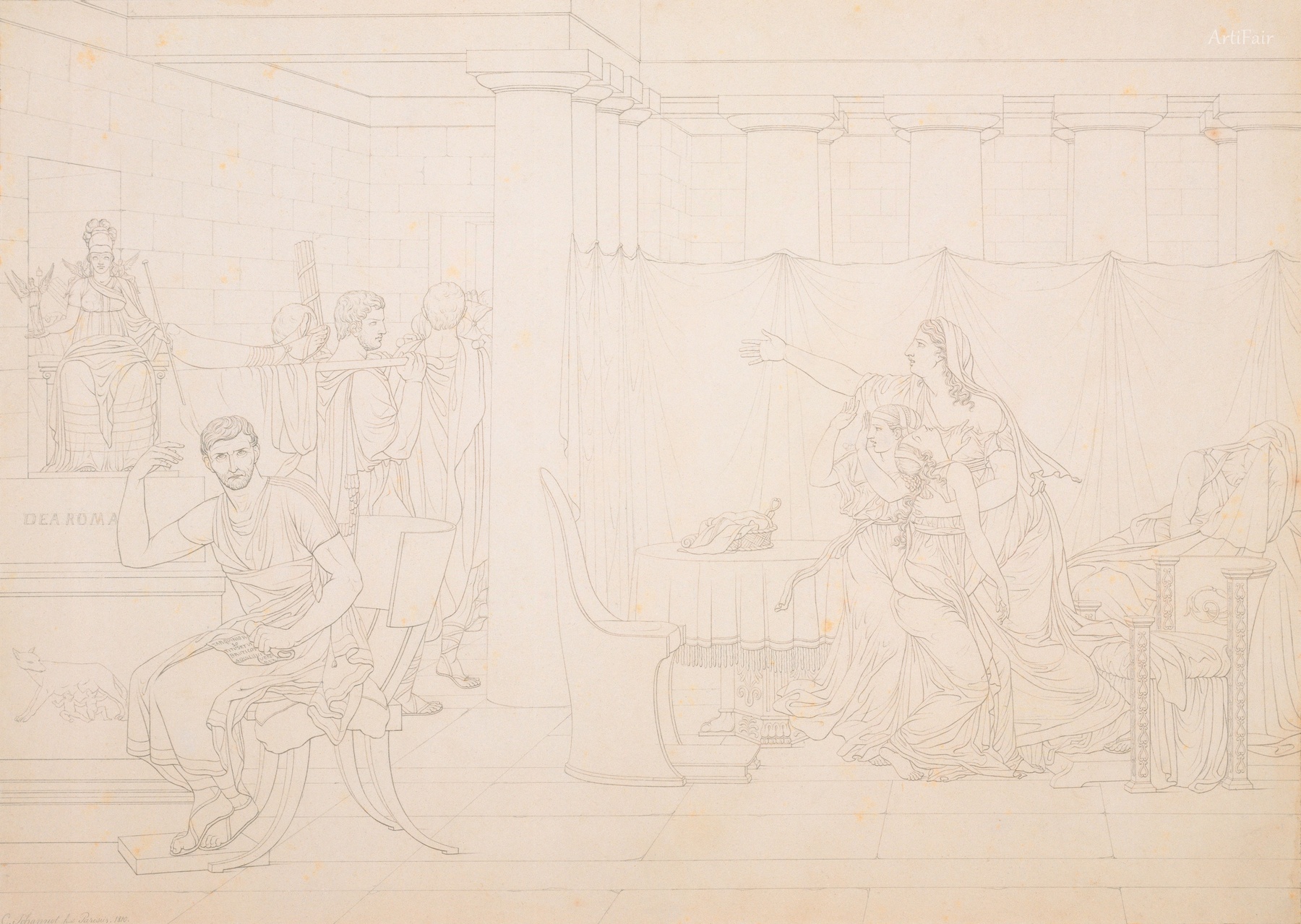
The Lictors Bring to Brutus the Bodies of His Sons (copy after Jacques-Louis David)
Category:
Created:
1810
Likes:
0
Dimensions:
Download:
New users get 4 free credits. 2K costs 1 credit; 4K and Ultra HD are priced by resolution. Public domain artworks can be used commercially.
Dominant colors
Public domain download summary
This artwork is provided as a public domain image resource. The 2K file costs 1 credit for everyday creative work, while 4K and Ultra HD files are priced by resolution.
Art Appreciation
This sheet is a pencil drawing on card by Charles Johannot after Jacques-Louis David's painting The Lictors Bring to Brutus the Bodies of His Sons, signed and dated lower left C. Johannot fecit Parisiis. 1810; it measures 360 × 505 mm and is in the graphic collection of the Städel Museum, Frankfurt am Main (inv. 6193 Z).
Johannot came from a Huguenot family of Offenbach and Frankfurt; his father, a silk manufacturer, moved the family to Paris in 1806, and Charles worked there as an engraver and printmaker, like his younger brothers Alfred and Tony Johannot. The Städel classes the drawing as a study after a model. It reproduces David's whole composition, architecture included, in fine outline with almost no shading. Johannot even transcribed the inscriptions: DEA ROMA on the base of the statue at left, and fragments of words, among them the names of the Tarquins and of Titus, on the paper in Brutus's hand. The sheet was acquired by the museum in 1870 and bears the estate stamp of the Frankfurt collector Johann Karl Brönner.
David's original, an oil on canvas of 323 × 422 cm now in the Louvre, was shown at the Salon of 1789, months into the Revolution. It shows Lucius Junius Brutus, founder of the Roman Republic, who had ordered the execution of his own sons for plotting to restore the monarchy. He sits brooding in shadow at the left beneath the statue of Roma, his feet tensely crossed, not turning as the lictors carry in the bodies; at the right his wife reaches out and his daughters collapse in grief while a servant at the far right is overcome with anguish. The return of the bodies is David's invention, not found in Livy or Plutarch. The painting was read as an allegory of civic virtue, and the authorities nearly kept it out of the Salon for fear of inflaming revolutionary passions, giving way only under public pressure.