
Allegory of the Catholic Faith
Category:
Created:
1672
Likes:
0
Dimensions:
Download:
New users get 4 free credits. 2K costs 1 credit; 4K and Ultra HD are priced by resolution. Public domain artworks can be used commercially.
Dominant colors
Public domain download summary
This artwork is provided as a public domain image resource. The 2K file costs 1 credit for everyday creative work, while 4K and Ultra HD files are priced by resolution.
Art Appreciation
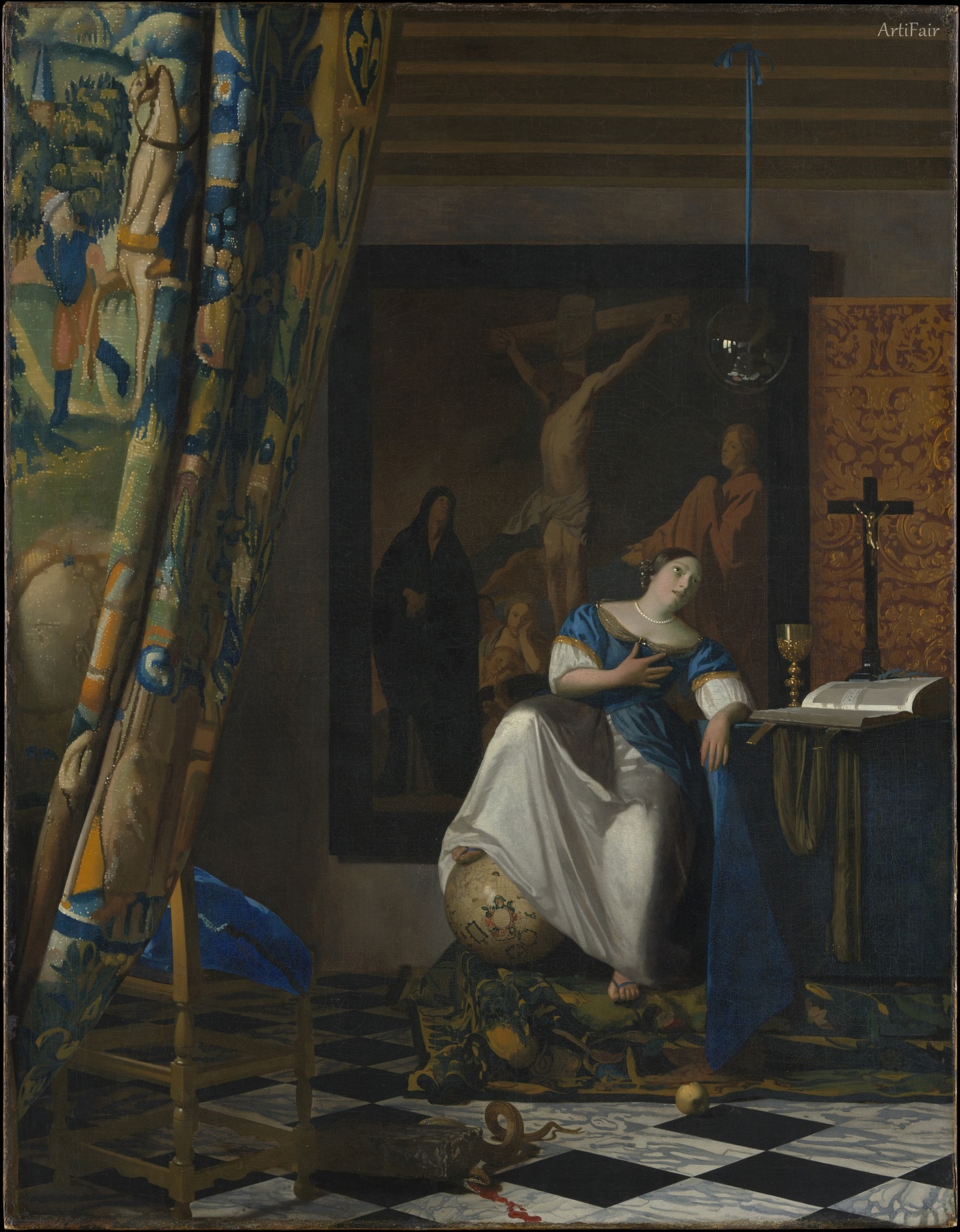
The Allegory of the Catholic Faith, also called The Allegory of Faith, is an oil painting on canvas by Johannes Vermeer, made around 1670–1674, and held by the Metropolitan Museum of Art in New York since 1931.
With The Art of Painting, it is one of Vermeer's only two history paintings in the period's hierarchy of genres, yet it keeps his usual arrangement of a single figure in a domestic interior behind a pulled-back woven hanging. A woman in white and blue satin sits on a raised platform, right hand on her heart, right foot on a terrestrial globe identified as one by Hendrick Hondius, gazing up at a glass sphere hanging from a blue ribbon. On the table beside her stand a gold chalice, a large book and a dark crucifix against gilt leather; on the floor lie an apple and a snake crushed by a cornerstone. A large Crucifixion based on a painting by Jacob Jordaens hangs behind her.
Much of the symbolism comes from Cesare Ripa's Iconologia, published in Dutch in 1644: Faith dressed in white and blue, her hand on her breast, the world beneath her feet, the apple of original sin and Christ as the cornerstone crushing the serpent. Vermeer added elements not found in Ripa. Arthur Wheelock saw in the chalice, book and crucifix a Eucharistic emphasis, and the glass orb has been traced by Eddy de Jongh to a 1636 emblem book by the Jesuit Willem Hesius. The patron is unknown; the Met regards the picture as surely commissioned, probably by someone both learned and devout, and the original owner may have been a Delft Catholic or the city's Jesuits. Many critics have counted it among his less successful works, finding the ecstatic pose at odds with the realistic Dutch setting.
Its first known owner was the Amsterdam postmaster Herman van Swoll, at whose sale in 1699 it fetched 400 guilders; by 1735 it sold for only 53. Attributed to Eglon van der Neer in the late 19th century, it was bought in Berlin in 1899 by Abraham Bredius, who lent it to the Mauritshuis and later called it a large but unpleasant Vermeer. He sold it in 1928 to Michael Friedsam of New York, who bequeathed it to the Met.