
The Return of the Herd (Autumn)
Category:
Created:
1565
Likes:
0
Dimensions:
Download:
New users get 4 free credits. 2K costs 1 credit; 4K and Ultra HD are priced by resolution. Public domain artworks can be used commercially.
Dominant colors
Public domain download summary
This artwork is provided as a public domain image resource. The 2K file costs 1 credit for everyday creative work, while 4K and Ultra HD files are priced by resolution.
Art Appreciation
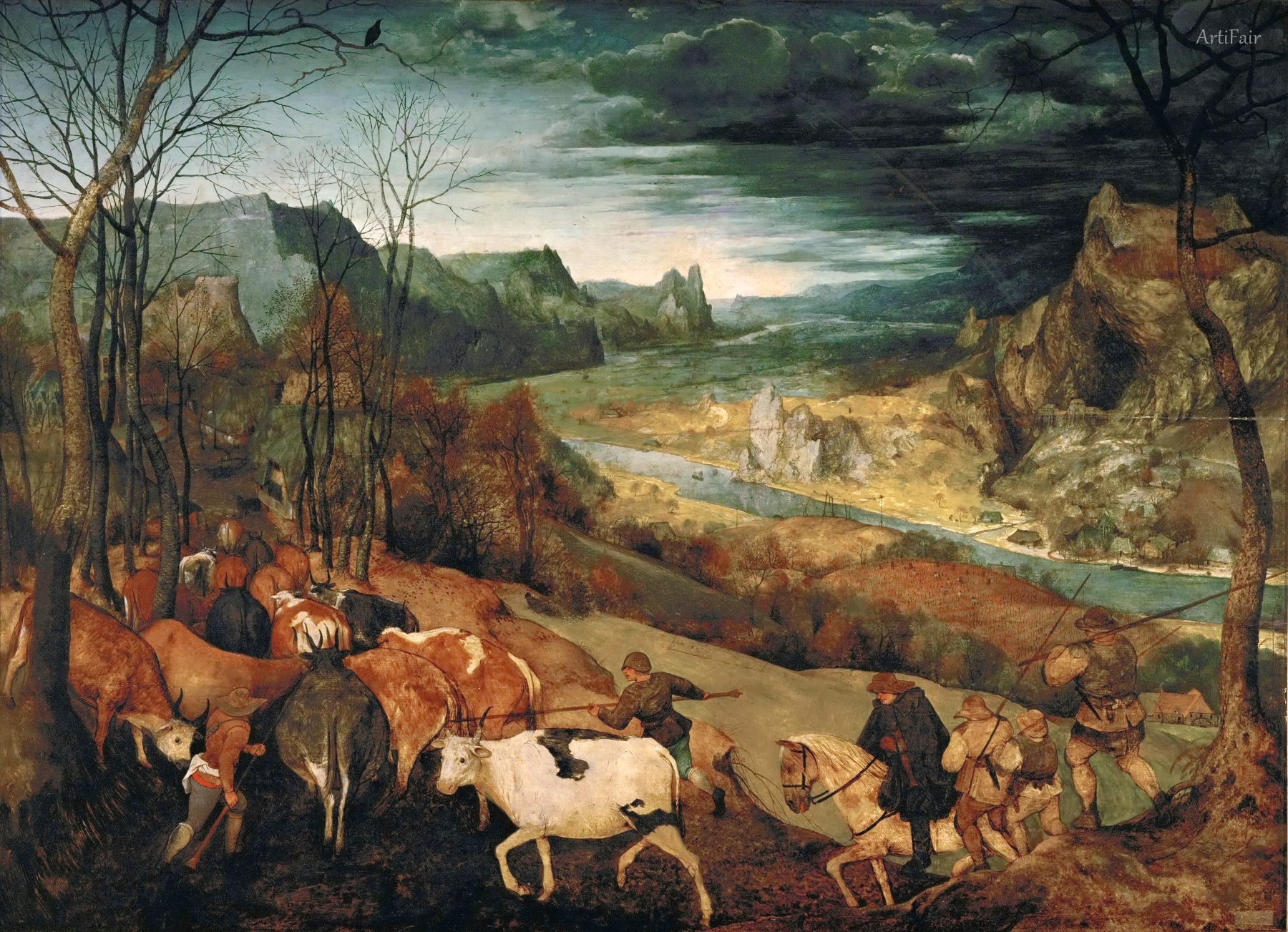
The Return of the Herd (Autumn) is an oil painting on oak panel by Pieter Bruegel the Elder, made in 1565, in the Kunsthistorisches Museum, Vienna.
It is one of the six paintings of the times of the year that Bruegel made in 1565 for the Antwerp collector Nicolaes Jongelinck; in the Netherlands of his day the year was divided into six seasons rather than four. Five survive: this panel, The Hunters in the Snow and The Gloomy Day in Vienna, The Hay Harvest in Prague and The Harvesters in New York, while the spring picture is lost. The autumn colours and bare trees connect this panel with October and November. In 1594 the city of Antwerp presented the series to Archduke Ernst; it later belonged to Emperor Rudolf II and Archduke Leopold Wilhelm. Only traces of a signature survive at lower left.
From a raised viewpoint we watch herdsmen with long staves, one on horseback, drive cattle down towards a village. Foreground and background lie in shadow while the river in the valley catches the sun, and storm clouds gather overhead. Near the centre is a bird net, and on a hill in the middle distance stand a gallows and raised wheels; the vineyards there and across the river have already been harvested. A conspicuous white cow in the foreground pushes the eye into depth.
The museum points out that the motif of the returning herd, driven down from the Alpine pastures, was unusual for the Netherlands, and that Bruegel drew on impressions from his travels through Switzerland. German Wikipedia adds that, like the other seasons, the landscape is not a real place but a composite overview, and that vine-growing too was rare in the north. For the museum, the true subject is the landscape, raised to the sublime through its tonal colour and mood. The panel measures 117 × 159.7 cm.