
The Red Vineyard
Category:
Created:
1888
Likes:
0
Dimensions:
Download:
New users get 4 free credits. 2K costs 1 credit; 4K and Ultra HD are priced by resolution. Public domain artworks can be used commercially.
Dominant colors
Public domain download summary
This artwork is provided as a public domain image resource. The 2K file costs 1 credit for everyday creative work, while 4K and Ultra HD files are priced by resolution.
Art Appreciation
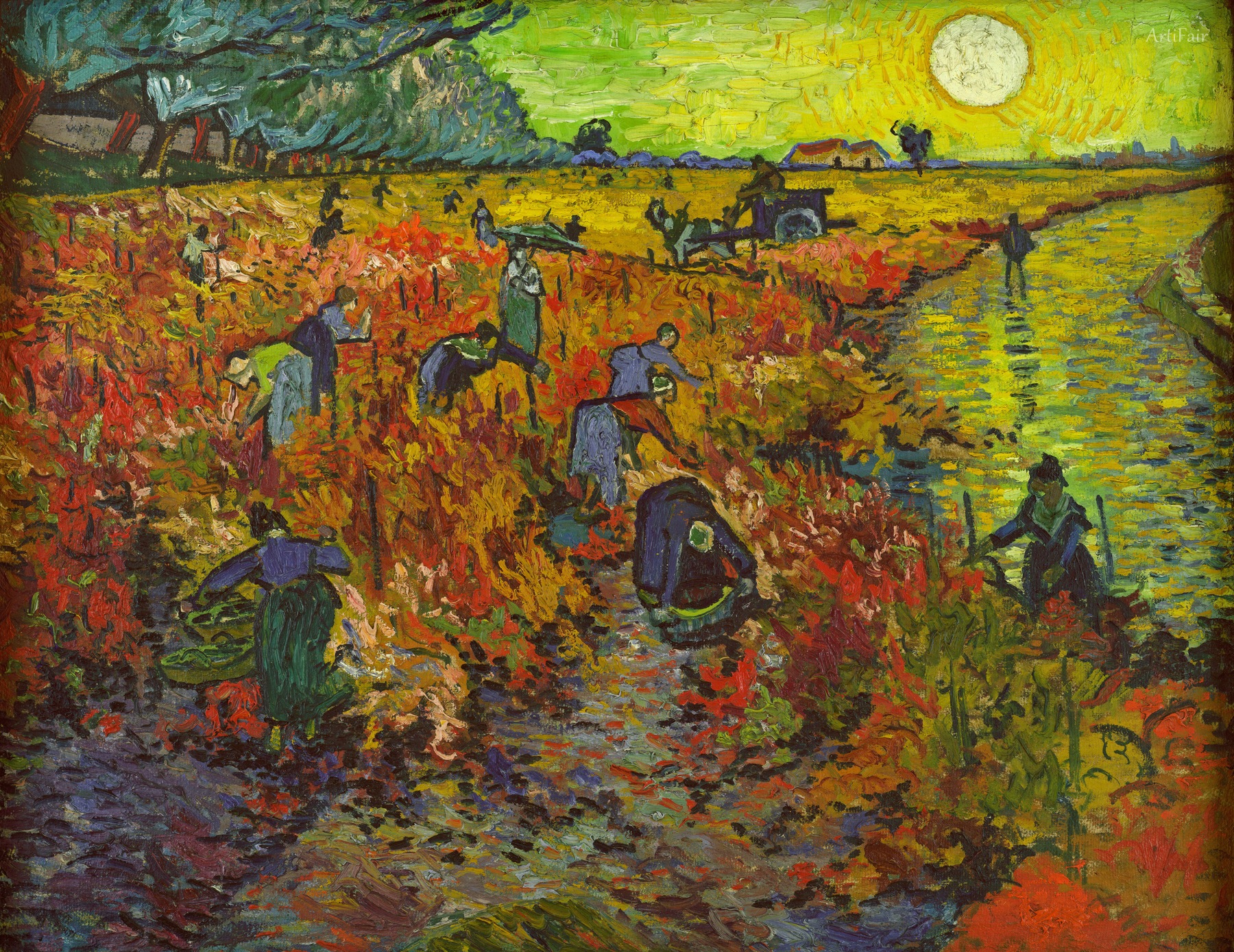
The Red Vineyard, also known as The Red Vineyards at Arles (Montmajour), is an oil painting on canvas by Vincent van Gogh, made in Arles in early November 1888 and now in the Pushkin State Museum of Fine Arts, Moscow. The museum gives its size as 73 × 91 cm.
The grape harvest around Arles was new to Van Gogh, and the Pushkin Museum places the scene near the abbey of Montmajour. Paul Gauguin was staying with him at the Yellow House at the time. According to the Dutch-language literature, Van Gogh painted the picture in his studio on 5 November, from memory, after a walk through the vineyards the evening before, and finished it in a single day; he wrote that he had sweated blood and tears over it but had succeeded. It is often paired with The Green Vineyard, painted in Arles shortly before, as a contrast of complementary colours, and both show the influence of Japanese prints.
Small figures of pickers bend over vines whose leaves glow red and orange under a low, blazing evening sun in a yellow-green sky; a road or canal at the right reflects the light, and the foreground turns to lilac. The paint is laid on in quick, broad strokes. The Pushkin Museum reads the harvesters as a symbol of life as exhausting daily toil, while other writers stress the idealised, almost Arcadian treatment, with no sign of aching backs or worn faces.
The picture was first exhibited at Les XX in Brussels in 1890, where the Belgian painter Anna Boch, sister of Van Gogh's friend Eugène Boch, bought it; most accounts give the price as 400 francs, the museum 350. It is often called the only painting known by name that Van Gogh sold in his lifetime. Boch sold it in 1906, and in 1909 it was bought in Paris by the Moscow collector Ivan Morozov. Nationalised after the Revolution, it hung in the State Museum of New Western Art until that museum was closed in 1948, when it passed to the Pushkin Museum.