
Dance of Life
Category:
Created:
1899
Likes:
0
Dimensions:
Download:
New users get 4 free credits. 2K costs 1 credit; 4K and Ultra HD are priced by resolution. Public domain artworks can be used commercially.
Dominant colors
Public domain download summary
This artwork is provided as a public domain image resource. The 2K file costs 1 credit for everyday creative work, while 4K and Ultra HD files are priced by resolution.
Art Appreciation
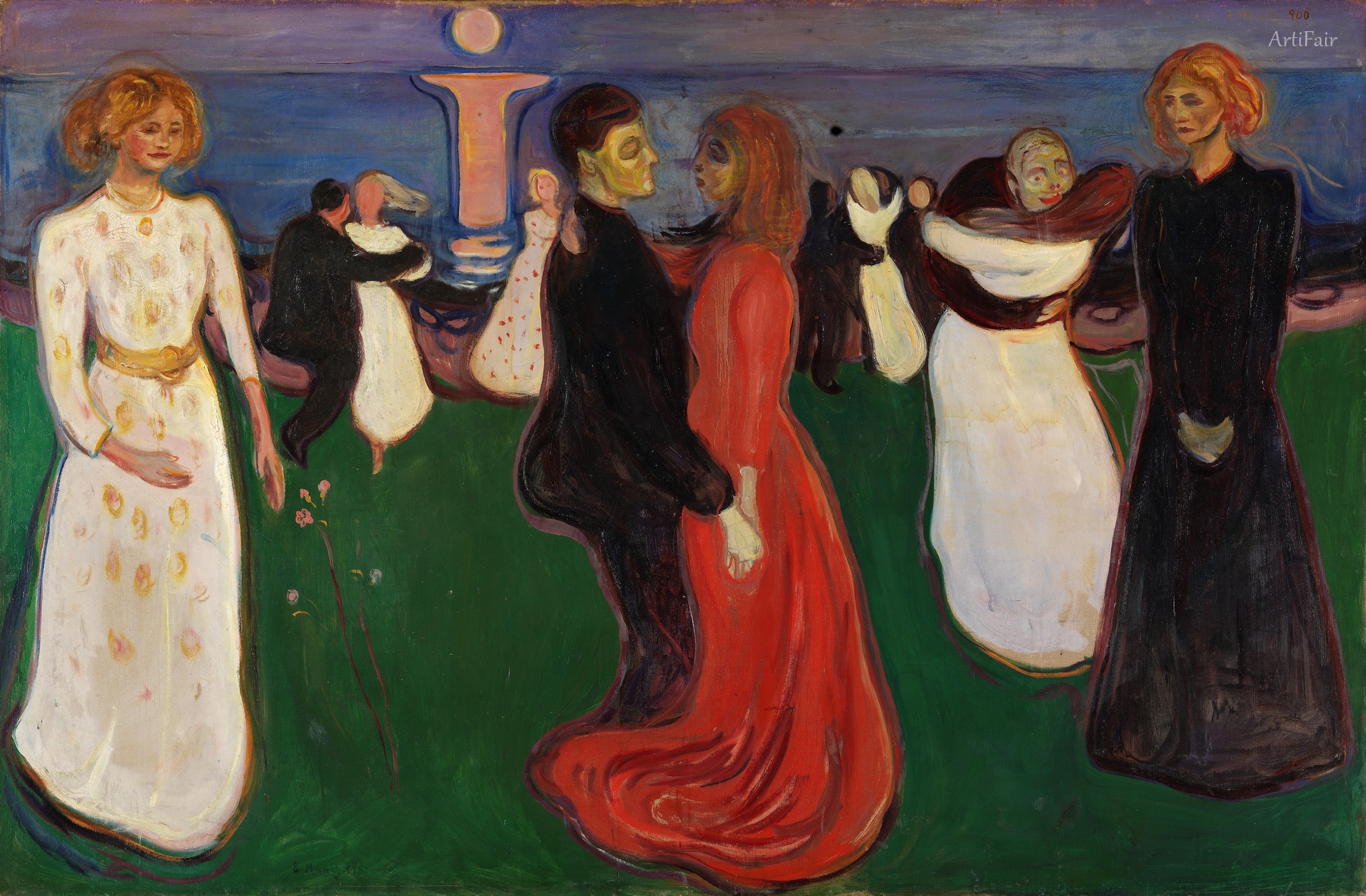
The Dance of Life (Livets dans) is an oil-on-canvas painting by Edvard Munch, begun in 1899 and finished in 1900, showing couples dancing on a meadow by the sea on a summer night; it is in the National Museum of Norway, Oslo (NG.M.00941).
Munch painted it after a trip to Florence, where he studied Italian Renaissance painting, and it was the last picture he added to the Frieze of Life, his cycle on love, anxiety and death. The canvas, 125 by 191 cm, carries two signatures, E. Munch 99 at lower left and E. Munch 1900 at upper right. It was first exhibited in Dresden in 1900 under the title Johannisnacht (Midsummer Eve) and took the title The Dance of Life at Munch's exhibition at the Dioramalokalet in Kristiania in 1904. It held a central place when the frieze was shown in Berlin in 1902, Leipzig in 1903, Kristiania in 1904 and Prague in 1905; in Berlin it hung in the group headed Love's Flowering and Fall. Munch may have been inspired by Helge Rode's 1898 play Dansen gaar, a copy of which he kept.
In the foreground a man in black holds a woman in a long red dress, the colour of love. They are flanked by a young, hopeful woman in white and an older, careworn woman in black, so that the woman appears at different stages of life. Behind them other couples whirl in sweeping strokes whose speed contrasts with the static foreground figures, while the shoreline, horizon and the moon reflected in the sea close the scene. The intense colour and flat fields point to Paul Gauguin and Synthetism, and the museum sees the work as the culmination of Munch's symbolist period.
Olaf Schou bought the painting at Munch's 1910 exhibition at the Dioramalokalet and gave it straight to the National Gallery. Munch returned to the composition in later friezes and in January 1925 signed the National Gallery's copyist register in order to copy it; his later version of 1925 is richer in colour.