
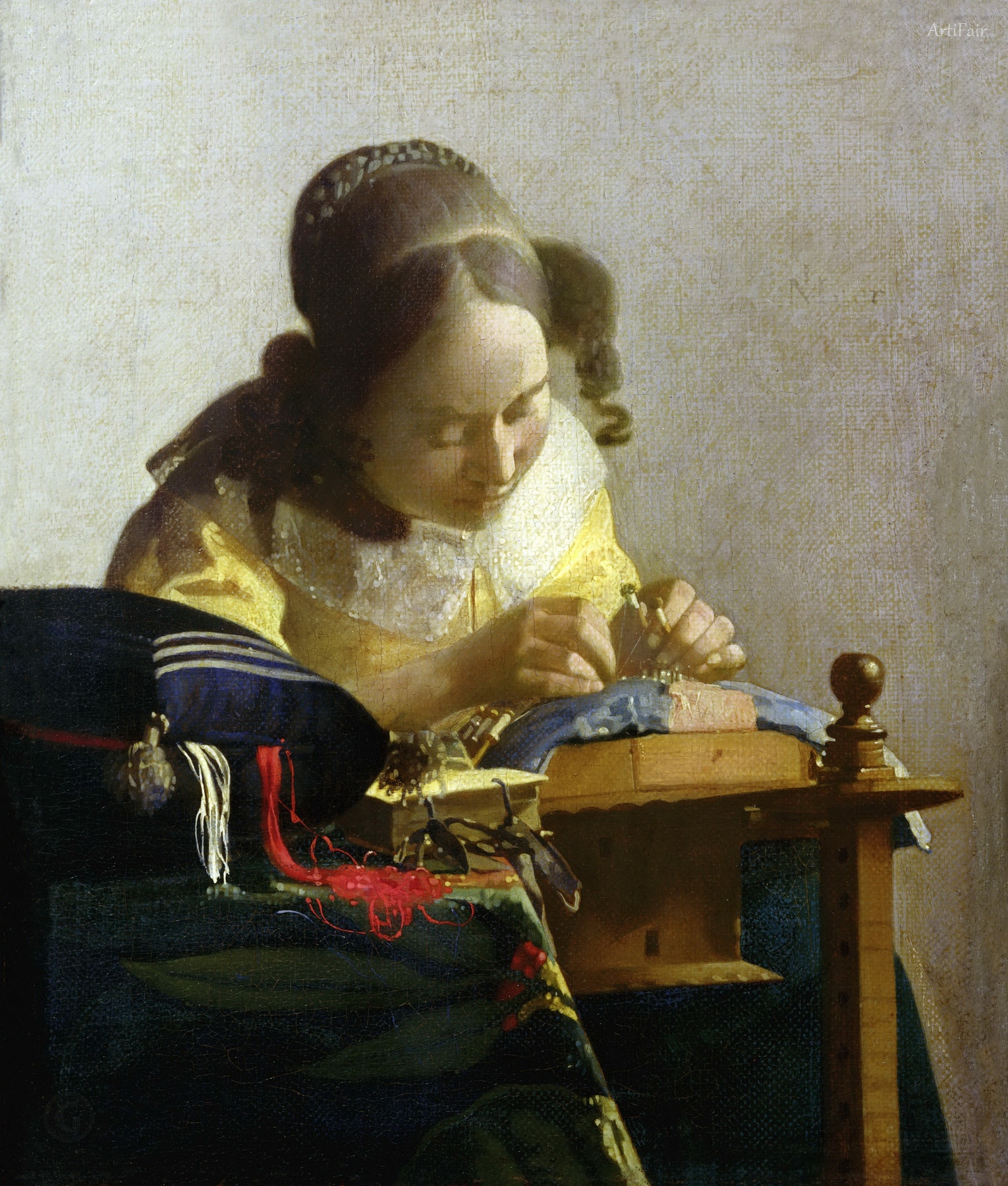
The Lacemaker
Category:
Created:
1670
Likes:
0
Dimensions:
Download:
New users get 4 free credits. 2K costs 1 credit; 4K and Ultra HD are priced by resolution. Public domain artworks can be used commercially.
Dominant colors
Public domain download summary
This artwork is provided as a public domain image resource. The 2K file costs 1 credit for everyday creative work, while 4K and Ultra HD files are priced by resolution.
Art Appreciation
The Lacemaker (La Dentellière) is an oil painting on canvas laid down on panel by Johannes Vermeer, dated to about 1669–1670, and held by the Musée du Louvre in Paris, which bought it in 1870.
At 24.5 × 21 cm it is the smallest of Vermeer's paintings. A young woman in a yellow bodice bends close over her lace pillow, holding a pair of bobbins in her left hand while she sets a pin, against a bare grey wall that removes every distraction. In the foreground red and white threads spill from a cushion-like sewing bag, painted so softly that they look almost liquid next to the precise lace she is making. That blurred near zone, unusual in Dutch painting of the period, is one reason some scholars think Vermeer used a camera obscura. The canvas came from the same bolt as A Young Woman Seated at a Virginal, and the two pictures seem once to have had identical dimensions.
The Louvre notes that lacemaking traditionally signified domestic virtue with a religious, moral tone; the small book at right is probably a Bible or prayer book. The sitter is a woman of good social standing at home, not a professional lacemaker, and nothing proves she is the painter's wife. The light falls from the right, which is rather rare in Vermeer. An X-ray shows that her knee was first placed lower. The critic Lawrence Gowing wrote that there is only one Lacemaker and we cannot imagine another.
The painting was in the Dissius sale in Amsterdam on 16 May 1696 and passed through several Dutch collections. The Rotterdam collector Dirk Vis Blokhuyzen left it with the rest of his collection to his city, but Rotterdam declined the bequest in 1869; after his estate sale in Paris on 1 April 1870 the Louvre acquired it from Eugène Féral. Salvador Dalí, an admirer of Vermeer, painted his own version of The Lacemaker in 1955.