
The Railway Bridge at Argenteuil
Category:
Created:
1874
Likes:
1
Dimensions:
Download:
New users get 4 free credits. 2K costs 1 credit; 4K and Ultra HD are priced by resolution. Public domain artworks can be used commercially.
Dominant colors
Public domain download summary
This artwork is provided as a public domain image resource. The 2K file costs 1 credit for everyday creative work, while 4K and Ultra HD files are priced by resolution.
Art Appreciation
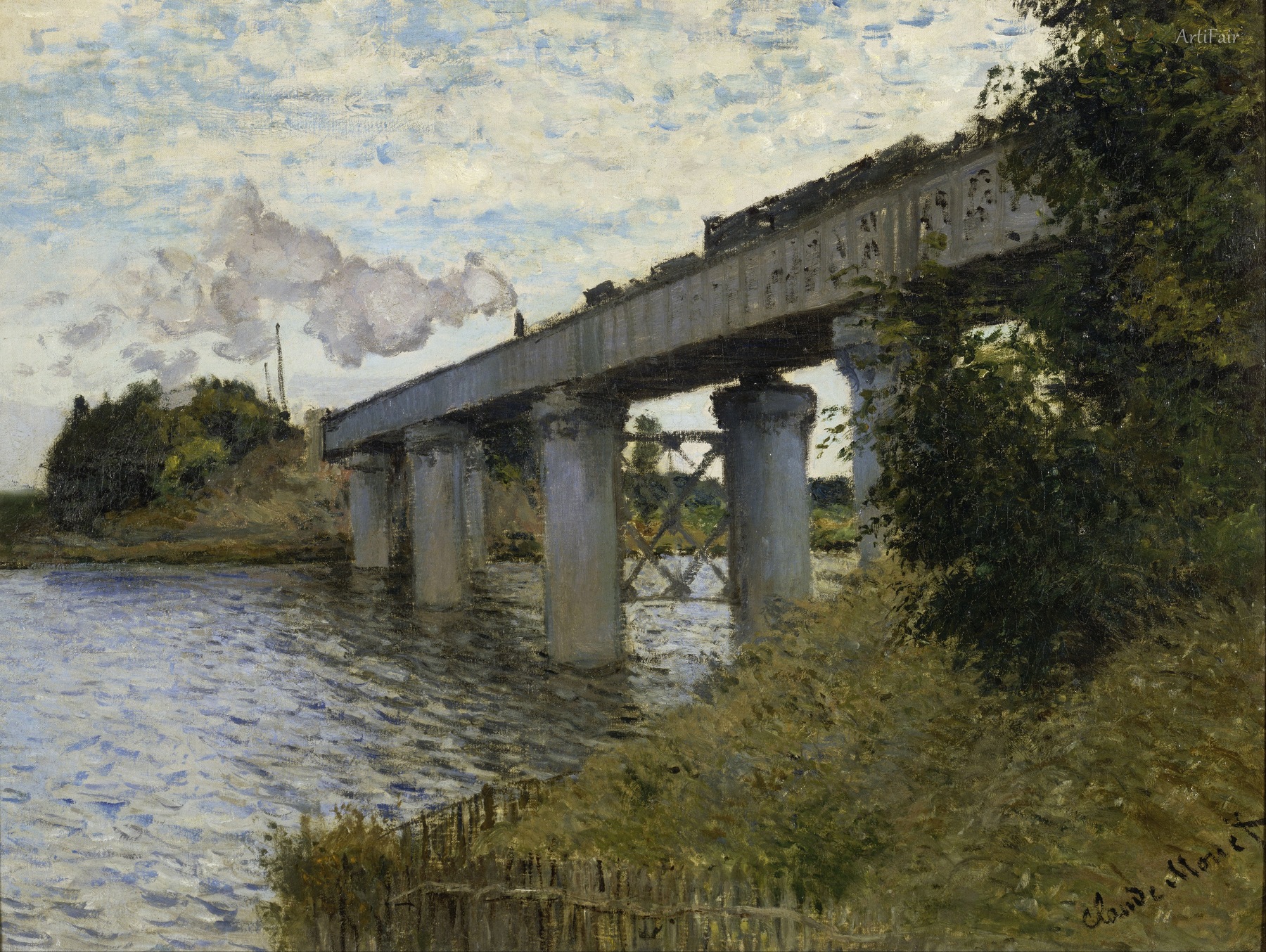
The Railway Bridge at Argenteuil (Le Pont du chemin de fer à Argenteuil) is an oil-on-canvas painting by Claude Monet, made between 1873 and 1874, showing a train crossing the Seine on the railway bridge at Argenteuil; it is in the Musée d'Orsay, Paris (RF 1679).
Monet lived in Argenteuil, a suburban town on the Seine linked to Paris by rail, from 1871 to 1878, and the railway bridge over the river became one of his motifs there. Besides this canvas he painted the bridge in at least four other pictures, including versions in the Philadelphia Museum of Art, the Musée Marmottan Monet and the Saint Louis Art Museum (where the bridge appears beside a riverside promenade), as well as one in a private collection.
The canvas measures 54 by 71 cm and is signed at lower right. Seen from the bank, the bridge with its massive cylindrical piers cuts diagonally across the picture, and a train passes over it, its smoke blowing back against the direction of travel. An Orsay visitor guide on the industrial world in nineteenth-century art notes that two key elements of French industrialisation, the bridge and the railway, dominate the landscape. It observes that Monet still approached the railway cautiously, showing the old-fashioned wagons and leaving the modern locomotive to be implied by its plume of smoke, and reads the whole picture as a meditation on passage: the current of the river, the track, the bridge and the train all stand for movement through space, the passing of time and a change of era.
The painting belonged to Faure by 1876, entered the collection of Mme Adolphe Moreau in Paris from 1886 and then that of Étienne Moreau-Nélaton. He gave it to the French state in 1906 as part of his donation; it was shown at the Musée des Arts décoratifs from 1907 to 1934, then at the Louvre and the Jeu de Paume, before being assigned to the Musée d'Orsay in 1986. The terms of the donation forbid its loan.