
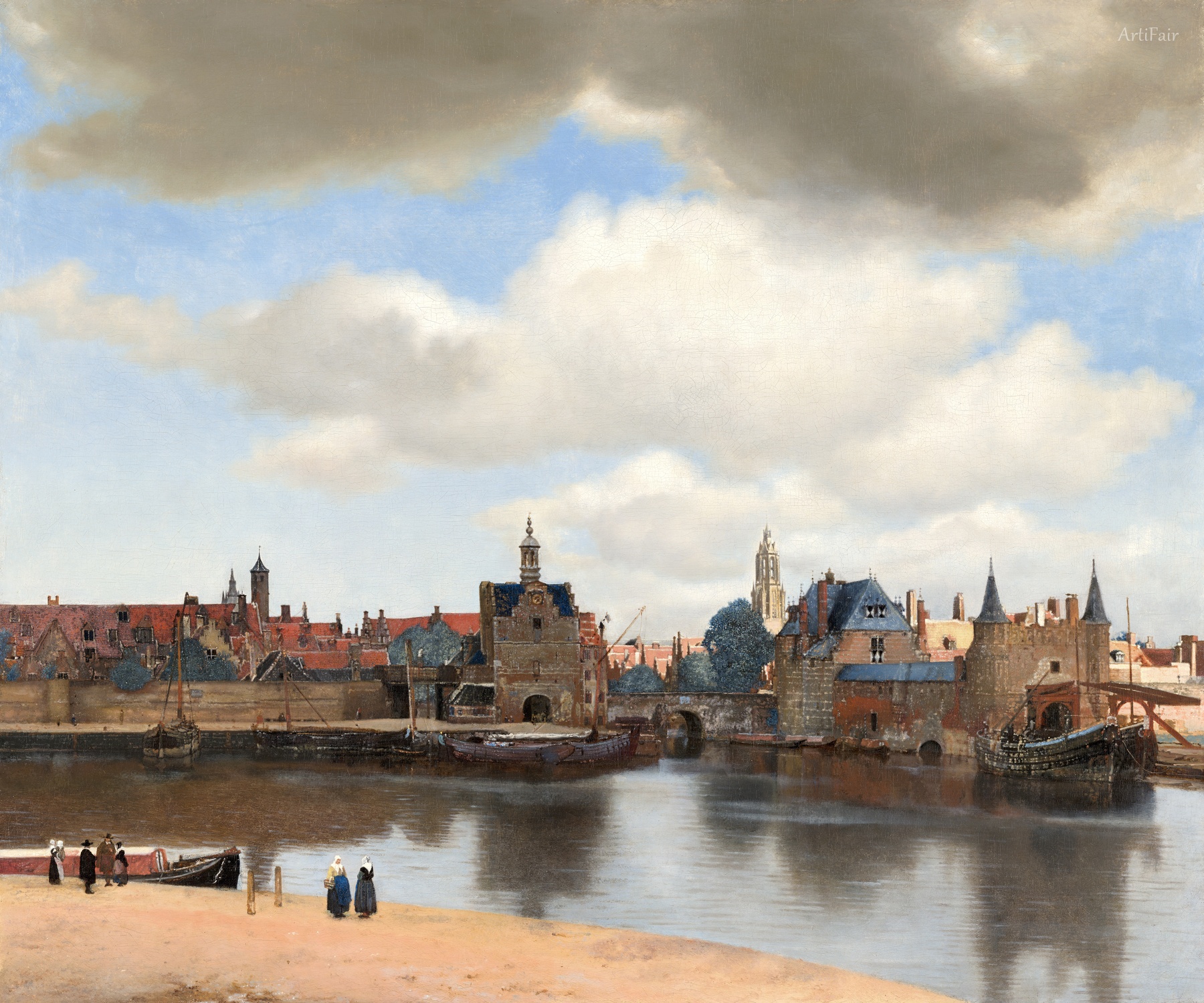
View of Delft
Category:
Created:
1661
Likes:
0
Dimensions:
Download:
New users get 4 free credits. 2K costs 1 credit; 4K and Ultra HD are priced by resolution. Public domain artworks can be used commercially.
Dominant colors
Public domain download summary
This artwork is provided as a public domain image resource. The 2K file costs 1 credit for everyday creative work, while 4K and Ultra HD files are priced by resolution.
Art Appreciation
View of Delft (Zicht op Delft) is an oil on canvas, 96.5 × 115.7 cm, painted by Johannes Vermeer around 1660–1661 and showing his home town from across the water; it is in the Mauritshuis, The Hague.
It is Vermeer's only cityscape and one of three known pictures of Delft by him, with The Little Street and a lost view of a house. The Mauritshuis calls it the most celebrated cityscape of seventeenth-century Dutch art. It was probably owned by his Delft patron Pieter van Ruijven, and at the Dissius sale in Amsterdam in 1696 it fetched 200 guilders, the highest price of the Vermeers sold there.
The city is seen from the south-east, beyond the Kolk, a triangular harbour at the southern edge of Delft. From left to right run part of the city wall, the Schiedam Gate with its clock and the Rotterdam Gate, with two herring busses moored in front; between them the sunlit tower of the Nieuwe Kerk rises above the roofs, moved a little towards the centre to give it prominence. On the near bank a few people wait by a barge, and Vermeer painted out a third figure he had first placed beside the two talking women. The composition is built in three horizontal bands of water, city and sky. The air is almost still, the boats lie with sails lowered, and a nearby cloud throws the foreground buildings into shadow while the roofs behind catch the morning sun. Vermeer used calcite, lead white, yellow ochre, natural ultramarine and madder lake, and tidied the buildings slightly.
In 1822 the painting was bought at the Stinstra sale in Amsterdam for 2,900 guilders and, by decision of King William I, placed in the new Royal Cabinet of Paintings at the Mauritshuis. Marcel Proust saw it there in 1902 and later called it the most beautiful painting in the world; in his novel The Prisoner the writer Bergotte dies in front of its 'little patch of yellow wall'. In 2020–21 the museum exhibited it entirely on its own.