
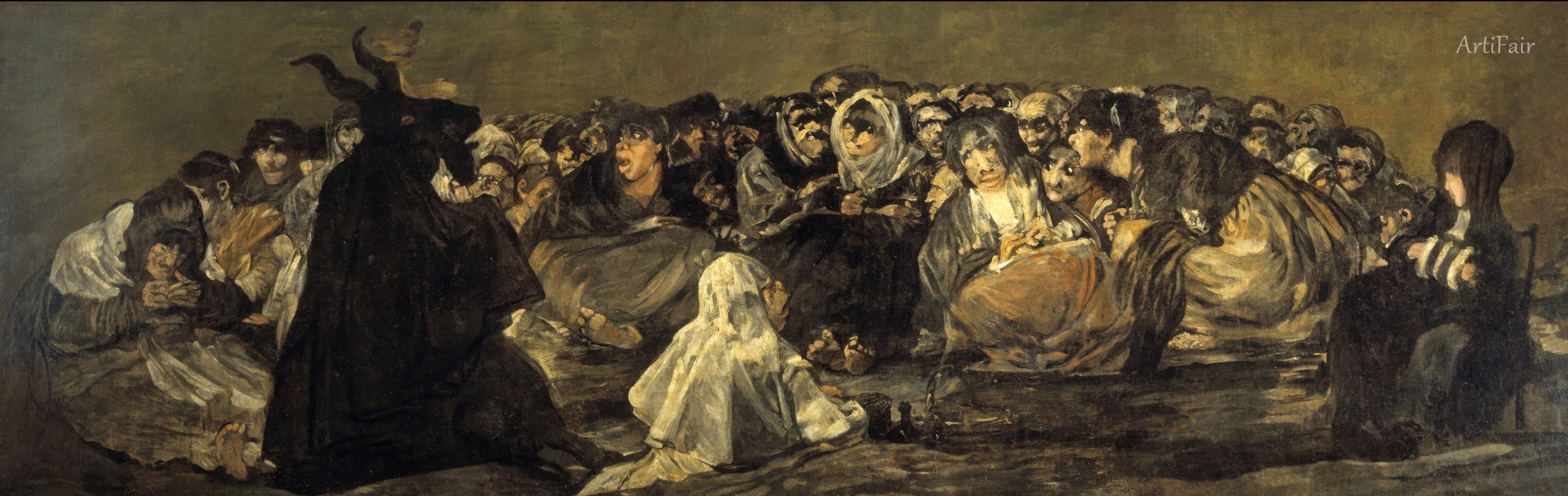
Witches' Sabbath
Category:
Created:
1823
Likes:
1
Dimensions:
Download:
New users get 4 free credits. 2K costs 1 credit; 4K and Ultra HD are priced by resolution. Public domain artworks can be used commercially.
Dominant colors
Public domain download summary
This artwork is provided as a public domain image resource. The 2K file costs 1 credit for everyday creative work, while 4K and Ultra HD files are priced by resolution.
Art Appreciation
Witches' Sabbath, also called The Great He-Goat (El aquelarre or El gran cabrón), is one of the Black Paintings that Francisco Goya painted in oil on the plaster walls of his house outside Madrid between about 1820 and 1823; transferred to canvas in the 1870s, it is in the Museo del Prado.
It was the widest of the fourteen murals at the Quinta del Sordo, filling the long wall between two windows of the ground-floor room, opposite A Pilgrimage to San Isidro, with Saturn Devouring His Son and Judith and Holofernes on the end wall. Goya left no title or comment; the name El gran cabrón comes from the painter Antonio Brugada, and aquelarre is the Basque word for a witches' meeting. Unlike most of the Black Paintings, it seems to have been painted straight onto the wall without a preparatory drawing.
In the left half, Satan in the shape of a goat, dressed in what may be a cassock, preaches in black silhouette to a crowd of crouching women with grotesque, almost animal faces, most of them staring at him in fear or awe. At the far right a young woman sits apart, face hidden, perhaps a novice about to be admitted, and a figure in a white hood sits with her back to us. Goya laid a black ground first and worked over it in broad strokes of grey, blue, brown and ochre, letting the black show through in the devil's body. The scene is usually read as a satire on superstition and on the witch trials of the Inquisition, and more broadly as a silent protest against the royalist and clerical reaction after 1814. Goya had treated the subject on a small scale in 1797–98.
In July 1875 a Madrid newspaper described the transferred canvas as more than five metres long. During the restoration, Salvador Martínez Cubells removed more than 140 cm of landscape and sky from the right, moving the seated woman off the centre of the composition. Today the canvas measures 140 × 438 cm, and it is in poor condition.