
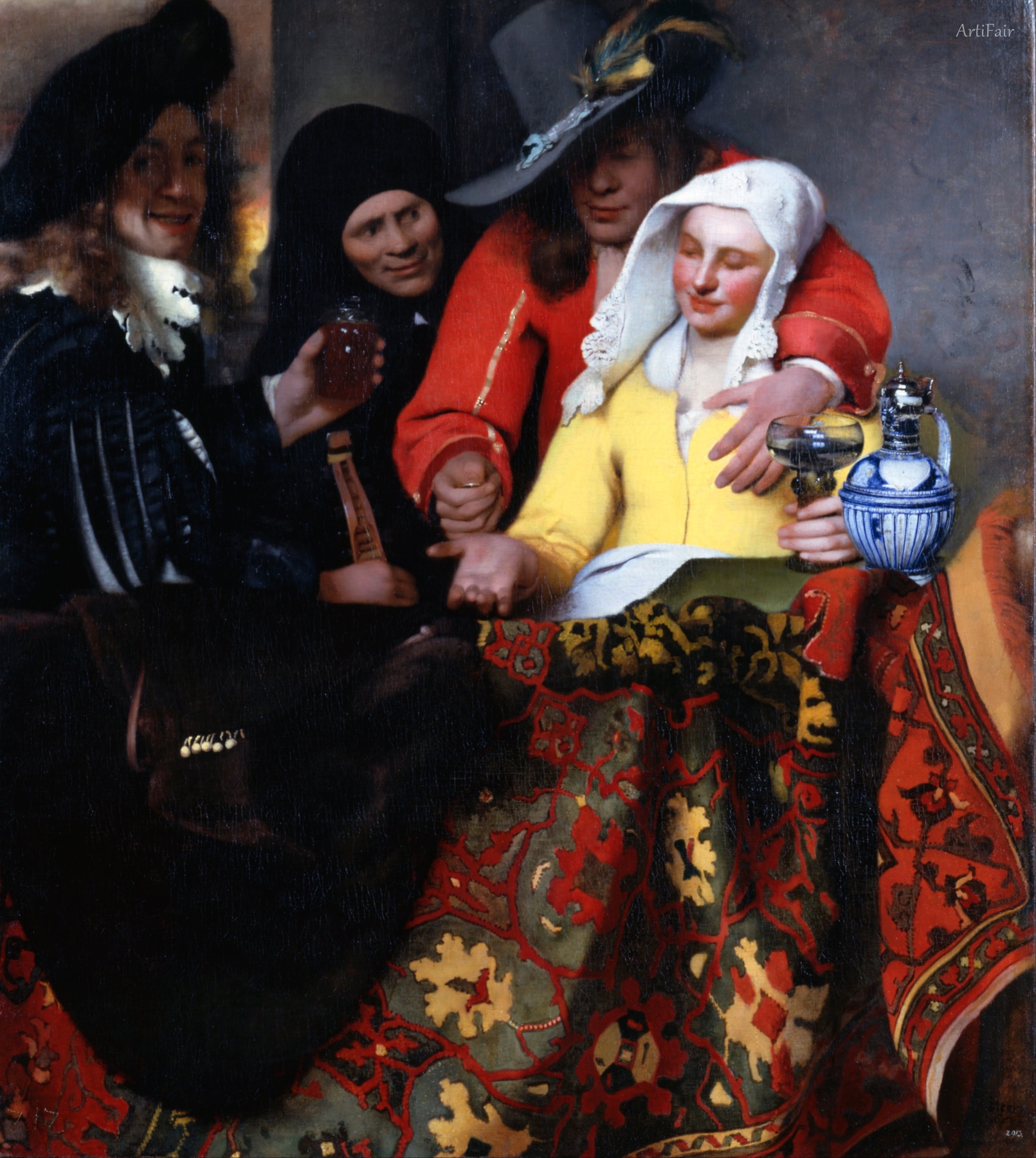
The Procuress
Category:
Created:
1656
Likes:
0
Dimensions:
Download:
New users get 4 free credits. 2K costs 1 credit; 4K and Ultra HD are priced by resolution. Public domain artworks can be used commercially.
Dominant colors
Public domain download summary
This artwork is provided as a public domain image resource. The 2K file costs 1 credit for everyday creative work, while 4K and Ultra HD files are priced by resolution.
Art Appreciation
The Procuress (De koppelaarster) is an oil painting on canvas by Johannes Vermeer, signed and dated 1656 at lower right, and held by the Gemäldegalerie Alte Meister in Dresden.
Painted when Vermeer was about 24, it is his first known genre picture, a scene of contemporary life that breaks with the biblical and mythological subjects of his earliest work. It is also one of only three paintings he both signed and dated, with The Astronomer and The Geographer. A soldier in a red jacket fondles a young woman's breast as he drops a coin into her open hand; beside them an older woman in black, perhaps the procuress of the title, watches, while at left a man in a black beret and slashed doublet raises a glass and holds a cittern. That man has been read as a self-portrait, since he resembles the painter seen from behind in The Art of Painting.
Vermeer probably drew on earlier treatments of the theme by Gerard ter Borch and on Dirck van Baburen's Procuress of about 1622, which belonged to his mother-in-law Maria Thins. A kilim, probably from Uşak, is thrown over the balustrade and fills a third of the 143 × 130 cm canvas; the jug on it is Westerwald stoneware, and the dark coat at left was added at a late stage. Technical study for the 2004 Dresden restoration found that Vermeer shaded both men's faces with larger hats and turned the soldier's gaze toward the payment, concentrating the light on the woman and the still life.
The work was in the Waldstein collection at Dux (Duchcov) in Bohemia before 1737 and was acquired in 1741 for Augustus III, Elector of Saxony. Taken to the Soviet Union in 1945, it returned to Dresden in 1955. A different Procuress once attributed to Vermeer was shown by analysis in 2011 to contain Bakelite and is regarded as a forgery, most probably by Han van Meegeren.