
Girl with the Red Hat
Category:
Created:
1669
Likes:
0
Dimensions:
Download:
New users get 4 free credits. 2K costs 1 credit; 4K and Ultra HD are priced by resolution. Public domain artworks can be used commercially.
Dominant colors
Public domain download summary
This artwork is provided as a public domain image resource. The 2K file costs 1 credit for everyday creative work, while 4K and Ultra HD files are priced by resolution.
Art Appreciation
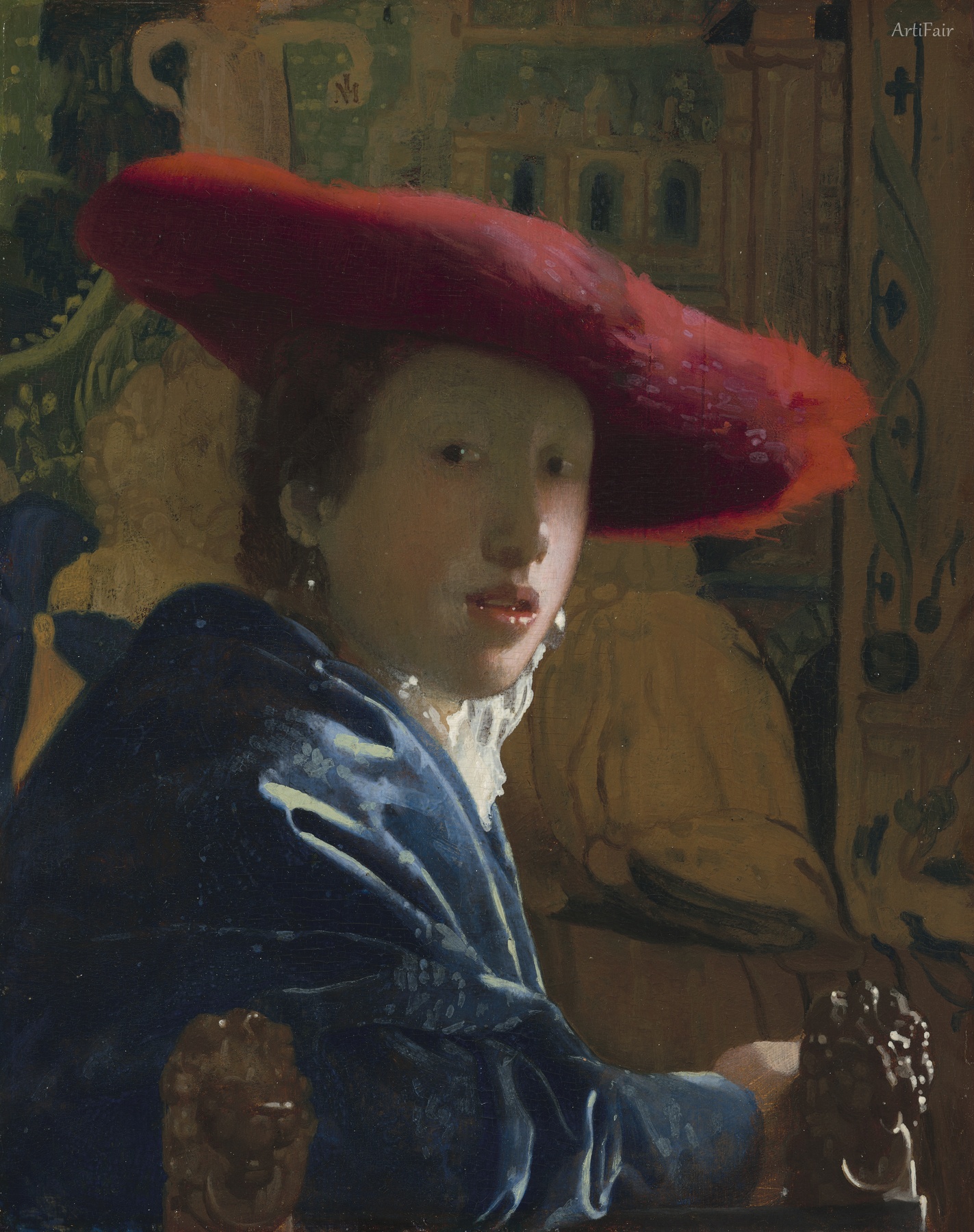
Girl with the Red Hat is a small oil painting on wood panel by Johannes Vermeer, dated to about 1665–1667, and held by the National Gallery of Art in Washington, DC, which received it from the Andrew W. Mellon trust in 1937.
Measuring only about 23 × 18 cm, it is a tronie, a study of a fancifully dressed model that was not meant as a portrait of an identifiable person. A very young woman in a blue robe, a high white scarf and a broad red hat turns toward us with lips parted, as if a sound had just caught her attention, while light falls on her face from the right, unusual in Vermeer. The hat was built up in two layers, vermilion mixed with black under a glaze of madder lake. The blurred, glinting lion-head finials of the chair in the foreground have reminded many scholars of the effects of a camera obscura.
Because it is on a reused wooden panel rather than canvas, its attribution has long been debated. X-rays and neutron reflectography show that it was painted over an upside-down bust of a man in a wide-brimmed hat. Arthur Wheelock suggested the earlier image might be by Carel Fabritius, while Walter Liedtke doubted that Vermeer would paint over a work by an artist he admired. A multidisciplinary study made for the National Gallery's 2022 exhibition Vermeer's Secrets concluded that the painting is by Vermeer, a view supported by Dutch experts.
The picture may be one of the tronies listed in the Dissius sale in Amsterdam on 16 May 1696. It reappeared at a Paris sale on 10 December 1822, when Baron Louis Atthalin bought it for 200 francs, and stayed with his heirs until Knoedler sold it to Andrew W. Mellon in 1925 for $290,000. Mellon deeded it in 1932 to his educational and charitable trust, which gave it to the newly founded museum.