
The Concert
Category:
Created:
1665
Likes:
0
Dimensions:
Download:
New users get 4 free credits. 2K costs 1 credit; 4K and Ultra HD are priced by resolution. Public domain artworks can be used commercially.
Dominant colors
Public domain download summary
This artwork is provided as a public domain image resource. The 2K file costs 1 credit for everyday creative work, while 4K and Ultra HD files are priced by resolution.
Art Appreciation
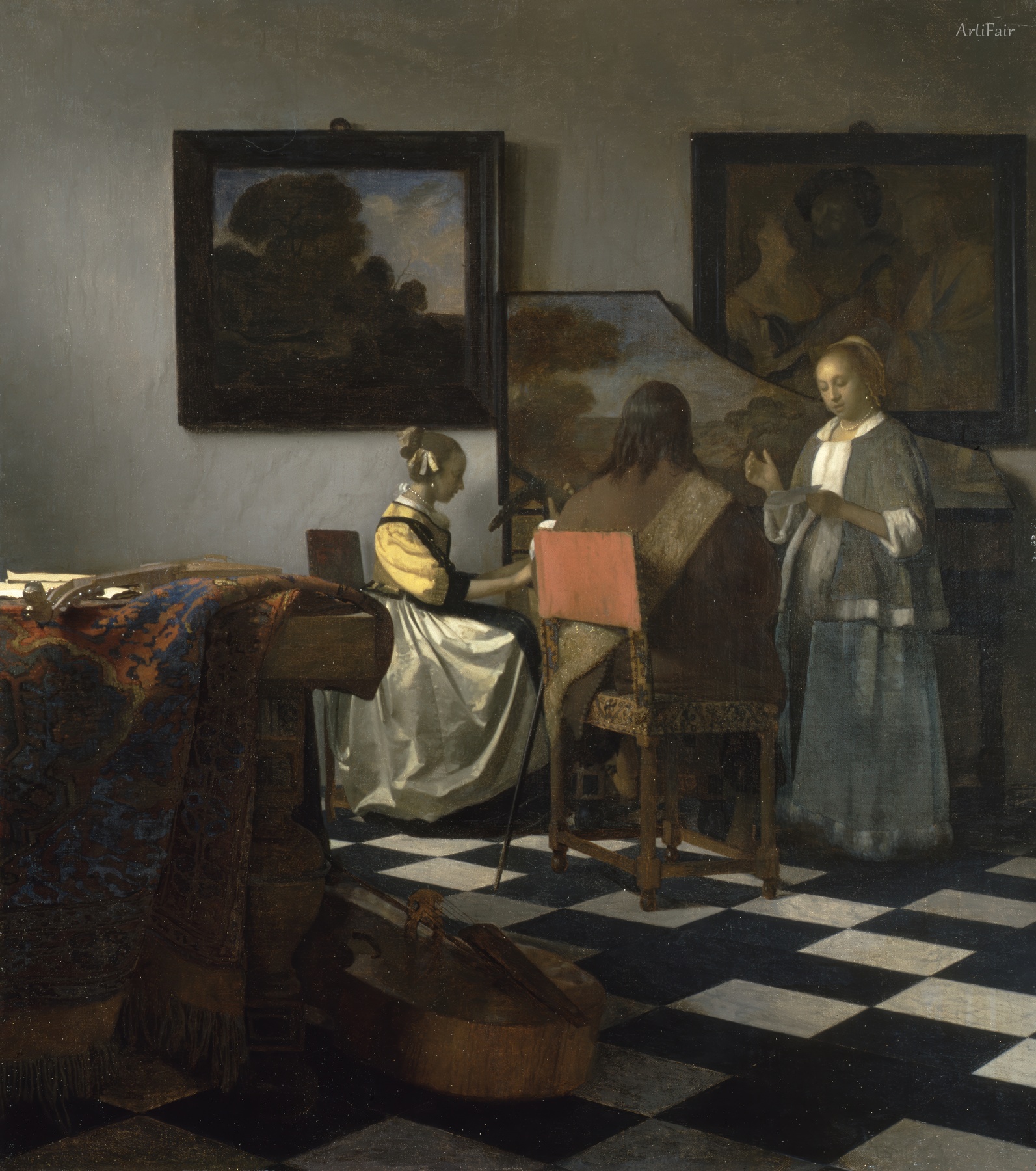
The Concert is an oil painting on canvas by Johannes Vermeer, dated on grounds of style to the mid-1660s (roughly 1663–1666); it belonged to the Isabella Stewart Gardner Museum in Boston until it was stolen in 1990, and it is still missing.
Measuring 72.5 × 64.7 cm, the picture shows three musicians in a well-to-do interior with a black-and-white marble floor. A young woman in a yellow jacket sits at a harpsichord, a man with his back to us plays a lute and wears a sash with a sword, and a standing woman sings from a sheet of music; a viola da gamba lies on the floor. The harpsichord, the only one in Vermeer's work, has a painted Arcadian landscape on its lid and was probably a borrowed Flemish instrument, likely made by the Ruckers family of Antwerp.
Two pictures hang on the wall. At left is a wild landscape; at right is The Procuress by Dirck van Baburen, a painting that most likely belonged to Vermeer's mother-in-law, Maria Thins, and that reappears in his Lady Seated at a Virginal. Music in Dutch genre painting often hinted at love and seduction, and early critics even read the scene as a brothel, but the calm mood leaves the meaning open; the bawdy Baburen may serve as a contrast or a warning rather than a key.
The painting is first documented securely at an Amsterdam sale in 1780. It later belonged to the French critic Théophile Thoré-Bürger, who did much to revive Vermeer's reputation, and at his sale in Paris in 1892 Isabella Stewart Gardner bought it for $5,000. On the night of 18 March 1990 thieves disguised as police officers took it with twelve other works from her museum. It has never resurfaced; its value has been estimated at US$250 million, and it is thought to be the most valuable stolen work still unrecovered.