
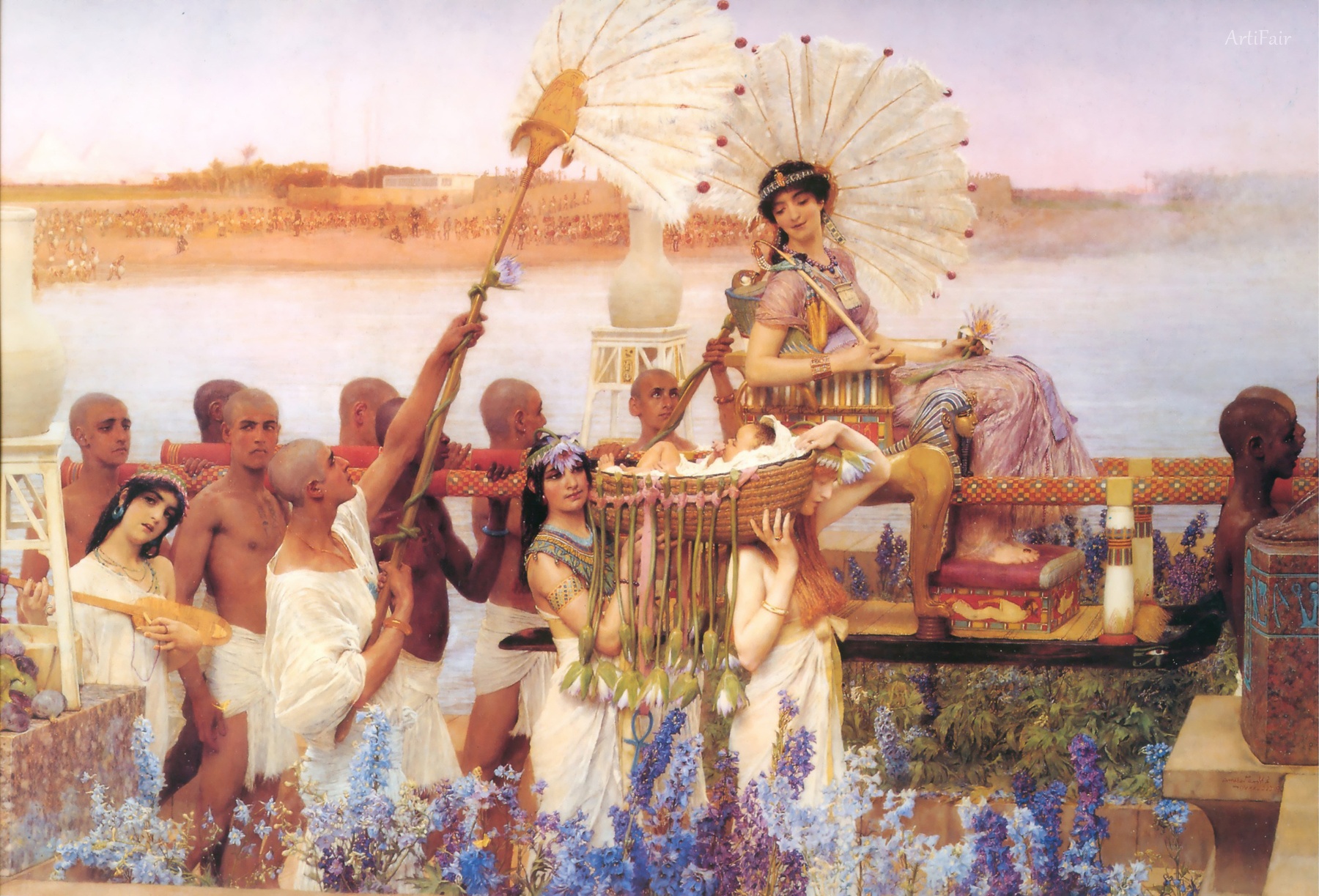
The Finding of Moses
Category:
Created:
1904
Likes:
0
Dimensions:
Download:
New users get 4 free credits. 2K costs 1 credit; 4K and Ultra HD are priced by resolution. Public domain artworks can be used commercially.
Dominant colors
Public domain download summary
This artwork is provided as a public domain image resource. The 2K file costs 1 credit for everyday creative work, while 4K and Ultra HD files are priced by resolution.
Art Appreciation
The Finding of Moses is an oil-on-canvas painting by Lawrence Alma-Tadema, dated 1904 and signed with the opus number CCCLXXVII; it measures 136.7 × 213.4 cm and is in a private collection.
The picture grew out of a journey to Egypt. In late 1902 Alma-Tadema, then sixty-six, travelled there as the guest of Sir John Aird, whose firm had built the first Aswan Dam, for its opening on 10 December. Aird, who already owned The Roses of Heliogabalus, offered the artist a commission; Alma-Tadema proposed three subjects and Aird chose this one. It let the painter return to the Egyptian themes of his work in the 1860s and became one of his rare biblical pictures. He spent two years on it, and Edward VII visited the studio while it was in progress; his wife is said to have joked that the infant would by then be two years old and no longer need carrying.
The story comes from Exodus 2, where Pharaoh's daughter finds the baby Moses in a basket among the reeds of the Nile. Alma-Tadema invented a triumphal return: the princess, holding a flail and a lotus, is carried in a chair modelled on Egyptian tomb paintings, her feet on a stool decorated with bound captives, while attendants wave ostrich-feather fans and maidens carry the cradle. Cartouches name her as a daughter of Ramesses II. Many objects were drawn from the British Museum and from Prisse d'Avennes's survey of Egyptian art, and a bank of blue delphiniums fills the foreground.
Shown at the Royal Academy in 1905, the painting received respectful rather than enthusiastic reviews. Aird paid 5,000 guineas plus expenses, but in 1935 his family's sale brought only 820 guineas, and by 1960 it failed to sell at Christie's and later hung in a Hertfordshire restaurant. The television producer Allen Funt lent it to the Metropolitan Museum's 1973 exhibition Victorians in Togas. Prints of the work were reportedly used by Cecil B. DeMille's designers, and at Sotheby's New York in November 2010 it sold for US$35,922,500.