
The Fight Between Carnival and Lent
Category:
Created:
1559
Likes:
0
Dimensions:
Download:
New users get 4 free credits. 2K costs 1 credit; 4K and Ultra HD are priced by resolution. Public domain artworks can be used commercially.
Dominant colors
Public domain download summary
This artwork is provided as a public domain image resource. The 2K file costs 1 credit for everyday creative work, while 4K and Ultra HD files are priced by resolution.
Art Appreciation
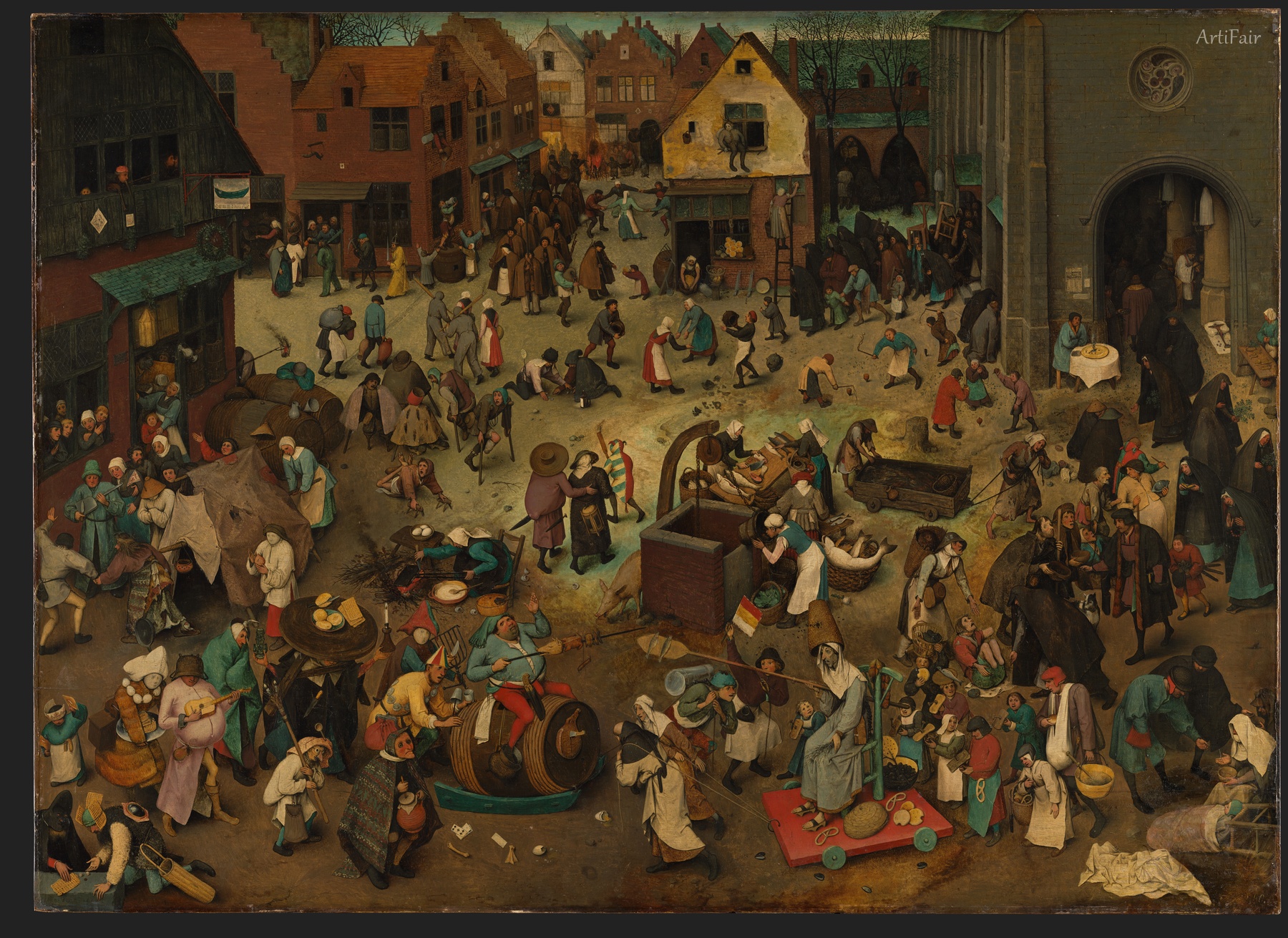
The Fight Between Carnival and Lent is an oil painting on oak panel by Pieter Bruegel the Elder, signed and dated 1559 on a stone at lower left; it is in the Kunsthistorisches Museum, Vienna.
The struggle between personifications of feasting and fasting was an old literary theme, from the thirteenth-century French poem of the battle of Lent and Flesh to a 1558 print after Frans Hogenberg in which the fat and the lean are pushed together on carts. Bruegel's panel belongs with Netherlandish Proverbs of the same year and Children's Games of 1560, each a catalogue of folk customs marking his move from draughtsman to painter of large panels. The painting probably belonged to Emperor Rudolf II and was moved from the imperial treasury into the picture gallery in 1748.
In the foreground the two adversaries meet in a mock joust of the kind actually staged at the time. Carnival, a fat butcher with a pie on his head, straddles a beer barrel and brandishes a spit with a pig's head, poultry and sausages. Lent, a thin woman in a beehive headdress, sits on a cart pulled by a monk and a nun and holds out a baker's peel with two herrings. Nearly 200 figures fill the square: at left, around the Blue Barge inn, people drink, dance and perform farces; at right, by the church, worshippers come out of the service, give alms to beggars and buy fish.
The Kunsthistorisches Museum calls the picture an encyclopaedia of Netherlandish customs around Carnival and Lent. Its details match the folklore of the time, but showing everything happening in one place at once was Bruegel's invention. X-rays have revealed that a later hand painted out some figures, including a corpse under a white shroud, which are still visible in early copies. The panel measures 118 × 163.7 cm.