
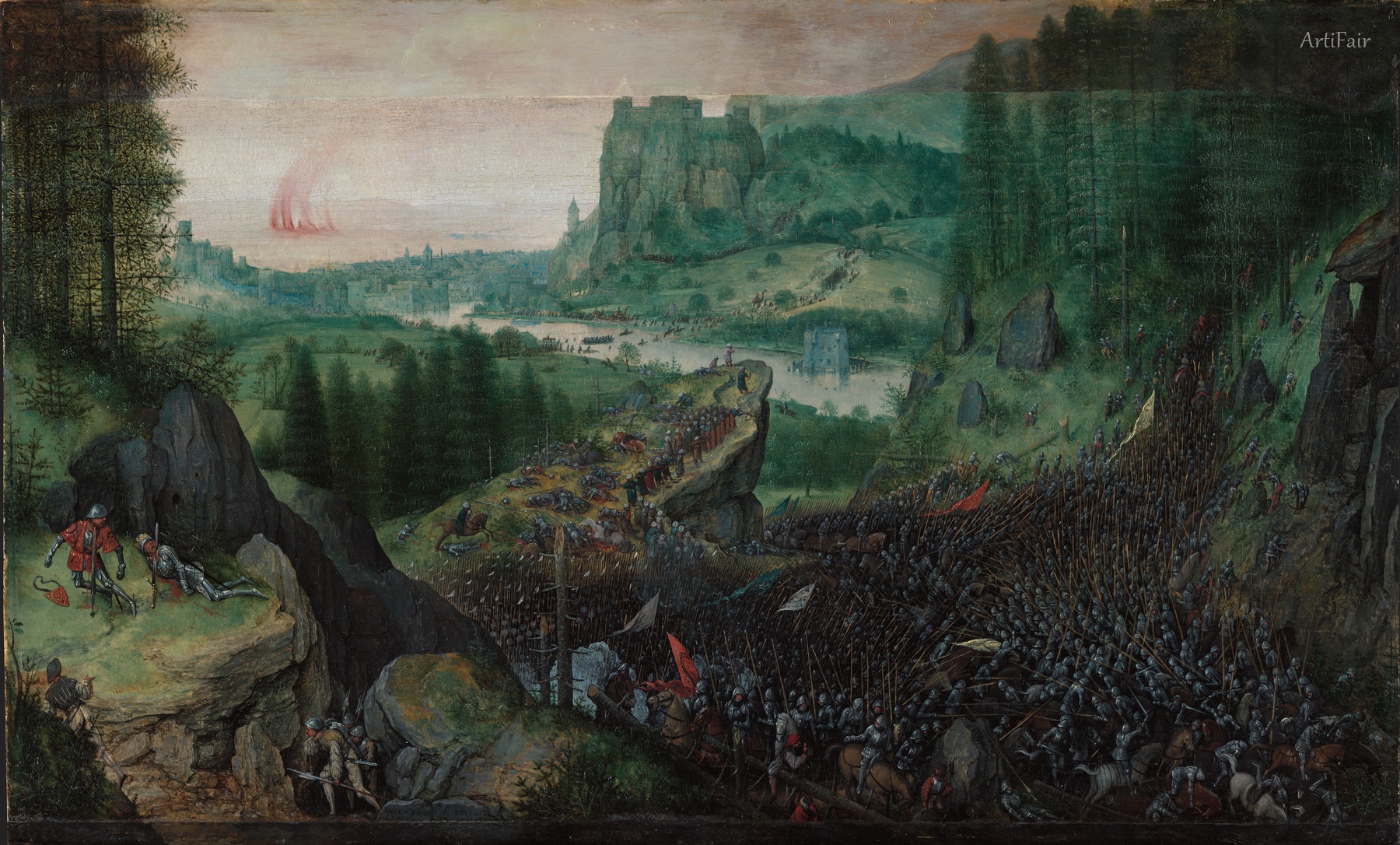
The Suicide of Saul
Category:
Created:
1562
Likes:
0
Dimensions:
Download:
New users get 4 free credits. 2K costs 1 credit; 4K and Ultra HD are priced by resolution. Public domain artworks can be used commercially.
Dominant colors
Public domain download summary
This artwork is provided as a public domain image resource. The 2K file costs 1 credit for everyday creative work, while 4K and Ultra HD files are priced by resolution.
Art Appreciation
The Suicide of Saul is an oil painting on panel by Pieter Bruegel the Elder, dated 1562, in the Kunsthistorisches Museum in Vienna (GG 1011). At 33.5 by 55 cm it is one of his smallest paintings, barely larger than some of his drawings, yet it holds a vast battle landscape.
An inscription between two rocks at the lower left, SAVL. XXXI. CAPIT., points to chapter 31 of the First Book of Samuel, followed by the signature and date BRVEGEL. M.CCCCC.LXII. The text tells how the Israelites were routed by the Philistines on Mount Gilboa; the wounded King Saul asked his armour-bearer to kill him and, when he refused, fell on his own sword, and the armour-bearer then did the same. Bruegel places Saul and his armour-bearer on a rocky ledge at the left as Philistine soldiers close in below, while a dense army bristling with lances pours through the valley to the right. As in most of his biblical scenes, the troops wear sixteenth-century armour, and some of the Philistines are dressed as Turks. The massed tiny soldiers and forests of lances owe much to Albrecht Altdorfer's Battle of Alexander at Issus of 1529. The subject appears not to have been painted before, although it occurs in other media such as manuscript illumination.
The panel is an early attempt by Bruegel to join figure painting with landscape. Foreground and distance are not yet fully reconciled, and the jutting central rock is a Mannerist device he would use again in The Procession to Calvary, but the hazy distant view marks a new stage in his naturalistic landscape. Interpretations range from punished pride, a reading supported by Dante's placing of Saul among the proud in Purgatory, to human folly or vanitas.
Narrow strips were once cut from the top and bottom and later replaced in Vienna with new fruitwood. The painting may be the one listed in Rubens's estate inventory of 1640, and it was in the Viennese imperial gallery by the early 1780s.