
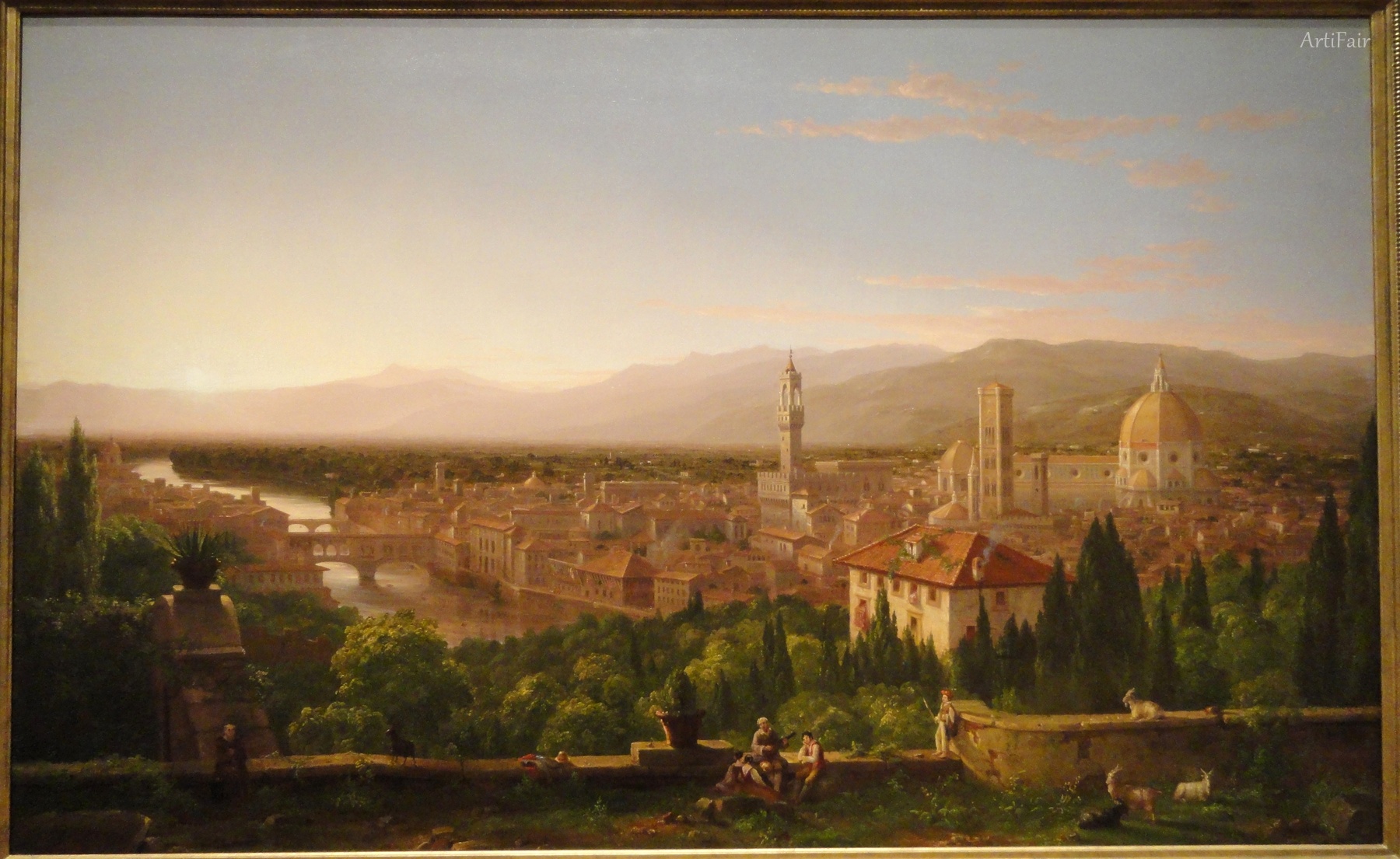
View of Florence
Category:
Created:
1837
Likes:
0
Dimensions:
Download:
New users get 4 free credits. 2K costs 1 credit; 4K and Ultra HD are priced by resolution. Public domain artworks can be used commercially.
Dominant colors
Public domain download summary
This artwork is provided as a public domain image resource. The 2K file costs 1 credit for everyday creative work, while 4K and Ultra HD files are priced by resolution.
Art Appreciation
View of Florence, also known as View of Florence from San Miniato, is an oil painting on canvas by Thomas Cole, dated 1837 and held by the Cleveland Museum of Art (1961.39). It measures 99.5 by 160.4 cm and is signed T C at the lower right.
Cole spent time in Italy during his first European journey, and in 1831 he made a small pencil sketch of this view of Florence from the hill of San Miniato al Monte, shortly before sunset. Six years later, in his New York studio, he turned the drawing into a large oil, adding picturesque figures and goats to the foreground. He showed it at the National Academy of Design annual exhibition of 1837 alongside a painting of the Catskill Mountains, setting out to prove that he had mastered the very different landscapes of the Old World and the New.
The panorama looks down over terraces and dark cypresses to the city in the valley of the Arno, its bridges catching the low light at left, the tower of the Palazzo Vecchio and the cathedral with its dome rising on the right, and a range of hills fading into the haze under the setting sun. In the foreground a monk and other figures rest by a low wall. The picture was exhibited again at the Boston Athenaeum in 1839 as View on the Arno, Florence, and at the American Art-Union's memorial exhibition after Cole's death in 1848.
By 1854 the canvas belonged to Henry James Sr. It hung in the family's front parlour on West 14th Street in Manhattan, and his son, the novelist Henry James, recalled in his 1913 memoir A Small Boy and Others that its foreground monk was his constant friend. Its whereabouts were then unknown for about a century, until it turned up in the window of a New York antique shop. After cleaning and lining by the restorer Francis Moro, it passed through the dealer Victor Spark to the Cleveland Museum of Art in 1961.