
Memory of the Garden at Etten
Category:
Created:
1888
Likes:
0
Dimensions:
Download:
New users get 4 free credits. 2K costs 1 credit; 4K and Ultra HD are priced by resolution. Public domain artworks can be used commercially.
Dominant colors
Public domain download summary
This artwork is provided as a public domain image resource. The 2K file costs 1 credit for everyday creative work, while 4K and Ultra HD files are priced by resolution.
Art Appreciation
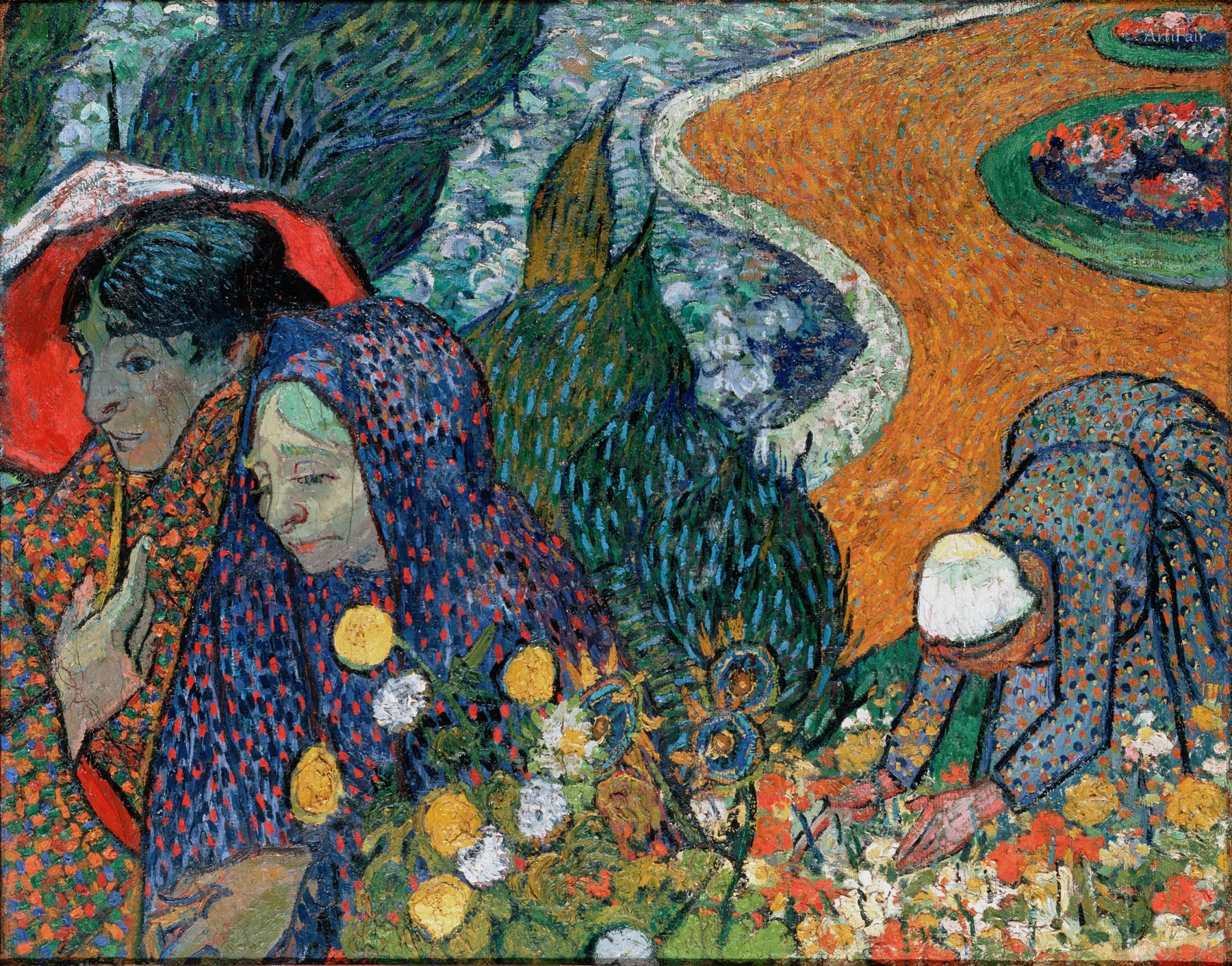
Memory of the Garden at Etten, also known as Ladies of Arles, is an oil-on-canvas painting by Vincent van Gogh, made in Arles around November 1888; it is in the State Hermitage Museum, St Petersburg.
Van Gogh painted it to decorate his own bedroom in the Yellow House while Paul Gauguin was staying with him. The title recalls the garden of his parents' parsonage at Etten in Holland, where in 1881 Vincent began working in earnest as an artist. Rather than painting from the motif, he worked from memory and imagination, the method Gauguin was encouraging; the Hermitage sees Gauguin's influence in the flattened space and in the broad areas of colour bounded by heavy contours. The picture in turn influenced Gauguin's Arlésiennes (Mistral), painted about a month later.
In a letter to his sister Willemien, Van Gogh set out the colours: a younger woman in a Scottish shawl with green and orange checks under a red parasol, an older one in a blue-violet shawl, almost black, against which lemon-yellow and pink-and-white dahlias explode, emerald cypresses, a raw orange sandy path, and in the middle ground a maid in blue tending flowers. He asked her to suppose the two walkers were Willemien and their mother, insisting that the resemblance lay in the choice of colour rather than in likeness, and said the snaking lines were meant to show the garden as if seen in a dream. The biographer Marc Edo Tralbaut thought the younger woman might also echo his cousin Kee Vos-Stricker. Van Gogh later wrote that he had spoiled the picture, though Jan Hulsker found it fascinating and enigmatic, and both writers compared it to medieval stained glass.
The canvas measures about 73 × 92 cm. It belonged to the Schuffenecker family at Clamart and was shown at the Galerie Druet in Paris in 1908, then entered Sergei Shchukin's collection in Moscow. Nationalised in 1918, it passed to the State Museum of New Western Art and in 1948 to the Hermitage.