
Sleep and His Half-Brother Death
Category:
Created:
1874
Likes:
1
Dimensions:
Download:
New users get 4 free credits. 2K costs 1 credit; 4K and Ultra HD are priced by resolution. Public domain artworks can be used commercially.
Dominant colors
Public domain download summary
This artwork is provided as a public domain image resource. The 2K file costs 1 credit for everyday creative work, while 4K and Ultra HD files are priced by resolution.
Art Appreciation
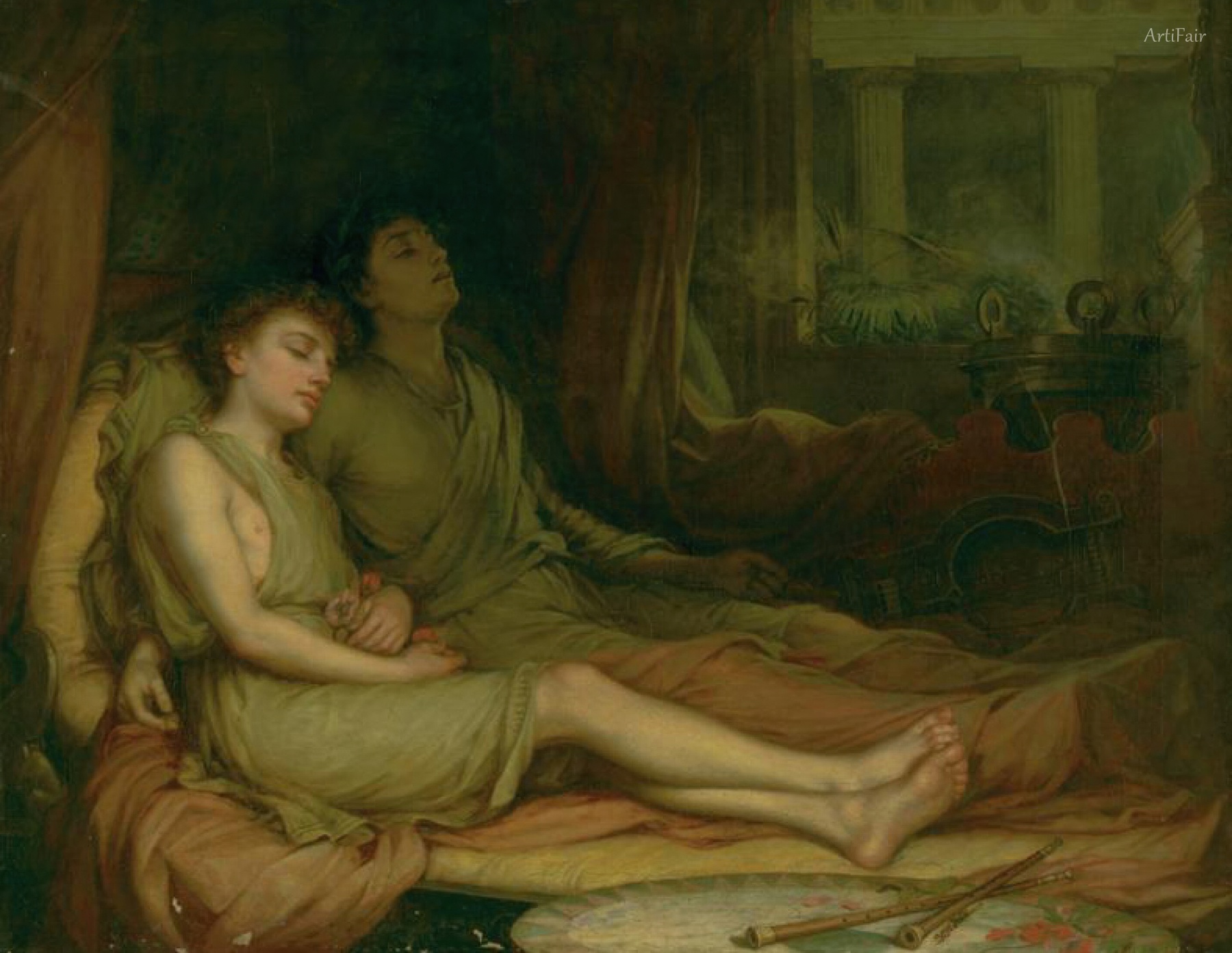
Sleep and His Half-Brother Death is an oil painting on canvas by John William Waterhouse, completed in 1874 and now in a private collection; it was his first picture shown at the Royal Academy in London.
Waterhouse, born in 1849, was still in his twenties and had entered the Royal Academy Schools in 1870. He submitted the work to the Summer Exhibition from his father's house at 1 Scarsdale Villas, and it was painted after both of his younger brothers had died of tuberculosis. The Victorian Web commentary calls it a promising first exhibit, noting its sure handling of colour and of light and shade.
The two reclining youths personify Hypnos and Thanatos, Sleep and Death, who in Greek myth were brothers; Hesiod makes them twin sons of Night. Their poses are almost identical, but the figure in front is bathed in light and clasps poppies, the flower of narcotic sleep, while the one behind him, head tipped back, sinks into shadow, so that the eye passes from Sleep to Death as it moves into the picture. The reclining bodies recall figures on ancient tombs and sarcophagi, such as the sleeping Endymion, which Waterhouse could study at the South Kensington Museum and the British Museum. A curtain, a balcony and two ancient instruments, an aulos and a lyre, lie around them, details that have led some writers to see the pair as musicians resting after a performance.
At about 70 by 91 cm, it is one of Waterhouse's early, smaller works. Dani Cavallaro has read it as an early sign of two concerns of Aestheticism: a fascination with youthful, almost genderless beauty, and the pursuit of intense, intoxicating sensation. It sits alongside the contemporary Victorian interest in the border between sleep and death.