
Lady Godiva
Category:
Created:
Date unknown
Likes:
1
Dimensions:
Download:
New users get 4 free credits. 2K costs 1 credit; 4K and Ultra HD are priced by resolution. Public domain artworks can be used commercially.
Dominant colors
Public domain download summary
This artwork is provided as a public domain image resource. The 2K file costs 1 credit for everyday creative work, while 4K and Ultra HD files are priced by resolution.
Art Appreciation
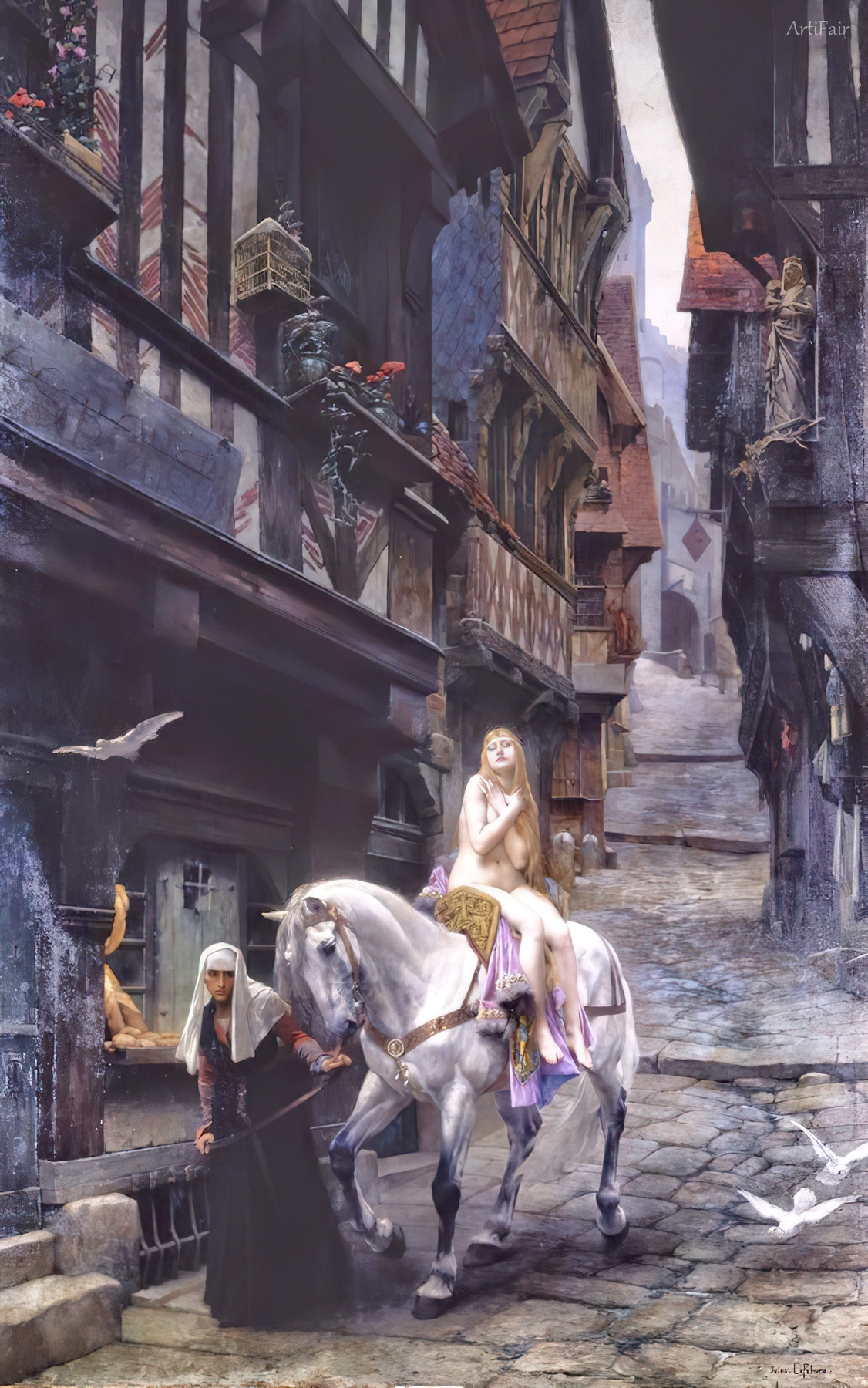
Lady Godiva is a monumental oil painting on canvas by the French academic painter Jules Joseph Lefebvre, shown at the Paris Salon of 1890 and held since 1891 by the Musée de Picardie, Amiens.
The legend concerns Godiva, an eleventh-century Anglo-Saxon noblewoman married to Leofric, Earl of Mercia, who burdened the people of Coventry with heavy taxes. When she begged him to lift them, he agreed on condition that she ride naked through the town. The story was recorded about a century later by Roger of Wendover, a monk of St Albans, and later versions add that the townspeople stayed indoors out of respect, and that a man named Tom who dared to look was struck blind, the origin of the phrase Peeping Tom. Tennyson revived the tale in 1842 and it inspired many British artists, but it was little known in France, where it was translated only in 1888.
Seen from below, a deserted medieval street of half-timbered houses climbs toward a castle glimpsed at the top of the canvas. Godiva, covered only by her long fair hair, rides side-saddle on a white horse with her arms crossed over her breast and her eyes closed, led by a wary old servant in a long black cloak, while white doves flutter around them. A baker's stall in the foreground recalls the version of the story in which a baker broke the order. The model was probably Sarah Brown, who posed for other works by Lefebvre, and some forty preparatory drawings survive.
The picture, 620 by 390 cm, was a great success at the 1890 Salon. Coventry offered a large sum for it, but Lefebvre, son of a baker who had settled in Amiens, sold it to that city for about a quarter of the price, in thanks for the municipal grant that had paid for his studies. After decades in storage it was restored in public in 2013 and returned to the museum's Grand Salon.