
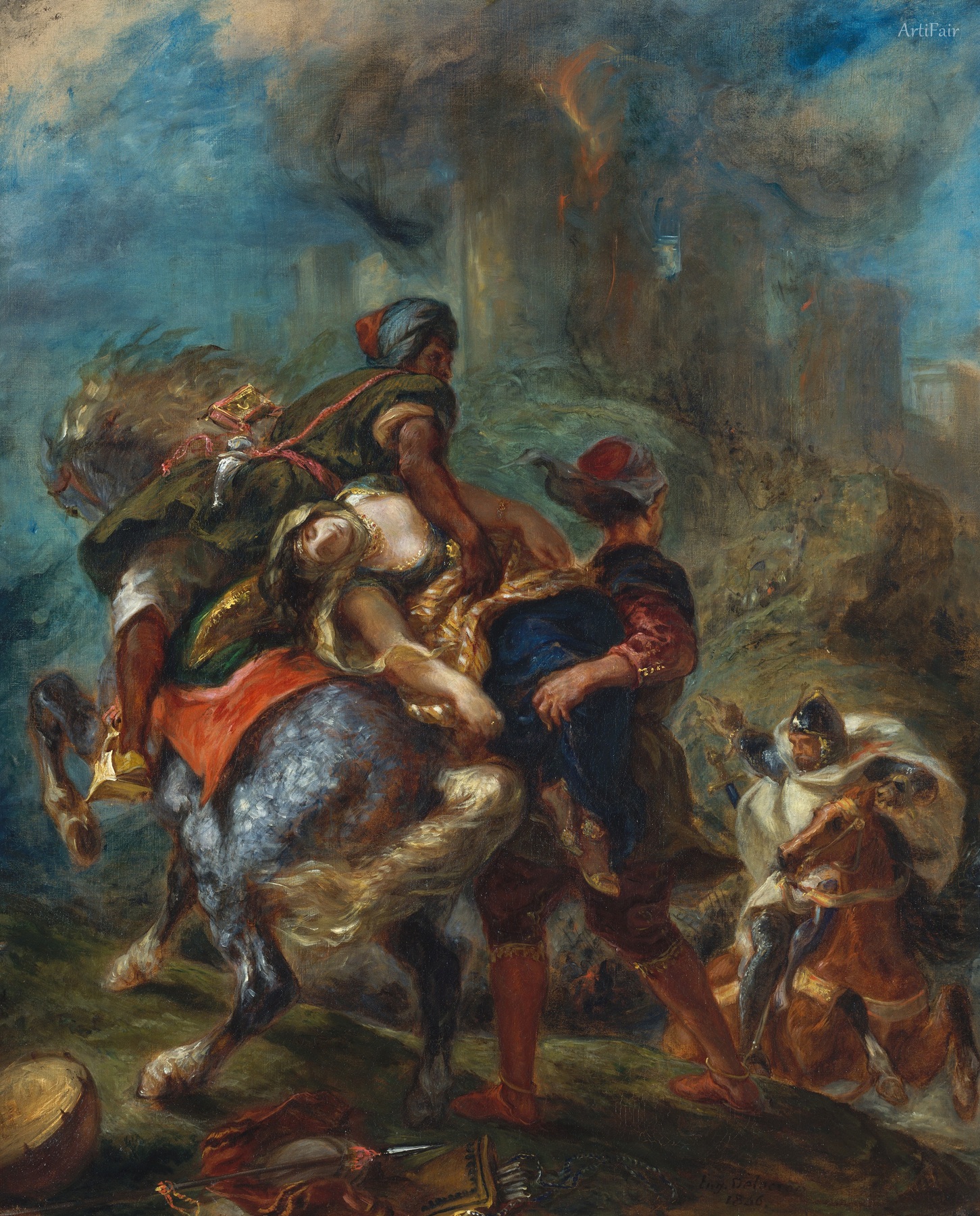
The Abduction of Rebecca
Category:
Created:
1846
Likes:
0
Dimensions:
Download:
New users get 4 free credits. 2K costs 1 credit; 4K and Ultra HD are priced by resolution. Public domain artworks can be used commercially.
Dominant colors
Public domain download summary
This artwork is provided as a public domain image resource. The 2K file costs 1 credit for everyday creative work, while 4K and Ultra HD files are priced by resolution.
Art Appreciation
The Abduction of Rebecca is an oil painting on canvas by Eugène Delacroix, dated 1846 and held by the Metropolitan Museum of Art in New York (03.30); it measures 100.3 × 81.9 cm and entered the museum in 1903 through the Catharine Lorillard Wolfe Collection, Wolfe Fund.
Delacroix drew on the novels of Sir Walter Scott, a favourite author of the French Romantics, throughout his career. This picture takes its subject from Ivanhoe, published in 1818 and set in the time of the Crusades and Richard the Lionheart. Rebecca, the Jewish daughter of Isaac of York, has been held in the castle of Front-de-Boeuf; as the castle burns, two enslaved Muslim warriors in the service of the Templar Brian de Bois-Guilbert carry her off. Delacroix showed it at the Salon of 1846 and returned to the subject in a second version, painted in 1858 for the Salon of 1859, which is now in the Louvre.
The two men heave the fainting Rebecca, pale and limp in a golden dress, onto a rearing dappled horse, while a mounted knight in a white cloak appears at the lower right and figures flee from the flaming fortress above. The Met points out how the twisting, interlocking poses and the cramped space, which drops abruptly from the raised foreground to the castle behind, create intense drama; apart from the still life of shield and weapons at lower left, Rebecca herself is the only calm element. The sky is painted in quick, thin strokes through which the weave of the canvas shows, while the paint on the horse is built up in layers.
Critics at the 1846 Salon attacked the work's Romantic qualities, but Charles Baudelaire admired its perfect ordering of intense, tightly packed tones and remarked that Delacroix's painting, like nature, abhors a vacuum. The Met today calls it one of Delacroix's greatest paintings.