
Wheat Field with Cypresses
Category:
Created:
1889
Likes:
8
Dimensions:
Download:
New users get 4 free credits. 2K costs 1 credit; 4K and Ultra HD are priced by resolution. Public domain artworks can be used commercially.
Dominant colors
Public domain download summary
This artwork is provided as a public domain image resource. The 2K file costs 1 credit for everyday creative work, while 4K and Ultra HD files are priced by resolution.
Art Appreciation
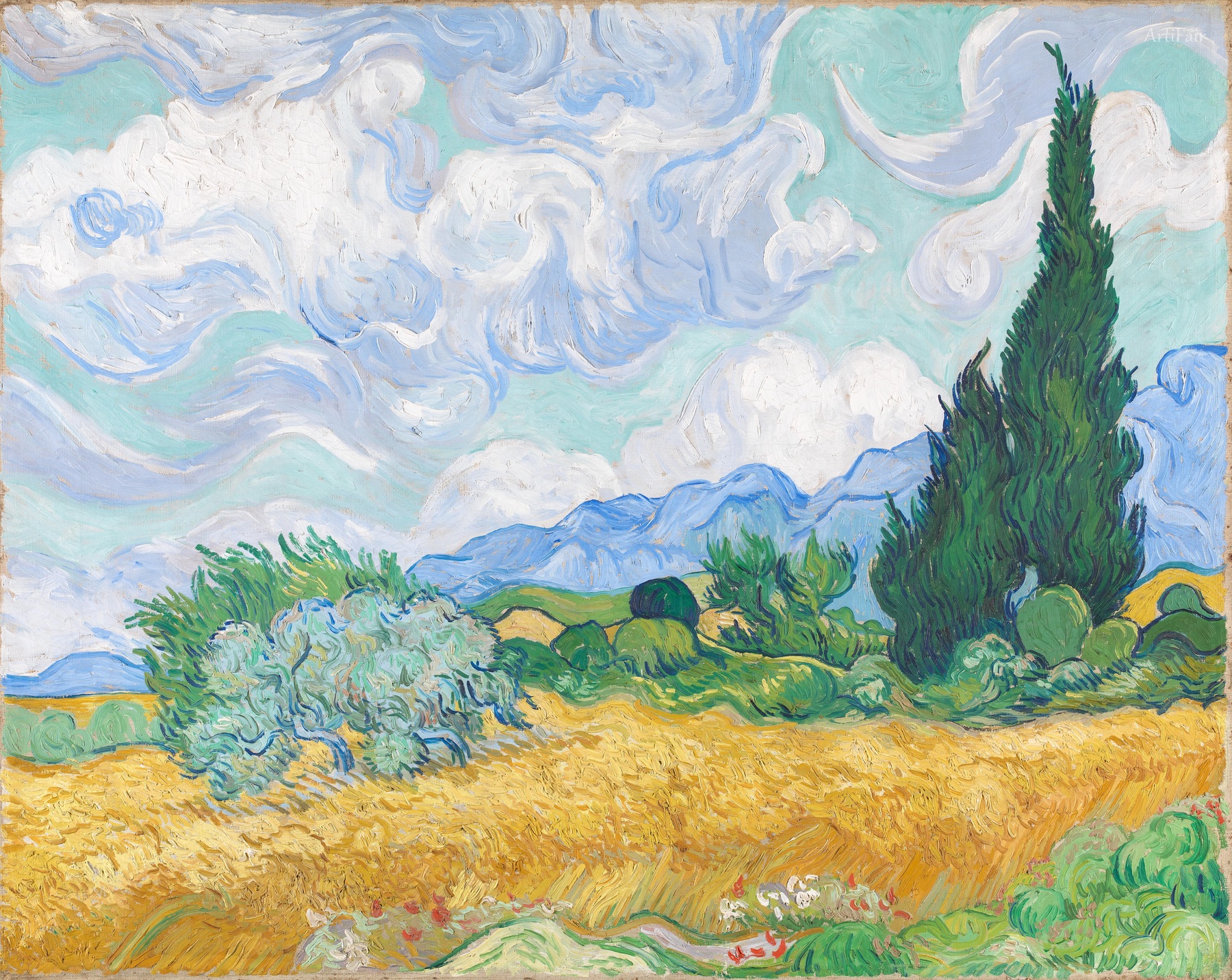
Wheat Field with Cypresses, catalogued by the National Gallery as A Wheatfield, with Cypresses, is an oil painting on canvas by Vincent van Gogh, made at Saint-Rémy-de-Provence in September 1889; this version belongs to the National Gallery, London. It measures 72.1 × 90.9 cm.
Van Gogh admitted himself to the psychiatric hospital of Saint-Paul-de-Mausole in May 1889. On 25 June he told his brother Theo that the cypresses still preoccupied him: he wanted to do something with them like his sunflower canvases, found them as beautiful in line and proportion as an Egyptian obelisk, and called their green the dark patch in a sun-drenched landscape. Allowed out with a guardian, he painted a first version on the spot in late June or early July, now in the Metropolitan Museum of Art, and regarded it as a study. After a relapse kept him in his room, he made a reed-pen drawing of the composition and in September painted this finished version at the same scale, followed by a smaller copy for his mother and sister, now in a private collection.
The picture combines typical Provençal motifs: a golden wheat field, tall dark cypresses, an olive bush and the blue Alpilles behind. Van Gogh wrote of painting in the mistral, and here the wind seems to move the wheat, the trees, the clouds and even the hills. Repeating the subject let him make it slightly more stylised, in line with what Paul Gauguin and Émile Bernard were doing. He sketched the design in charcoal, painted the sky and cypresses thinly, with the ground showing in places, and kept thick impasto for the wheat and the clouds, using zinc white, cobalt blue, chrome yellows, viridian and emerald green, with touches of vermilion for the poppies. For Van Gogh the cycle of the wheat from sowing to harvest was a metaphor for human life and death.
He sent the canvas to Theo later in September 1889. It later belonged to the critic Octave Mirbeau and passed through Paris dealers to a collector in Oslo before being bought through the Courtauld Fund in 1923. It has never been relined, varnished or waxed.