
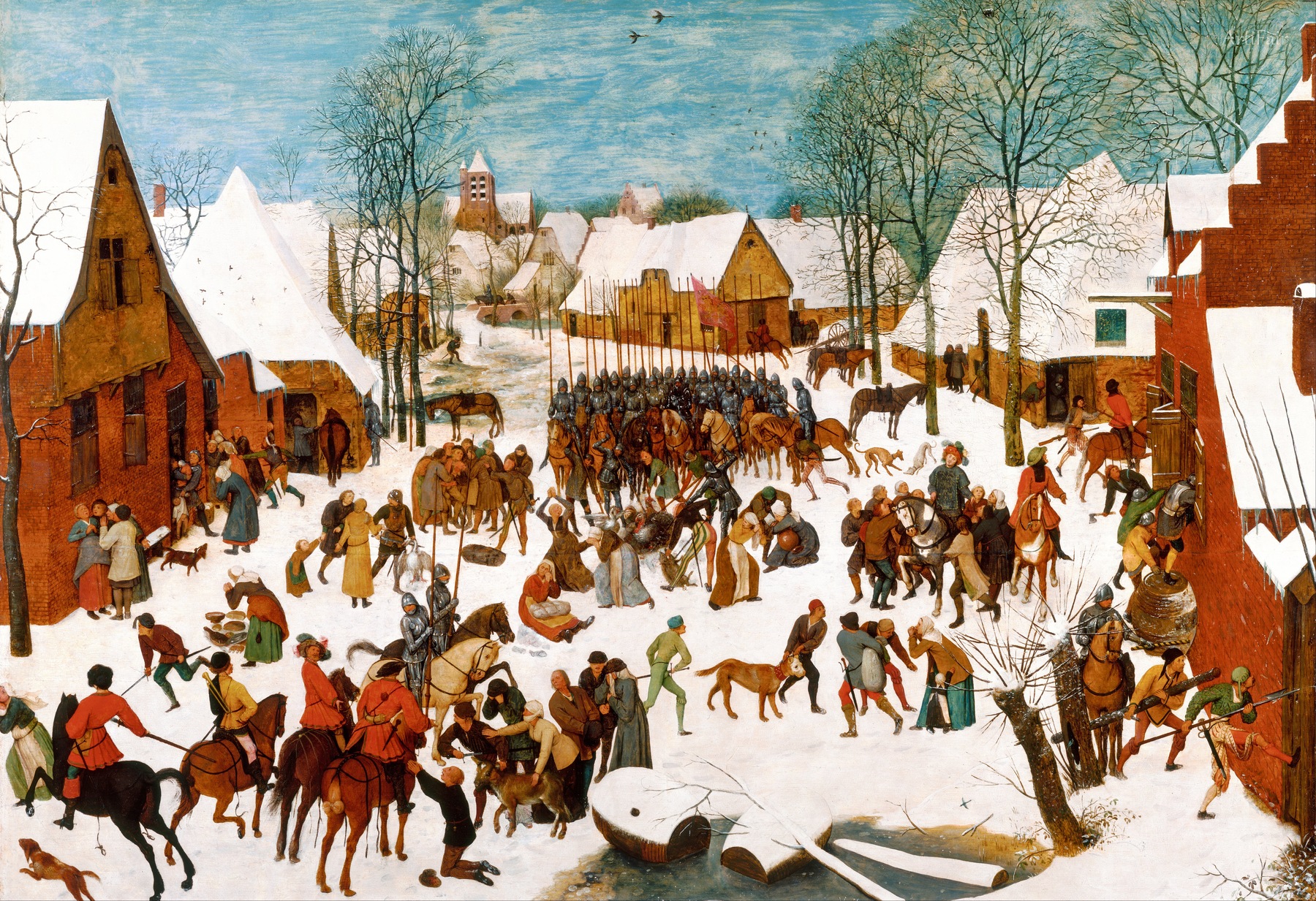
Massacre of the Innocents
Category:
Created:
1565
Likes:
0
Dimensions:
Download:
New users get 4 free credits. 2K costs 1 credit; 4K and Ultra HD are priced by resolution. Public domain artworks can be used commercially.
Dominant colors
Public domain download summary
This artwork is provided as a public domain image resource. The 2K file costs 1 credit for everyday creative work, while 4K and Ultra HD files are priced by resolution.
Art Appreciation
The Massacre of the Innocents is an oil painting on oak panel by Pieter Bruegel the Elder, painted around 1565–67 and now in the British Royal Collection; it has been shown at Hampton Court and, since 2017, at Windsor Castle. It is regarded as the only version by the elder Bruegel among many related panels.
The subject comes from the Gospel of Matthew, in which King Herod orders the killing of all infants in Bethlehem. Bruegel moved the event to a snowbound Flemish village of his own day, attacked by mounted troops in black armour and red coats, a choice often read as a comment on Spanish rule in the years before the Dutch Revolt. The hard winter of 1564–65, which also lies behind The Hunters in the Snow, may have inspired the setting. As in Netherlandish Proverbs, many small episodes unfold across the square: soldiers break into an inn, villagers plead with a herald, and families resist.
What the picture shows today is not what Bruegel painted. After it reached Emperor Rudolf II in Prague, the slaughtered children were painted over with food, sacks, bundles and animals, apparently at his order, turning the massacre into a scene of plunder; a herald's tabard with the Habsburg double-headed eagle was also obscured. The overpainting became evident during conservation in 1998, and Lorne Campbell identified the panel as Bruegel's original. Copies such as the one in the Kunsthistorisches Museum in Vienna, long thought to be the original and now attributed to Pieter Brueghel the Younger or his studio, preserve the dead infants.
The panel was probably taken from Prague Castle by Swedish troops in 1648, was in Queen Christina's collection by 1652, and was acquired by Charles II at Breda in 1660 while he was in exile. It bears the signature BRVEGEL.