
Jupiter and Semele
Category:
Created:
1894
Likes:
0
Dimensions:
Download:
New users get 4 free credits. 2K costs 1 credit; 4K and Ultra HD are priced by resolution. Public domain artworks can be used commercially.
Dominant colors
Public domain download summary
This artwork is provided as a public domain image resource. The 2K file costs 1 credit for everyday creative work, while 4K and Ultra HD files are priced by resolution.
Art Appreciation
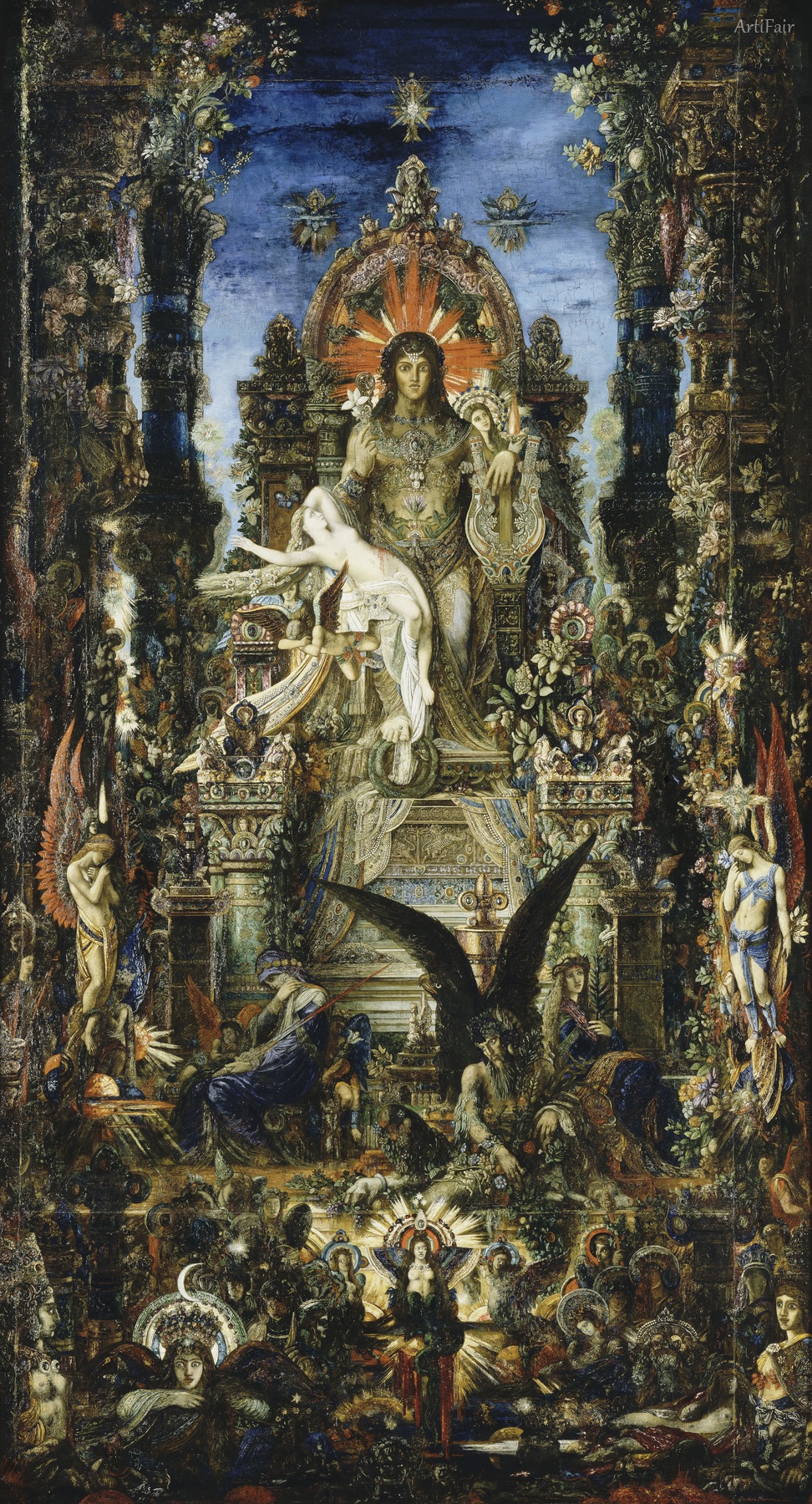
Jupiter and Semele (Jupiter et Sémélé) is an oil on canvas by Gustave Moreau, commissioned in 1889 and completed in 1895, in the Musée Gustave Moreau, Paris (Cat. 91); the museum gives its size as 212 × 118 cm.
The collector Léopold Goldschmidt ordered the picture; Moreau's first sketch is dated 1889, but it was delivered only in 1895, and Goldschmidt gave it to the museum in 1903. The museum regards it as a synthesis of Moreau's art and in effect his painted testament. In the myth, Semele, daughter of Cadmus, founder of Thebes, and Harmonia, is Jupiter's mortal lover. Jealous Juno, disguised as Semele's nurse Beroe, persuades her to ask the god to appear in his full divinity, knowing that no mortal can survive the sight. Moreau shows the moment she is struck down, sprawled pale and bloodied across the god's right thigh, while Jupiter, enthroned and staring straight ahead, blazes with light.
Moreau broke with tradition by painting Jupiter beardless and giving him a lyre, the usual attribute of Apollo or Orpheus, making him a poet-god. A winged figure hiding its eyes was, for Moreau, the genius of earthly love with goat's feet, though it is sometimes identified as Bacchus, the child of the union. At the base of the throne sit Death, holding a bloodied sword, and Sorrow, crowned with thorns and holding a lily, which in Moreau's words form the tragic basis of human life. Nearby are Jupiter's eagle with spread wings and Pan, a god of the earth, linking heaven with the underworld ruled by Hecate, who appears at the bottom with a crescent moon among the monsters of darkness, guarded by two sphinxes. The museum suggests reading the picture upward, as the soul's ascent toward ever more spiritual realms; architecture and plants in jewel-like detail fill every part.
The writer Malcolm de Chazal called the central image a birth and death in one, and Michel Butor included the painting among the 105 decisive works of his imaginary museum of Western painting.