
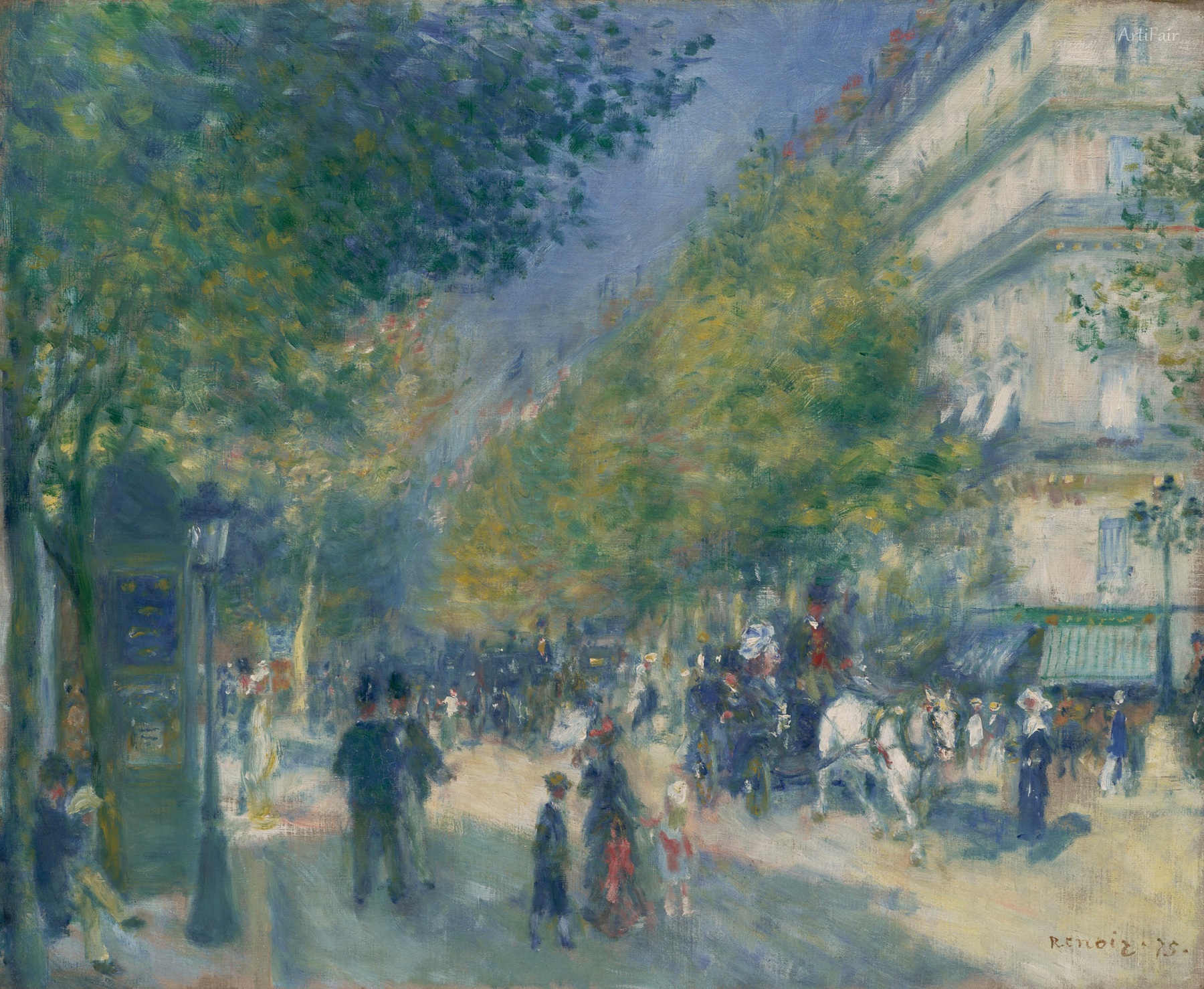
Les Grands Boulevards
Category:
Created:
1875
Likes:
0
Dimensions:
Download:
New users get 4 free credits. 2K costs 1 credit; 4K and Ultra HD are priced by resolution. Public domain artworks can be used commercially.
Dominant colors
Public domain download summary
This artwork is provided as a public domain image resource. The 2K file costs 1 credit for everyday creative work, while 4K and Ultra HD files are priced by resolution.
Art Appreciation
The Grands Boulevards (Les Grands Boulevards) is an oil on canvas cityscape painted by Pierre-Auguste Renoir in 1875; it is in the Philadelphia Museum of Art, which received it in 1986 with the Henry P. McIlhenny Collection.
Renoir had lived in Paris since the age of four, and in the 1870s he painted a series of views of the city. In the two previous decades, under Napoleon III, Baron Georges-Eugène Haussmann had replaced much of the old tangle of medieval streets with wide boulevards, uniform stone buildings and open vistas; Renoir's own family had been displaced twice to make way for these works. The Philadelphia museum describes this painting as perhaps his most famous view of Paris and an archetypal image of the newest and most fashionable district of the 1870s.
The boulevard is shown in full summer sun. Young trees line a broad paved street; a horse-drawn carriage with a white horse moves through the traffic, and men in top hats, women and children stroll along the pavement past a kiosk and a street lamp. Renoir gives the figures' clothes enough detail to suggest their social standing but leaves their faces undefined, concentrating instead on the light falling through the leaves and the shadows cast by trees, people and carriage. The museum points to the daubs of bright pigment and visible strokes, through which the city seems to pass by as a fleeting impression.
In 2012, when the painting was lent to an exhibition at the Carnegie Museum of Art in Pittsburgh, the curator Amanda Zehnder noted that its effect of one sharp detail amid a hazy whole, like peripheral vision, was the kind of thing nineteenth-century critics found unfinished and blurry. The canvas measures 52.1 × 63.5 cm.