
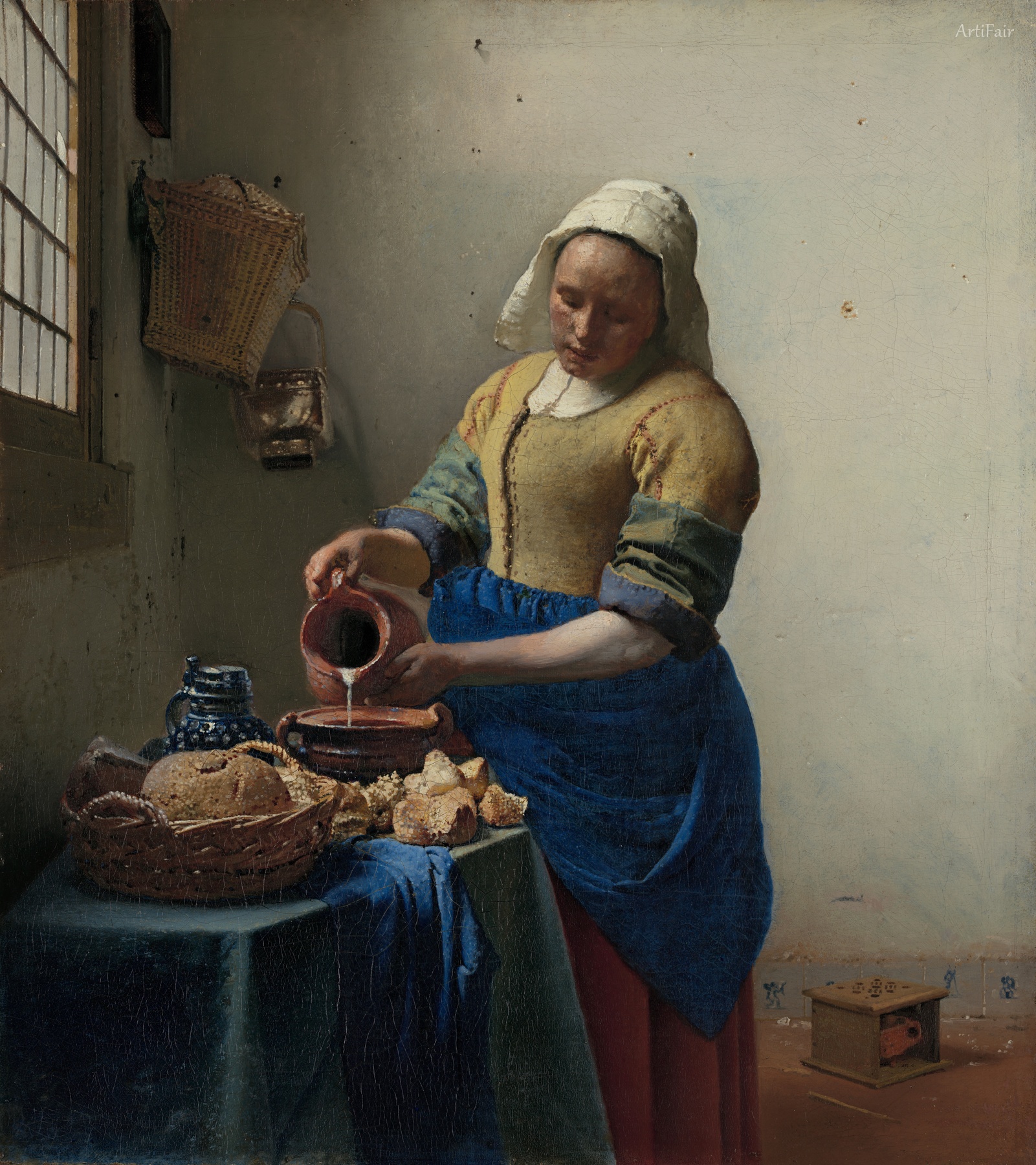
The Milkmaid
Category:
Created:
1660
Likes:
1
Dimensions:
Download:
New users get 4 free credits. 2K costs 1 credit; 4K and Ultra HD are priced by resolution. Public domain artworks can be used commercially.
Dominant colors
Public domain download summary
This artwork is provided as a public domain image resource. The 2K file costs 1 credit for everyday creative work, while 4K and Ultra HD files are priced by resolution.
Art Appreciation
The Milkmaid (Het melkmeisje) is an oil on canvas, 45.5 × 41 cm, painted by Johannes Vermeer around 1660, showing a kitchen maid pouring milk in a bare, sunlit room; it is in the Rijksmuseum, Amsterdam (SK-A-2344).
Dating estimates vary from about 1657 to 1661, and the Rijksmuseum currently gives c. 1660. Walter Liedtke of the Metropolitan Museum called it either Vermeer's last early work or his first mature one: its tactile, illusionistic finish recalls Leiden painters such as Gerrit Dou, while the light already points towards the luminous interiors to come. The woman is a household maid rather than a dairy worker. In Dutch art such maids were often shown as objects of desire, and a Cupid on one of the tiles behind her and the foot warmer have been read as amorous hints, but Vermeer's figure is unusually dignified, and many writers see the picture as an image of domestic virtue; the art historian Harry Rand suggested she is making bread pudding.
The Rijksmuseum describes her as standing like a statue, with only the stream of milk in motion. Vermeer used costly natural ultramarine for the apron and lead-tin yellow for the bodice, rendered the whitewashed wall with its nail and stains in lead white, umber and charcoal black, and dotted the bread and basket with hundreds of small points of light. X-rays show he painted out a large clothes basket on the floor and a map or painting on the wall. A pinhole in the canvas was used to snap chalk lines for the perspective.
The picture was probably bought from the artist by his Delft patron Pieter van Ruijven. At the Dissius sale in Amsterdam in 1696 it fetched 175 guilders, second only to View of Delft. It passed through several Amsterdam collections to Lucretia Johanna van Winter and, through her marriage, to the Six family, whose heirs sold it to the Rijksmuseum in 1908 with support from the Vereniging Rembrandt. During the Second World War it remained in the United States after the 1939 New York World's Fair.