
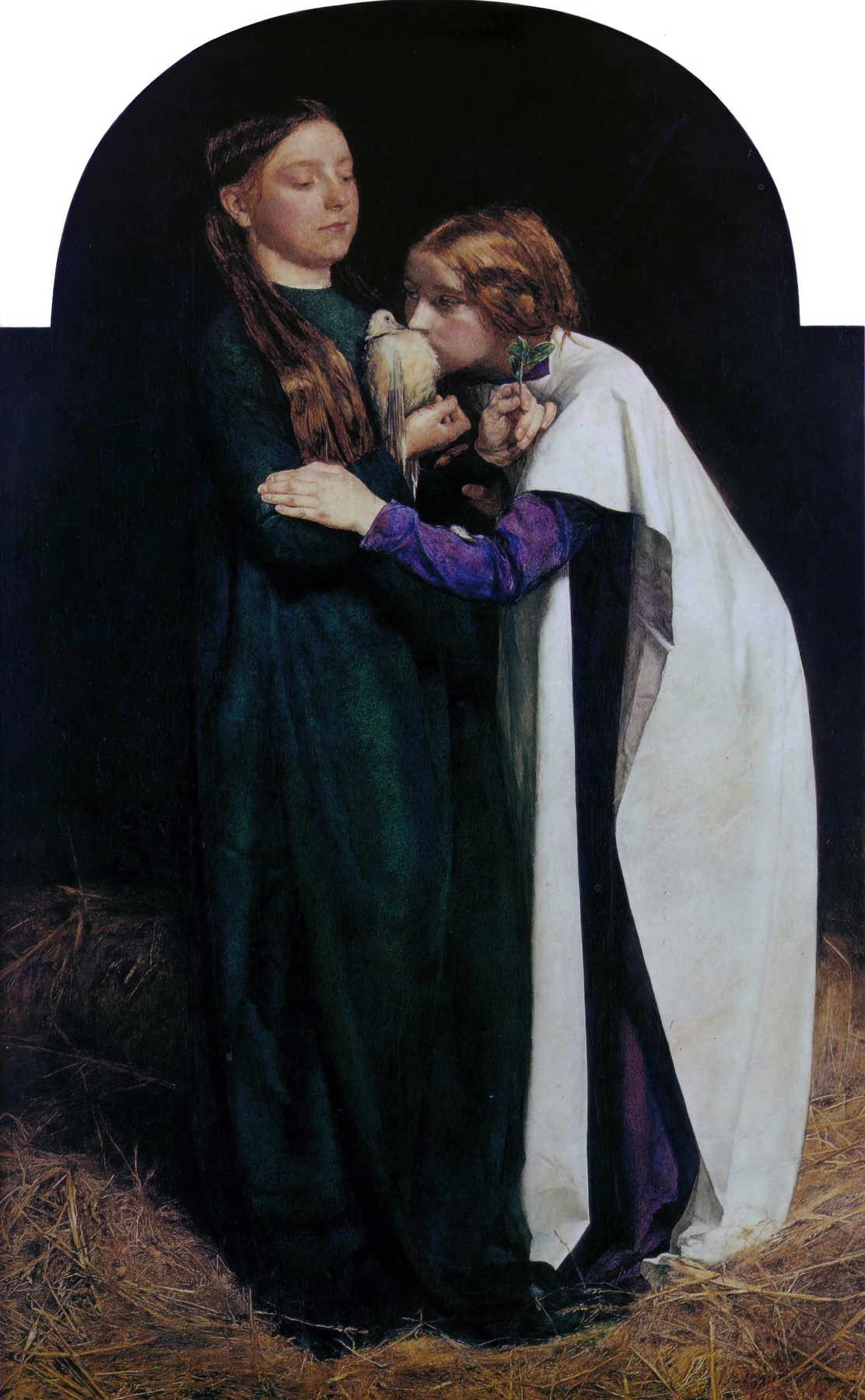
The Return of the Dove to the Ark
Category:
Created:
1851
Likes:
0
Dimensions:
Download:
New users get 4 free credits. 2K costs 1 credit; 4K and Ultra HD are priced by resolution. Public domain artworks can be used commercially.
Dominant colors
Public domain download summary
This artwork is provided as a public domain image resource. The 2K file costs 1 credit for everyday creative work, while 4K and Ultra HD files are priced by resolution.
Art Appreciation
The Return of the Dove to the Ark is an oil painting on canvas by John Everett Millais, signed and dated 1851 and held by the Ashmolean Museum in Oxford as part of the Combe Bequest.
The subject comes from Genesis 8:11: to learn whether the waters of the Flood had gone down, Noah sent out a dove, which came back with an olive leaf. Millais shows two of Noah's daughters-in-law receiving the bird inside the Ark. One, in a white robe, kisses it and holds the olive sprig, while the other, in green, presses it to her breast. They stand on loose straw against a darkness that is unusual for Pre-Raphaelite pictures of the time, and the Ashmolean notes that the details are painted with great fidelity to nature. Millais first planned to include Noah and several animals, and is thought to have left them out so that the picture would be ready for the Academy. He also had some intention of painting a companion, The Dove's First Flight, but never did.
The painting went on show at the Royal Academy in April 1851. To Millais's surprise, some Roman Catholic viewers took it as an allegory of England's return to the 'true faith'. John Ruskin and the French critic Théophile Gautier both praised it, and Ruskin wanted to buy it on first seeing it, but it had already been sold to Thomas Combe, superintendent of the Clarendon Press in Oxford who owned many other Pre-Raphaelite works. According to the museum, the picture influenced both Ruskin and William Morris. In 1855 the French satirical paper Journal pour rire printed a parody of it by the cartoonist Bertall.
The painting keeps its original frame, decorated with olive leaves and fruit to suit the subject. It passed to the Ashmolean in 1893 under the bequest of Combe's widow, and the canvas measures 88.2 by 54.9 cm.