
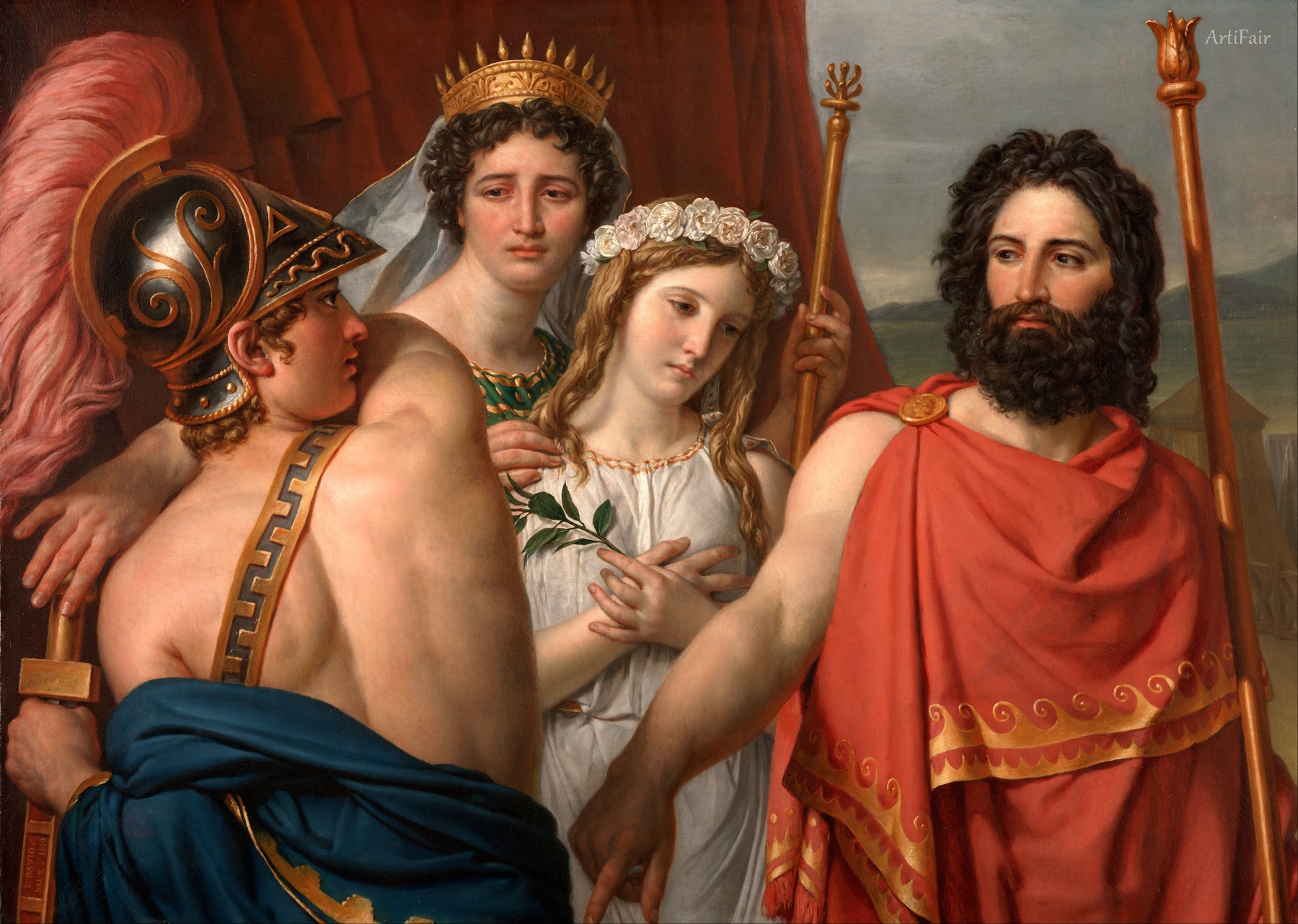
The Anger of Achilles
Category:
Created:
1819
Likes:
1
Dimensions:
Download:
New users get 4 free credits. 2K costs 1 credit; 4K and Ultra HD are priced by resolution. Public domain artworks can be used commercially.
Dominant colors
Public domain download summary
This artwork is provided as a public domain image resource. The 2K file costs 1 credit for everyday creative work, while 4K and Ultra HD files are priced by resolution.
Art Appreciation
The Anger of Achilles is an oil-on-canvas painting by Jacques-Louis David, dated 1819 and measuring 105.3 × 145 cm; it belongs to the Kimbell Art Museum in Fort Worth, Texas (AP 1980.07).
After Waterloo David went into exile in Brussels, and it was there that he painted and exhibited this picture, one of his last history paintings. According to the Kimbell he valued it highly, as the culmination of his lifelong effort to recapture the perfection of ancient Greek art. The episode comes from Euripides' tragedy Iphigenia in Aulis and from Racine's seventeenth-century version of the story. Agamemnon, king of the Greeks, has just told the young Achilles that Iphigenia has not been brought to Aulis to marry him but to be sacrificed to the goddess Diana, so that the Greek fleet can sail for Troy.
David packs the four figures close to the picture surface in half-length, as on a stage. Achilles, at the left, angrily begins to draw his sword, but Agamemnon's fixed gaze and commanding gesture seem to halt the outburst. Iphigenia, apparently dressed as a bride and looking almost angelic, presses a hand to her heart, unaware of the confrontation between the men, while her mother Clytemnestra weeps with a hand on her shoulder. The Kimbell reads Clytemnestra's expression as a mix of grief for her daughter and disappointment that Achilles cannot act, mirroring the divided feelings of a viewer caught between family, marital and civic duty. Late changes to costume and accessories are visible, the most prominent being the red cloak, fastened by a gold clasp, that now covers Agamemnon's once bare shoulder.
André Parmentier of Enghien acquired the canvas from the artist around 1 November 1819. After his bankruptcy it was sold in 1824 to Carion Delmotte of Mons for 8,300 florins, later belonged to J. Naigeon, curator of the Luxembourg gallery, and to Mme Noël des Vergers, and passed through a Swiss private collection before the Kimbell Art Foundation bought it in 1980. A copy of 1825, sometimes attributed to Michel Ghislain Stapleaux working under David's direction, is in a private collection.