
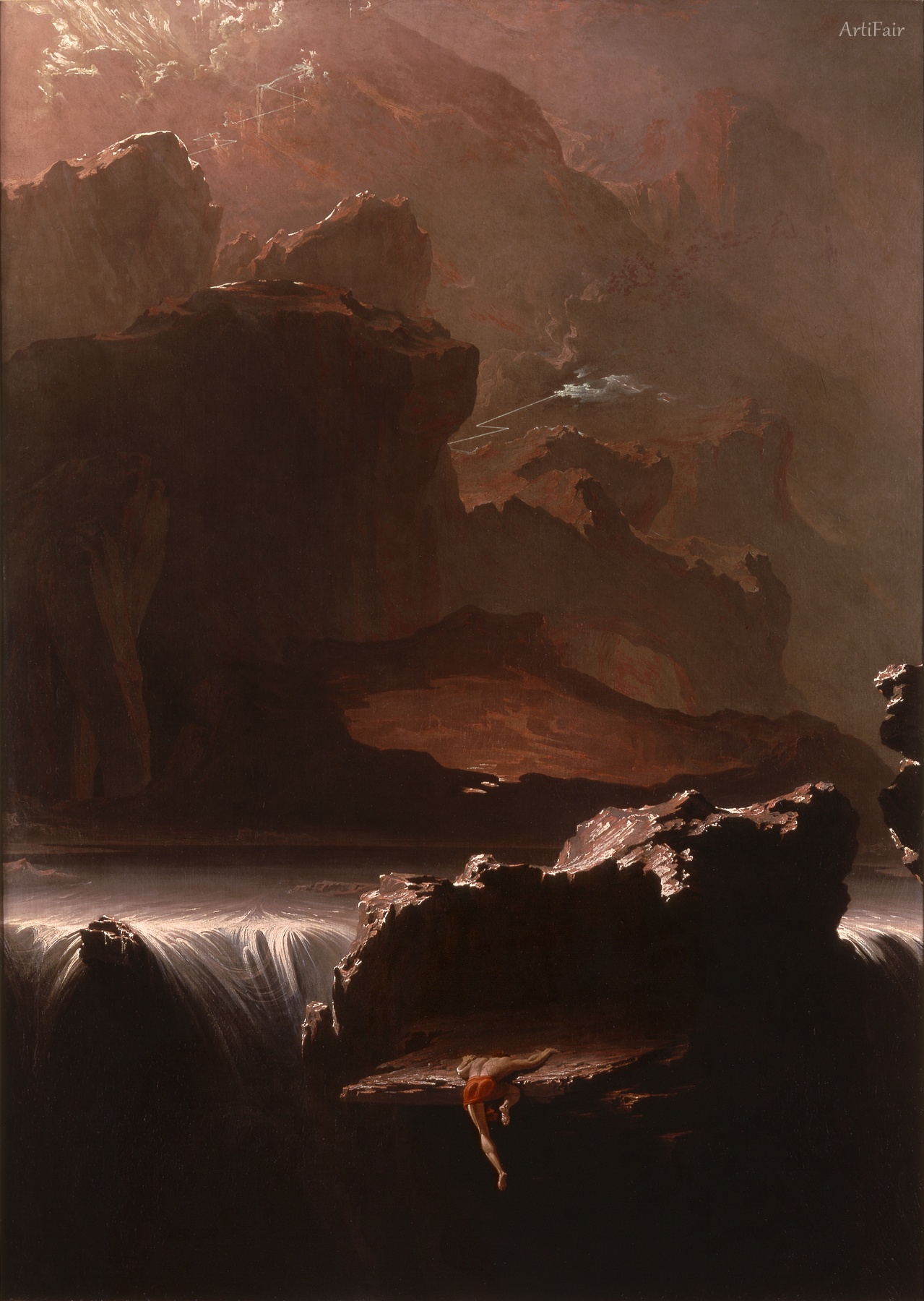
Sadak in Search of the Waters of Oblivion
Category:
Created:
1812
Likes:
3
Dimensions:
Download:
New users get 4 free credits. 2K costs 1 credit; 4K and Ultra HD are priced by resolution. Public domain artworks can be used commercially.
Dominant colors
Public domain download summary
This artwork is provided as a public domain image resource. The 2K file costs 1 credit for everyday creative work, while 4K and Ultra HD files are priced by resolution.
Art Appreciation
Sadak in Search of the Waters of Oblivion is an oil painting on canvas by John Martin, made in 1812 and acquired by the Saint Louis Art Museum in 1983 through its Friends Endowment Fund.
The subject comes from James Ridley's Tales of the Genii, published in 1764 as if translated from a Persian manuscript but in fact Ridley's own invention. Sadak, a Persian nobleman, is sent by the Sultan Amurath to fetch the memory-erasing waters of oblivion, which the Sultan secretly means to use on Sadak's wife Kalasrade, whom he has abducted. After a storm at sea, plague, evil genii and an underground whirlpool, Sadak reaches his goal, and in the end the Sultan himself falls victim to the waters. The tale was popular enough to be staged as a play in 1797 and as an opera in 1814.
Martin shows the tiny, half-naked hero hauling himself onto a ledge beside a pool and falling water at the foot of the canvas, while jagged cliffs rise and recede above him into a lurid sky. Rays of light break in at upper left, which the museum reads as a sign that Sadak will reach his goal. The contrast between the struggling figure and the overwhelming landscape became central to Martin's art, and this was the first of the large, dramatic pictures that defined his style.
Martin, who had given up a job as a glass painter in a china factory paying £2 a week, later said he finished the canvas in a month, and recalled his despair on hearing the framers argue over which way up it went. Shown at the Royal Academy in Somerset House in 1812, it was a popular success and established his reputation; William Manning, a governor of the Bank of England, bought it for fifty guineas. It was engraved in 1828. For many years only a reduced version in Southampton City Art Gallery was known, until the full-size original was rediscovered in Sweden. The canvas measures 183.2 by 131.1 cm.