
Jason and Medea
Category:
Created:
1907
Likes:
1
Dimensions:
Download:
New users get 4 free credits. 2K costs 1 credit; 4K and Ultra HD are priced by resolution. Public domain artworks can be used commercially.
Dominant colors
Public domain download summary
This artwork is provided as a public domain image resource. The 2K file costs 1 credit for everyday creative work, while 4K and Ultra HD files are priced by resolution.
Art Appreciation
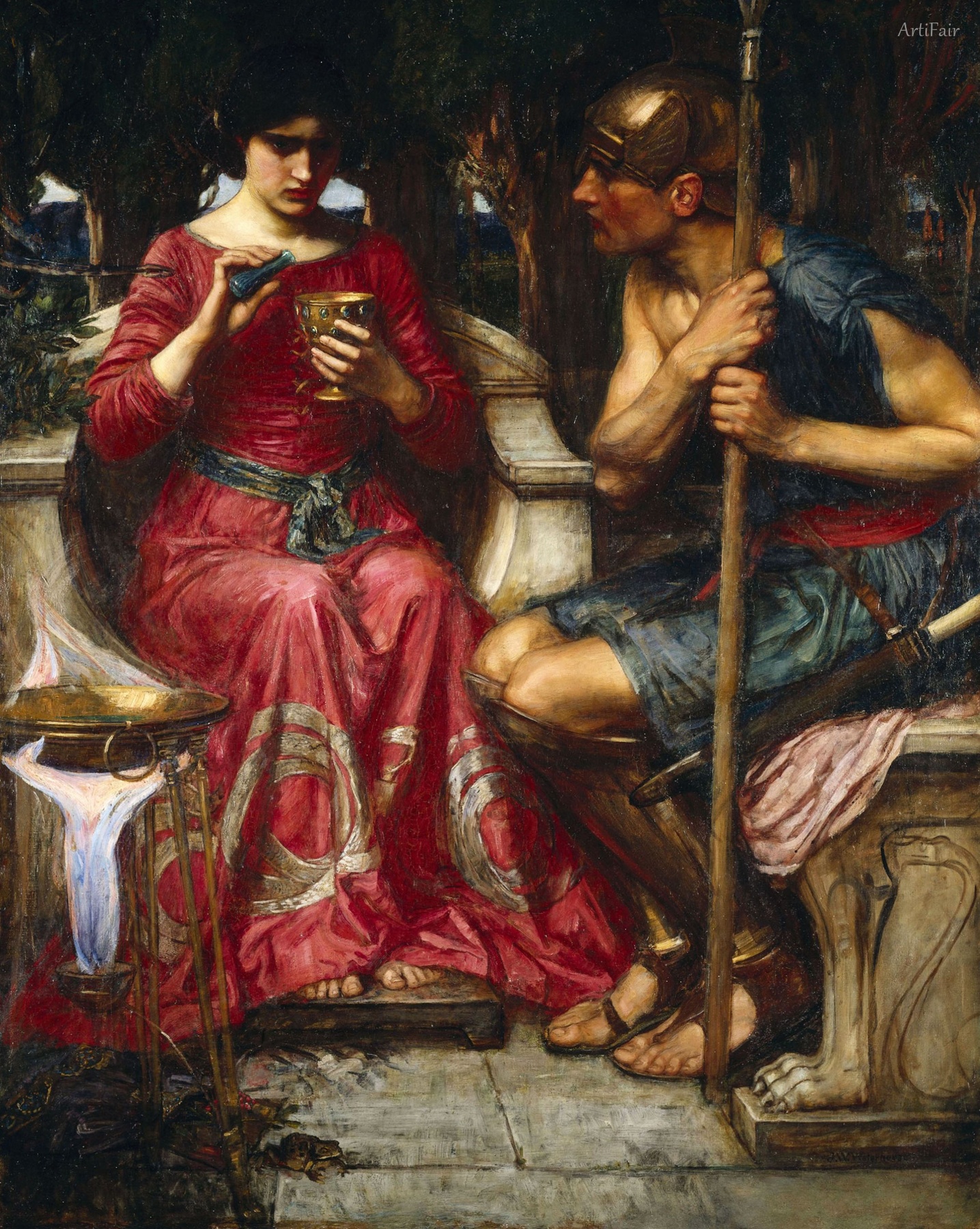
Jason and Medea is an oil painting on canvas by John William Waterhouse, dated 1907 and now in a private collection; it measures 134 by 107 cm.
The subject comes from the Greek legend of the Argonauts. Jason sailed to Colchis to win the Golden Fleece, but King Aeëtes set him tasks meant to be impossible: to yoke fire-breathing bulls, plough a field and sow it with dragon's teeth. The king's daughter Medea, a sorceress who had fallen in love with the hero, prepared the magic that let him succeed, and the potion in this picture has been described as the one meant for the dragon that guarded the fleece. The scene belongs to the beginning of their story, long before the betrayal and murders dramatised in Euripides' tragedy Medea.
The two figures sit on stone benches in a small courtyard screened by trees. Medea, in a red dress whose skirt carries large circular motifs that mark her as a sorceress, tips a small blue-green vial into a gold cup with an absorbed, serious expression, while ingredients heat over a flame on a tripod stand beside her. Jason, in a gold helmet and blue tunic, leans on a spear whose tip runs out of the frame and watches her anxiously. A toad sits near the foot of the stand. Writers have compared the picture, in theme and look, with Waterhouse's The Magic Circle of 1886, another image of a woman working magic beside a fire.
Waterhouse made preparatory studies for the composition. A pencil sheet sold at Christie's, measuring 26 by 17.8 cm, carries a bust-length study of a woman on one side and a study for Jason and Medea on the other. The finished canvas belongs to the late part of Waterhouse's career; he died in London ten years later, in 1917.