
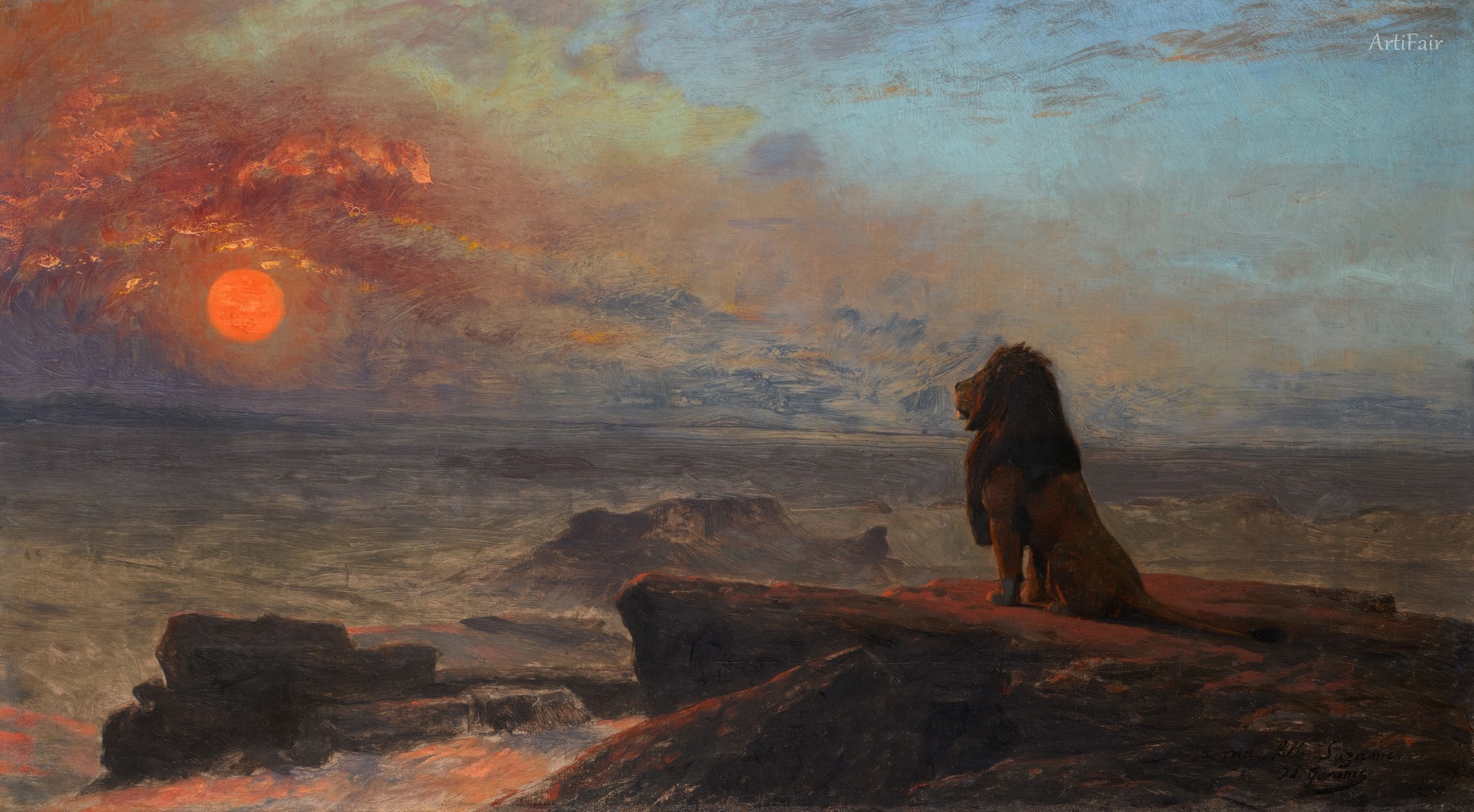
The Two Majesties
Category:
Created:
Date unknown
Likes:
0
Dimensions:
Download:
New users get 4 free credits. 2K costs 1 credit; 4K and Ultra HD are priced by resolution. Public domain artworks can be used commercially.
Dominant colors
Public domain download summary
This artwork is provided as a public domain image resource. The 2K file costs 1 credit for everyday creative work, while 4K and Ultra HD files are priced by resolution.
Art Appreciation
This version of The Two Majesties (Les Deux Majestés) is a small oil sketch on canvas, 25 × 44 cm, by Jean-Léon Gérôme, related to his finished painting of 1883 in the Milwaukee Art Museum; it is inscribed lower right 'A ma fille Suzanne / JL Gérôme'.
The finished picture, 69.22 × 128.91 cm, shows a lion on a rocky height gazing across empty country at the setting sun; the title pairs the king of beasts with the sun. It belongs to the series of lion pictures Gérôme began in the 1880s, drawing on his studies of big cats at the Jardin des Plantes menagerie in Paris. Edward P. Allis of Milwaukee bought it in 1888, and his son Louis Allis gave it to the museum in 1968. In her catalogue note for this sketch, the art historian Emily M. Weeks records one further, much larger sketch (Ackerman no. 322.2) and many variations and copies, and argues that the subject, setting and even the title closely follow a painting by the German artist Otto Friedrich Georgi.
In the sketch the composition is reduced to its essentials: broad, rapid strokes, a sky of smouldering reds around the sun at left, and the seated lion as the one upright form on the rocks at right. Gerald Ackerman, author of Gérôme's catalogue raisonné, read the subject as Napoleon facing exile; other writers have seen the lion as a stand-in for the painter, whose name contains 'Léon'. Gérôme himself mocked such theorising: in a story printed in The Century in 1889, he told a critic who asked what the picture proved that it proved he was an idiot.
Gérôme gave the sketch to his daughter Suzanne around 1900. In 1904, the year of the painter's death, it was bought by the photographer Nadar; it then passed to his assistant Jules Bourgeois, who gave it in 1910 to his goddaughter Angèle Saverse, and descended in her family in south-west France. Weeks has authenticated it for her revision of the catalogue raisonné.