
The Death of Sardanapalus
Category:
Created:
1827
Likes:
2
Dimensions:
Download:
New users get 4 free credits. 2K costs 1 credit; 4K and Ultra HD are priced by resolution. Public domain artworks can be used commercially.
Dominant colors
Public domain download summary
This artwork is provided as a public domain image resource. The 2K file costs 1 credit for everyday creative work, while 4K and Ultra HD files are priced by resolution.
Art Appreciation
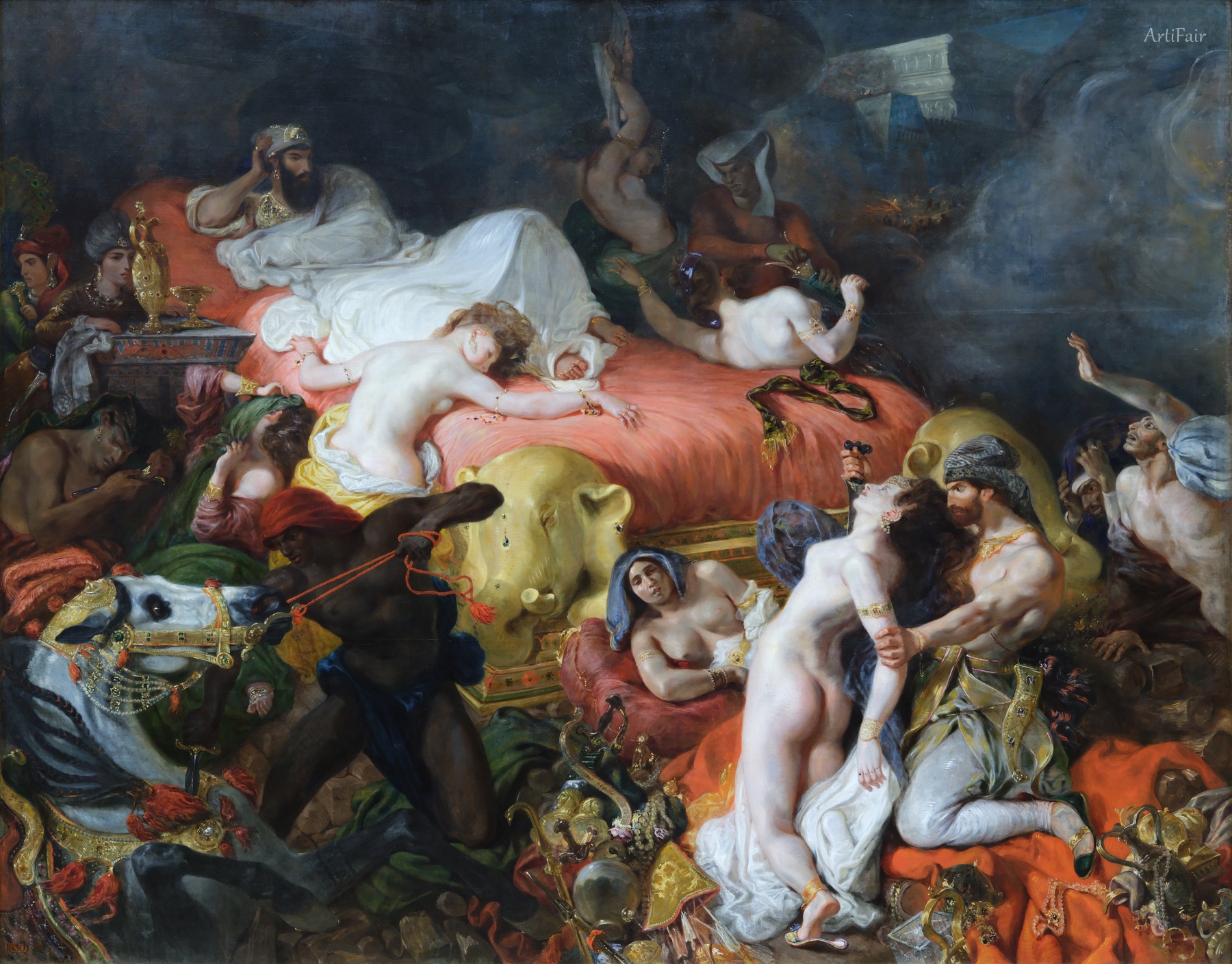
The Death of Sardanapalus (La Mort de Sardanapale) is an oil painting on canvas by Eugène Delacroix, made in 1827 and now in the Musée du Louvre, Paris (RF 2346); it measures 392 × 496 cm.
The subject is the legendary last king of Assyria, who, besieged in his palace by rebels and facing certain defeat, chose to die on a vast pyre together with his treasure. Lord Byron's drama Sardanapalus of 1821, translated into French the following year, gave Delacroix the figure of Myrrha, the favourite who lies across the foot of the bed; the slaughter of women, horses and riches comes rather from the ancient account preserved by Diodorus Siculus. In the Salon booklet Delacroix explained that the king, lying on a superb bed atop the pyre, orders his slaves and officers to kill his women, pages, horses and favourite dogs, so that nothing that had served his pleasures should survive him.
The king watches from the upper left, detached, while murder fills the canvas around a huge bed draped in red. The composition has no central hero and no stable pyramid; figures tumble towards the viewer, and red, gold and pale flesh carry the eye from corner to corner. Shown at the Salon of 1827 opposite Ingres's Apotheosis of Homer, the picture was received even worse than the Massacre at Chios three years earlier: one critic called it the fanaticism of ugliness, and the state did not buy it. Baudelaire later praised it warmly. Linda Nochlin has argued that contemporaries read it as Delacroix's own destructive sexual fantasy.
Delacroix sold the painting in 1846, and a smaller replica of 1844 is in the Philadelphia Museum of Art. The large canvas then fell into near-oblivion until the Louvre bought it from Baron Vitta in 1921; the museum also owns the oil sketch. A restoration from October 2022 to July 2023 removed thick layers of old varnish.