
Tahitian Women on the Beach
Category:
Created:
1891
Likes:
0
Dimensions:
Download:
New users get 4 free credits. 2K costs 1 credit; 4K and Ultra HD are priced by resolution. Public domain artworks can be used commercially.
Dominant colors
Public domain download summary
This artwork is provided as a public domain image resource. The 2K file costs 1 credit for everyday creative work, while 4K and Ultra HD files are priced by resolution.
Art Appreciation
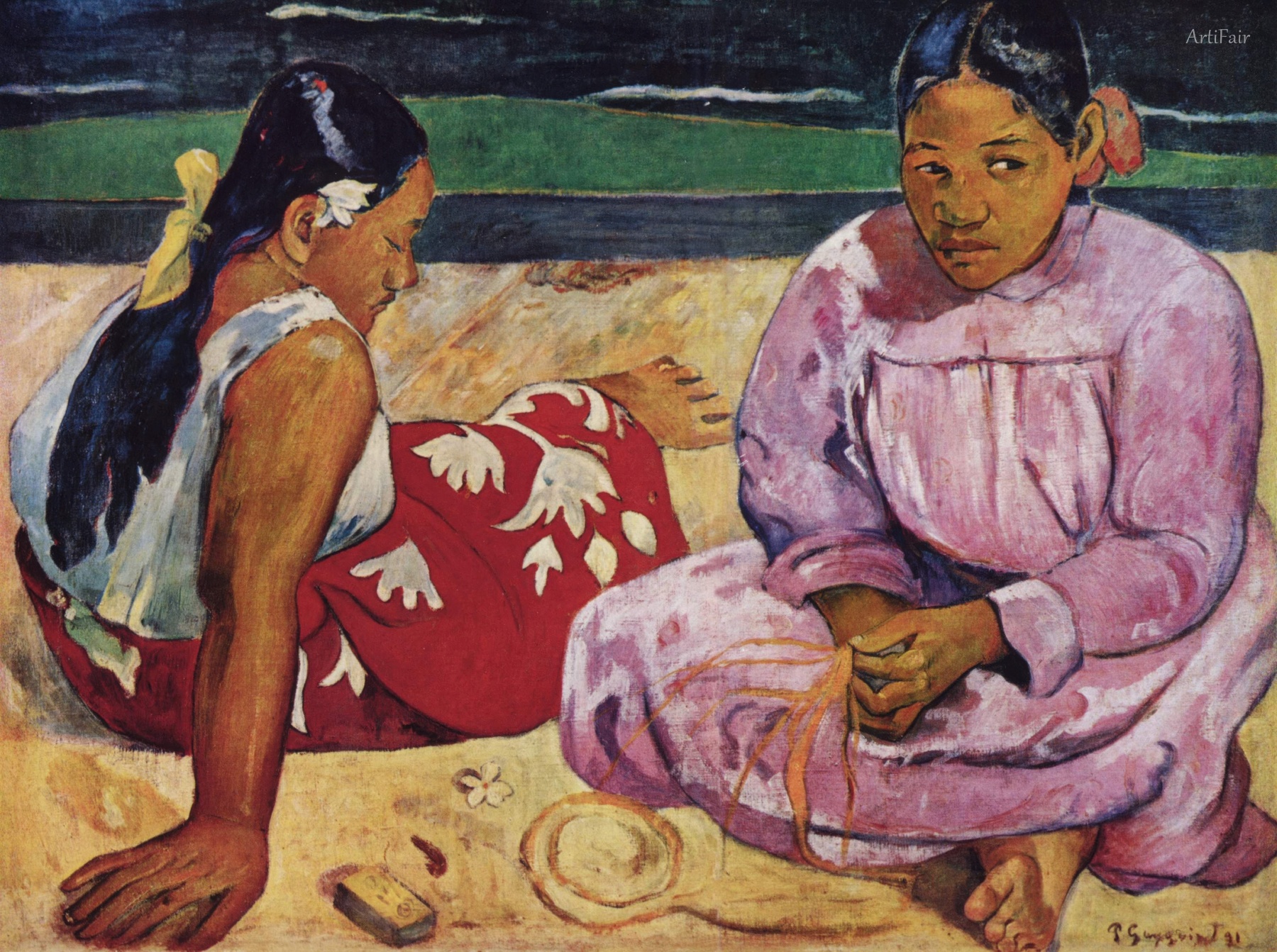
Tahitian Women on the Beach (Femmes de Tahiti, also called Sur la plage) is an oil on canvas painted by Paul Gauguin in November–December 1891, during his first stay in Tahiti; it measures 69 × 91.5 cm and is in the Musée d'Orsay, Paris.
Gauguin sailed for Tahiti in 1891 imagining a primitive paradise where, in his words, he could live in ecstasy, calm and art, free of the European scramble for money. His first months there produced many canvases of Tahitian women at simple daily occupations. Here, however, the two figures do nothing in particular. The woman at the left, seen from behind, wears a pareu, while the one at the right sits cross-legged in a high-necked pink mission dress, a reminder of the colonial and missionary presence on the island, idly working a strand of fibre.
The Orsay describes the heavy, hieratic figures as each occupying its own space, their faces reduced to a mask and a profile marked by melancholy, so that the work reads more as a genre scene than a double portrait. A small, almost monochrome still life lies in the foreground, and a few touches of white suggest breakers on the lagoon behind. Some historians have questioned whether the setting is a beach at all, since the bands of colour could be read as architecture. The simplified outlines have been linked to Manet, whom Gauguin admired, and the strong colour is seen as anticipating Matisse.
Gauguin thought the composition important enough to repeat it in 1892 as Parau Api (Dresden, Staatliche Kunstsammlungen), where a flowered pareu replaces the mission dress. The canvas is signed and dated 'P. Gauguin 91' at lower right. Gauguin gave it to a Captain Arnaud in Tahiti, whose daughter kept it until 1920; after passing through the collection of Vicomte Guy de Cholet, it was given to the national museums in 1923. It hung in the Musée du Luxembourg, the Louvre and the Jeu de Paume before moving to the Musée d'Orsay in 1986.