
The Ruling Passion
Category:
Created:
1885
Likes:
0
Dimensions:
Download:
New users get 4 free credits. 2K costs 1 credit; 4K and Ultra HD are priced by resolution. Public domain artworks can be used commercially.
Dominant colors
Public domain download summary
This artwork is provided as a public domain image resource. The 2K file costs 1 credit for everyday creative work, while 4K and Ultra HD files are priced by resolution.
Art Appreciation
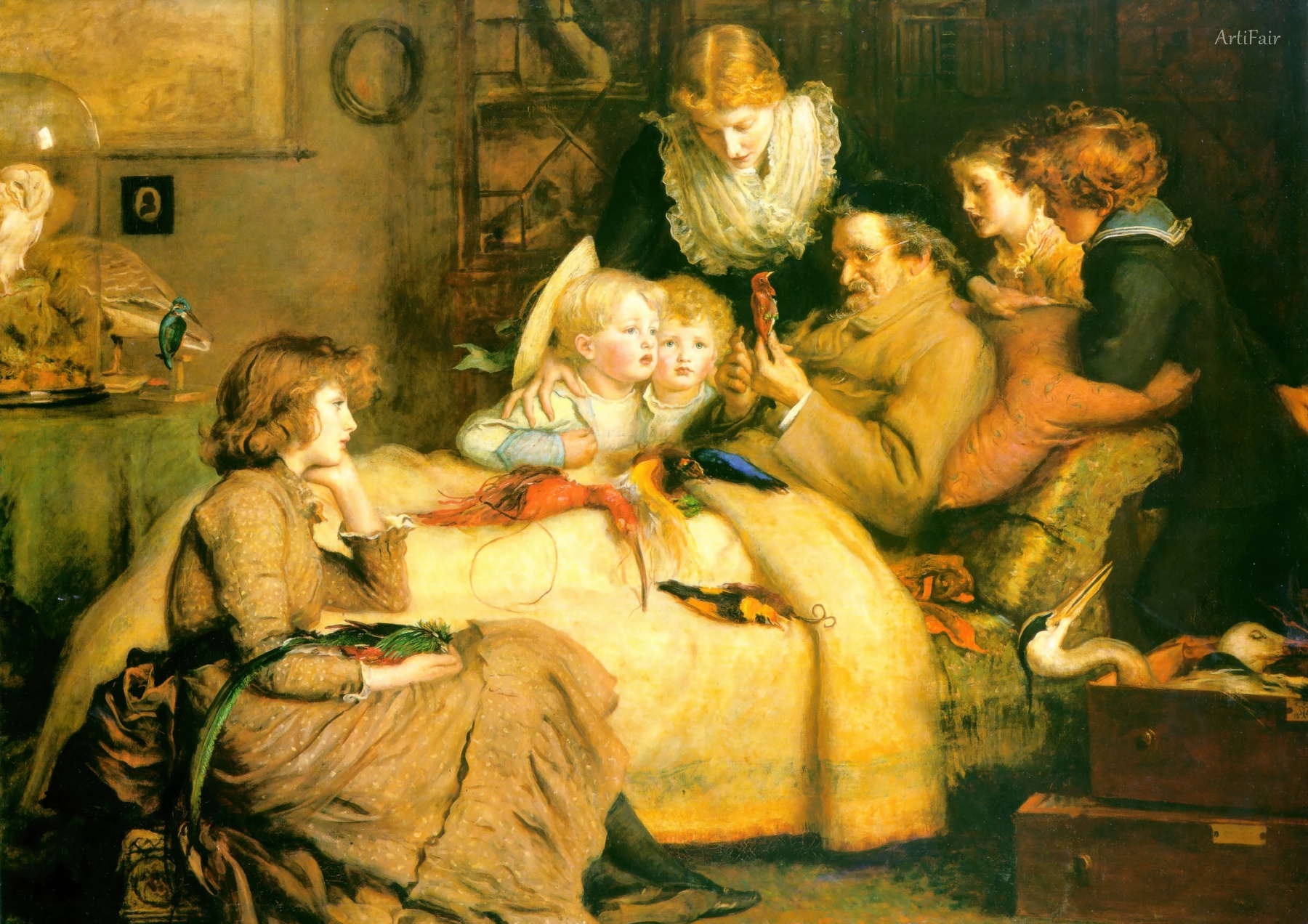
The Ruling Passion, also known as The Ornithologist, is an oil painting on canvas by John Everett Millais, shown at the Royal Academy in 1885 and owned since 1907 by Glasgow Museums, where it hangs in the Kelvingrove Art Gallery and Museum.
The idea came from a winter visit that Millais and his son John Guille Millais paid to the ornithologist and illustrator John Gould, then an ailing invalid, shortly before Gould's death in 1881. Gould called his daughters to help show off his latest specimens, and on the way home Millais told his son that it was a very fine subject which he would paint when he had time. He began the picture only in the early spring of 1885 and finished it for that year's Academy exhibition.
The finished work is not a portrait of Gould. An elderly man lies on a couch holding up a stuffed bird, identified as a king bird of paradise, for a group of children and a young woman, while a girl in the foreground holds a resplendent quetzal and other specimens lie about the room. The youngest children look on spellbound and the oldest girl seems almost bored. According to the son's biography, Millais's old friend the engraver Thomas Oldham Barlow sat for the main figure; the two small boys were the artist's grandsons William, the model for Bubbles, and George; the boy in the sailor suit was Ivor Byng; the woman and the girl at left were professional models. The bookcase came from the family house and all the birds from the son's own collection. After the exhibition Millais repainted the old man's pillow and blanket, whose colour had seemed crude.
John Ruskin named the picture as one of only three things worth looking at in the 1885 exhibition and called it the finest of its kind painted in modern times. Even so, the patron who had first wanted it declined to take it because it recalled a family death, and Millais wrote that he would not trouble the public again with an 'important picture'. The canvas measures 160.7 by 215.9 cm.