
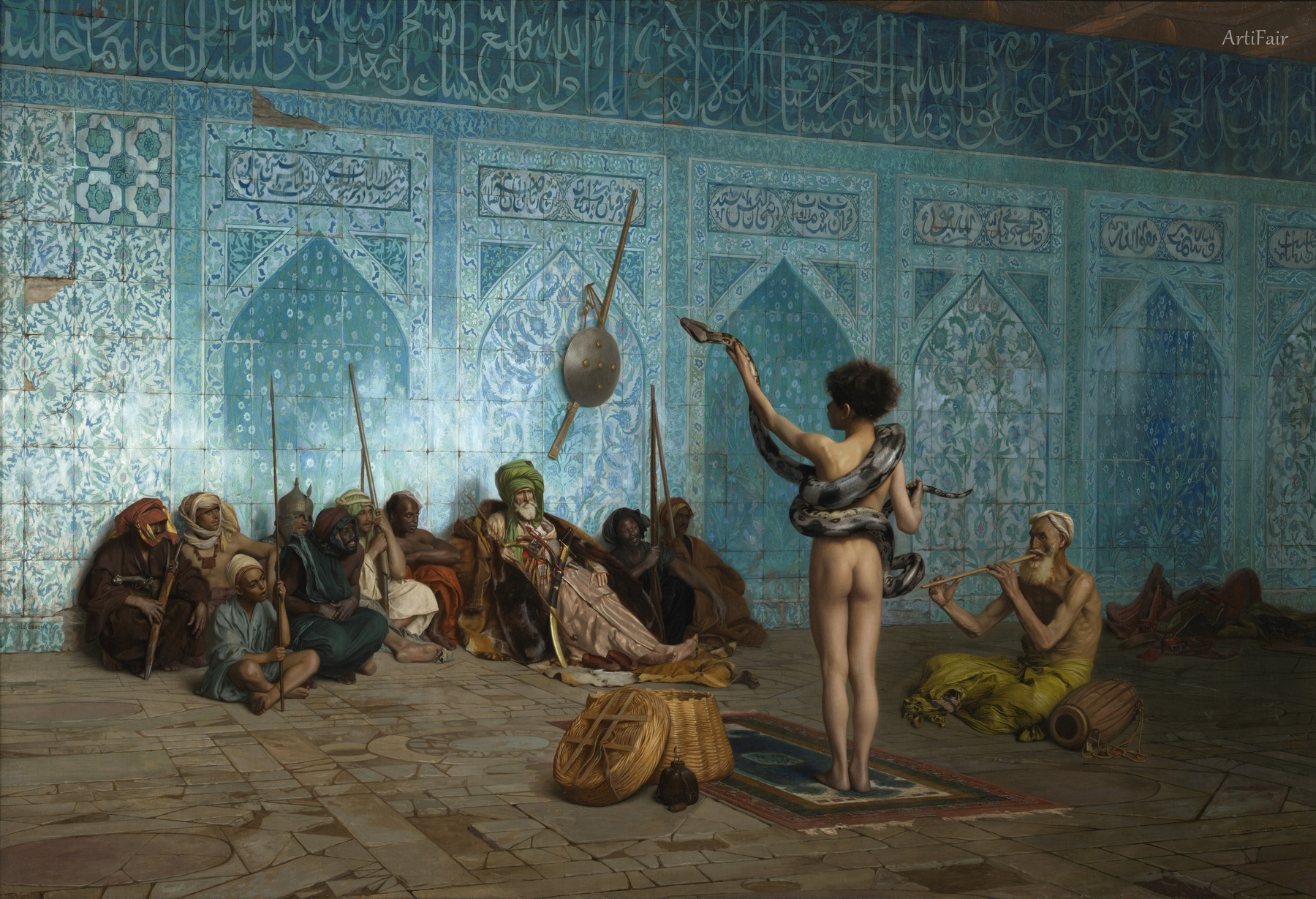
The Snake Charmer
Category:
Created:
1879
Likes:
0
Dimensions:
Download:
New users get 4 free credits. 2K costs 1 credit; 4K and Ultra HD are priced by resolution. Public domain artworks can be used commercially.
Dominant colors
Public domain download summary
This artwork is provided as a public domain image resource. The 2K file costs 1 credit for everyday creative work, while 4K and Ultra HD files are priced by resolution.
Art Appreciation
The Snake Charmer is an oil painting on canvas by Jean-Léon Gérôme, made around 1879 and in the collection of the Clark Art Institute, Williamstown, Massachusetts (1955.51); it has more recently been lent to the Metropolitan Museum of Art in New York.
A naked boy stands on a small carpet with his back to the viewer while a large snake coils around his waist and over his shoulder; an older man sitting at the right plays a flute. Against the wall a group of armed men in varied dress watch in a kind of daze. The Clark describes the scene as a European fantasy assembled from real places: the tiled wall was inspired by Istanbul's Topkapı Palace, and the stone floor resembles that of the Mosque of Amr in Cairo. In her catalogue essay Sarah Lees notes that snake charming belonged to Egypt rather than Ottoman culture, and that Maxime Du Camp described a Cairo charmer who undressed to rule out any suspicion of fraud. The upper frieze is legible as verse 256 of the Qur'an's second sura, and a herpetologist has suggested the snake looks most like a South American boa constrictor.
The canvas, 82.2 × 121 cm, was sold by Gérôme to his dealer Goupil in August 1880 and resold that October to the New York collector Albert Spencer. Alfred Corning Clark bought it at Spencer's sale in 1888; his widow lent it to the Metropolitan Museum in 1897–1898 before selling it. After passing to August Heckscher, it was bought in 1942 by Clark's son Robert Sterling Clark for just $500, a measure of how far Gérôme's reputation had fallen.
In 1978 the painting appeared on the cover of Edward Said's Orientalism, although Said does not discuss it, and the picture became a focus of debate about Orientalist art. Linda Nochlin's 1983 essay The Imaginary Orient called it a visual document of nineteenth-century colonialist ideology.