
The New House
Category:
Created:
1925
Likes:
0
Dimensions:
Download:
New users get 4 free credits. 2K costs 1 credit; 4K and Ultra HD are priced by resolution. Public domain artworks can be used commercially.
Dominant colors
Public domain download summary
This artwork is provided as a public domain image resource. The 2K file costs 1 credit for everyday creative work, while 4K and Ultra HD files are priced by resolution.
Art Appreciation
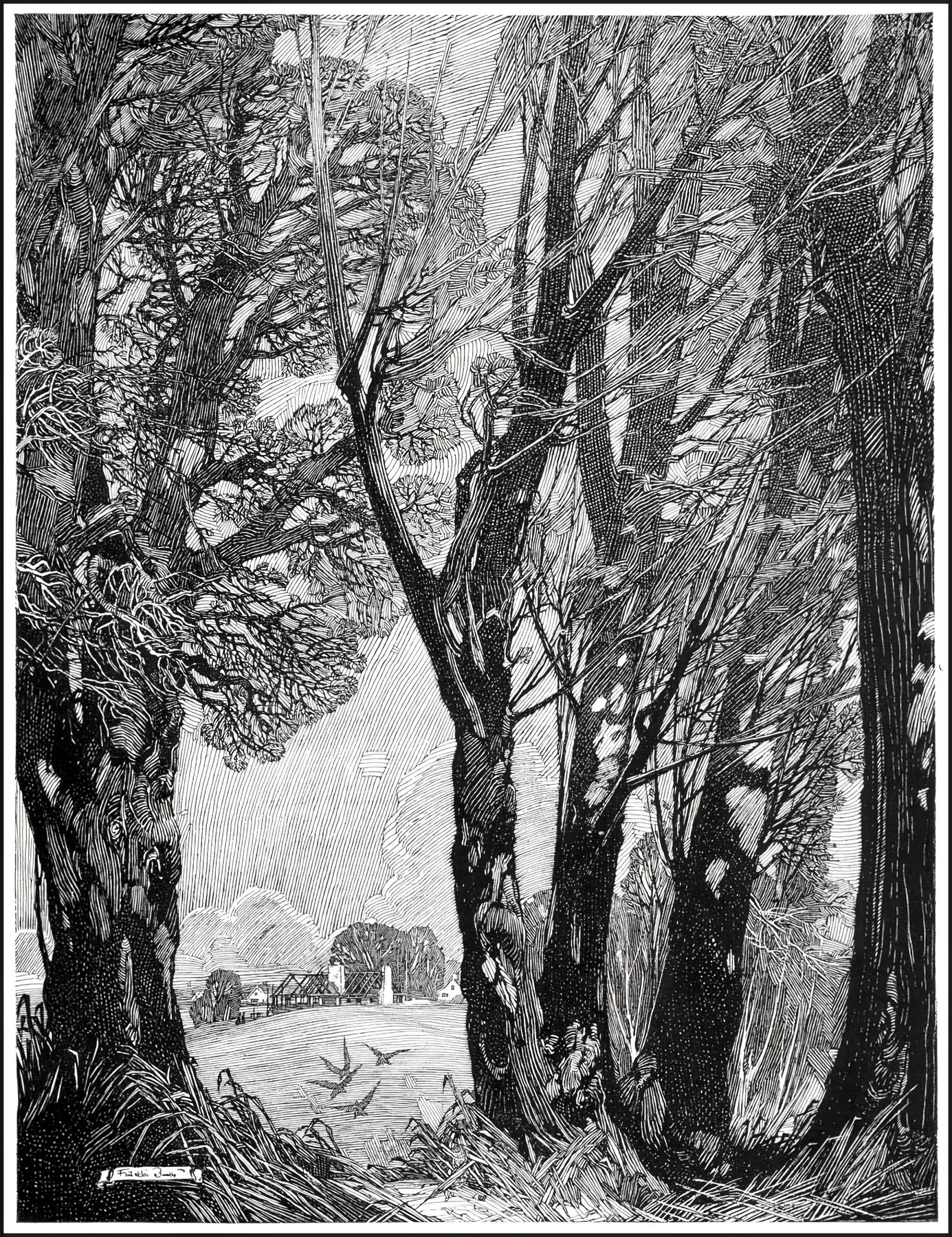
The New House is a pen-and-ink drawing by the American illustrator Franklin Booth, made to illustrate a poem in Good Housekeeping magazine and reproduced in 1925 in Franklin Booth: Sixty Reproductions from Original Drawings, published in New York by Robert Frank.
Booth (1874–1948) grew up on a farm near Carmel, Indiana, and taught himself largely by copying the illustrations in Scribner's and Harper's. He took them for pen drawings, but they were in fact wood engravings, and imitating them led him to a manner built from thousands of fine parallel lines whose spacing controls tone. From 1907 onward, through the first third of the twentieth century, his drawings appeared in Scribner's, Harper's, Good Housekeeping, Collier's and other magazines, and he worked for advertisers such as the Estey Organ Company. Typical features of his work are gnarled trees and forests looming over small figures or buildings, and the decorative scroll that carries his signature.
This sheet shows those traits clearly. Tall trees fill almost the whole page, their trunks and leaf masses described in dense, closely controlled hatching, while a pale field opens in the lower centre. On a knoll beyond it stands the house of the title, still only a timber frame; the dealer and illustration specialist bpibooks points out that the fine lines of the clouds can be read through its open rafters, an example of how Booth kept a crowded drawing legible. A few birds wheel above the field, and the signature scroll sits in the grass at lower left. According to the same source, Booth pencilled and inked his drawings one section at a time to avoid smudging, which makes the even density of line across the sheet all the more remarkable.
In the 1925 book the plate is listed among the poem illustrations made for Good Housekeeping, with the original drawing measuring a little over 11 by 16 inches. The volume carried an appreciation by the advertising writer Ernest Elmo Calkins and an introduction by the Indiana novelist Meredith Nicholson. The drawing was later reproduced again in The Indiana Home.