
The Night Café
Category:
Created:
1888
Likes:
0
Dimensions:
Download:
New users get 4 free credits. 2K costs 1 credit; 4K and Ultra HD are priced by resolution. Public domain artworks can be used commercially.
Dominant colors
Public domain download summary
This artwork is provided as a public domain image resource. The 2K file costs 1 credit for everyday creative work, while 4K and Ultra HD files are priced by resolution.
Art Appreciation
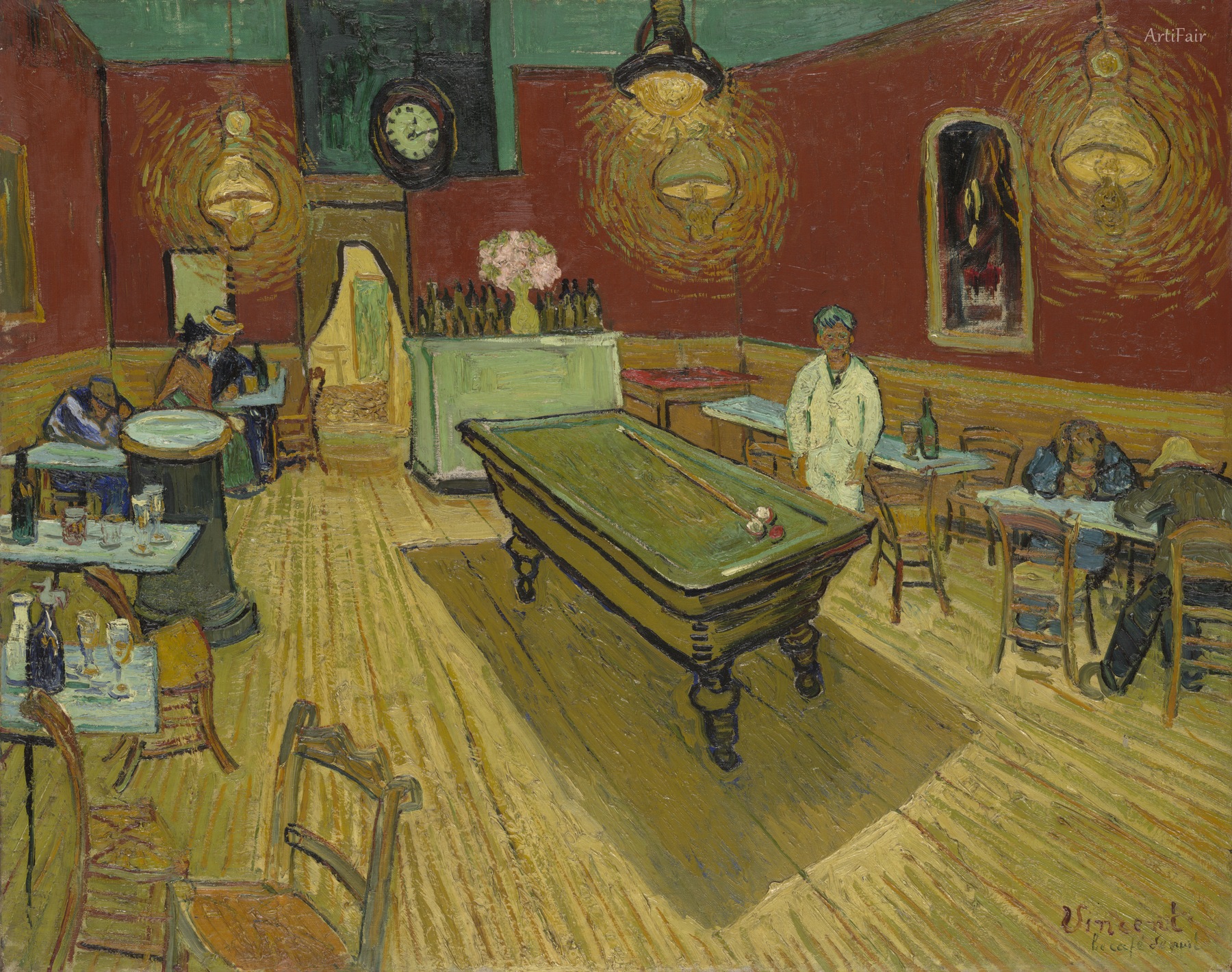
The Night Café (Le café de nuit) is an oil painting on canvas by Vincent van Gogh, made in Arles in September 1888 and now in the Yale University Art Gallery, New Haven. It measures 72.4 × 92.1 cm.
The room is the Café de la Gare on Place Lamartine, an all-night establishment run by Joseph-Michel Ginoux and his wife Marie, where Van Gogh had a room and often took his meals. In August he told his brother Theo that he meant to paint the interior by gaslight, explaining that such cafés stayed open all night and that night prowlers took refuge there when they had no money for lodging or were too drunk to be taken in. In early September he sat up for three nights running to paint it, sleeping during the day. Unusually, he gave the picture a title, written beneath his signature at lower right.
Van Gogh wrote about this canvas with particular conviction. He said he had tried to express the terrible passions of humanity by means of red and green: a blood-red and dull yellow room, a green billiard table in the middle, four lemon-yellow lamps with an orange and green glow, and the landlord's white clothes turning lemon yellow or pale luminous green. The next day he added that he wanted to show the café as a place where one can ruin oneself, go mad or commit a crime, in an atmosphere like a devil's furnace of pale sulphur. He also called it one of the ugliest pictures he had done, and the equivalent, though different, of The Potato Eaters. The steep perspective pulls the eye past scattered tables and a few slumped customers towards a curtained doorway at the back.
Van Gogh sent the painting to Theo in May 1889. Jo van Gogh-Bonger sold it to Bernheim-Jeune in 1907, and in 1908 it was bought by the Moscow collector Ivan Morozov. Nationalised in 1918, it was sold by the Soviet state and acquired in 1933 by Stephen Carlton Clark, who bequeathed it to Yale in 1961. A claim by Morozov's descendant Pierre Konowaloff was finally rejected when the US Supreme Court declined his appeal in 2016.