
Self-Portrait
Category:
Created:
1889
Likes:
0
Dimensions:
Download:
New users get 4 free credits. 2K costs 1 credit; 4K and Ultra HD are priced by resolution. Public domain artworks can be used commercially.
Dominant colors
Public domain download summary
This artwork is provided as a public domain image resource. The 2K file costs 1 credit for everyday creative work, while 4K and Ultra HD files are priced by resolution.
Art Appreciation
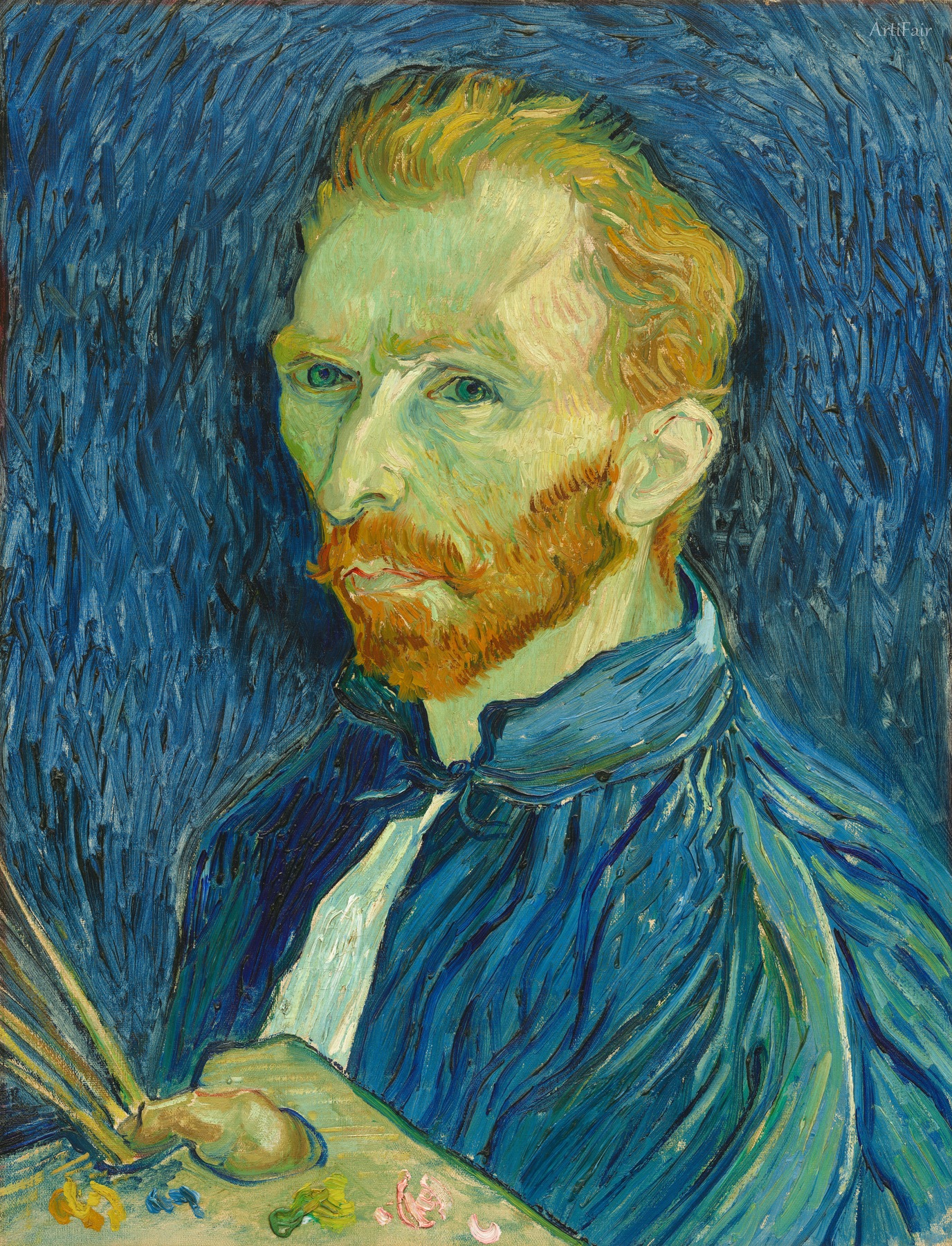
Self-Portrait (sometimes called Self-Portrait with Palette) is an oil-on-canvas painting by Vincent van Gogh, made in late summer 1889 at the asylum of Saint-Paul-de-Mausole in Saint-Rémy-de-Provence; it is in the National Gallery of Art, Washington.
Van Gogh painted about 36 self-portraits, beginning soon after he reached Paris in March 1886, and this is one of the very last. In early July 1889, while working in the fields near the asylum, he suffered a severe attack that left him unable to work for five weeks; afterwards he stayed in his studio and would not even go into the garden. According to the National Gallery, this canvas is the first thing he painted once he recovered. In a letter to his brother Theo in early September he wrote that he was working on two portraits of himself for want of another model, one begun on the day he got up, when he was thin and pale as a ghost, dark violet-blue with a whitish head and yellow hair.
He shows himself at work, in a painter's smock, with palette and brushes in hand, a guise he had used in two earlier self-portraits. The orange hair and beard set against the blue-violet smock and background sharpen the yellow-green, sallow tones of the gaunt face, and the agitated brushwork appears to have been laid down in a single sitting without later retouching. The companion self-portrait of the same weeks, now in the Musée d'Orsay, is calmer; Van Gogh nonetheless preferred the Washington picture as the one that showed his true character.
The canvas, 57.8 × 44.5 cm, belonged to Joseph Jacob Isaacson and then to Hugo Tutein Nolthenius of Delft, who lent it to an exhibition in Rotterdam in 1904. Sold through M. Knoedler & Co. to Mr and Mrs John Hay Whitney of New York in 1947, it came to the National Gallery in 1998 as part of Betsey Cushing Whitney's bequest.