
Paris and Helen
Category:
Created:
Date unknown
Likes:
1
Dimensions:
Download:
New users get 4 free credits. 2K costs 1 credit; 4K and Ultra HD are priced by resolution. Public domain artworks can be used commercially.
Dominant colors
Public domain download summary
This artwork is provided as a public domain image resource. The 2K file costs 1 credit for everyday creative work, while 4K and Ultra HD files are priced by resolution.
Art Appreciation
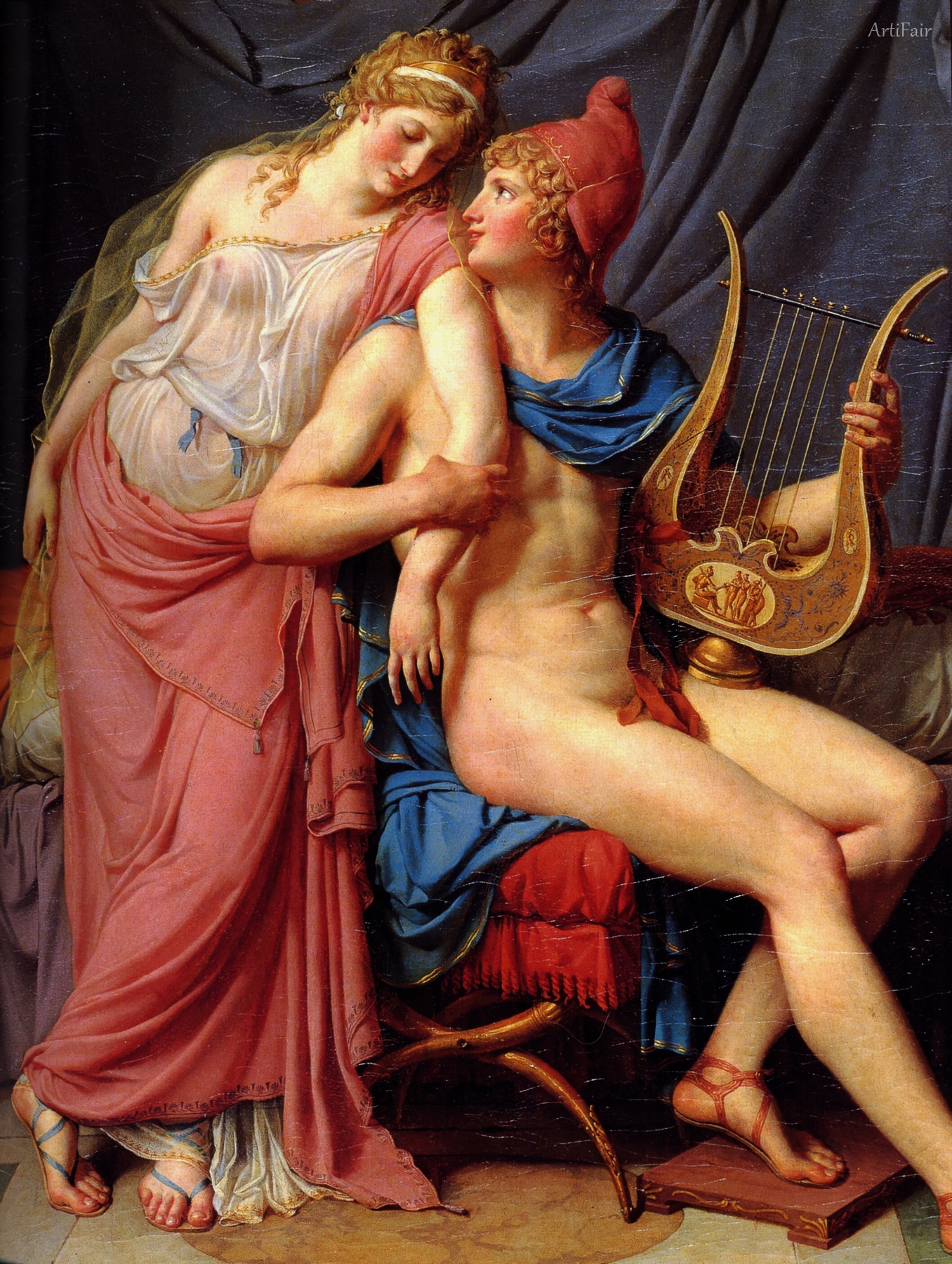
The Loves of Paris and Helen (Les Amours de Pâris et d'Hélène) is an oil-on-canvas painting by Jacques-Louis David, signed and dated 1788, measuring 1.46 × 1.81 m and held by the Louvre, Paris (INV 3696); our image shows a detail of the two lovers.
The picture was commissioned in 1785 or 1786 by Charles-Philippe, comte d'Artois, the king's younger brother and future Charles X, possibly for his bedroom at the Château de Bagatelle; François-André Vincent was asked for a pendant, Rinaldo and Armida, now lost. Coming between The Death of Socrates and the Brutus, it is one of David's rare works in the gallant mode, and it was interpreted at the time as a satire on the comte d'Artois's morals. Shown at the Salon of 1789, it was seized after its owner emigrated in July of that year and confiscated by the state as émigré property.
The subject comes from the third book of Homer's Iliad: Aphrodite has carried Paris off from his duel with Menelaus and brought him back to Helen in Troy. David sets the couple in a bedroom; Paris, nude except for a red Phrygian cap and holding a lyre, sits on a chair and looks up at Helen, who leans against him and lets him hold her arm. Reversing earlier treatments of the theme, David clothed Helen and left Paris nude. In the full canvas a statue of Aphrodite stands at left and four caryatids appear behind the drapery, copied from Jean Goujon's caryatids in the Louvre and reportedly painted by Jean-Baptiste Isabey. The Greek-style furniture was made by Georges Jacob, whose pieces David reused in the Brutus and the Portrait of Madame Récamier.
After the Revolution the painting stayed in state storage; it was shown at the Musée du Luxembourg from 1820 and moved to the Louvre in January 1826, shortly after David's death.