
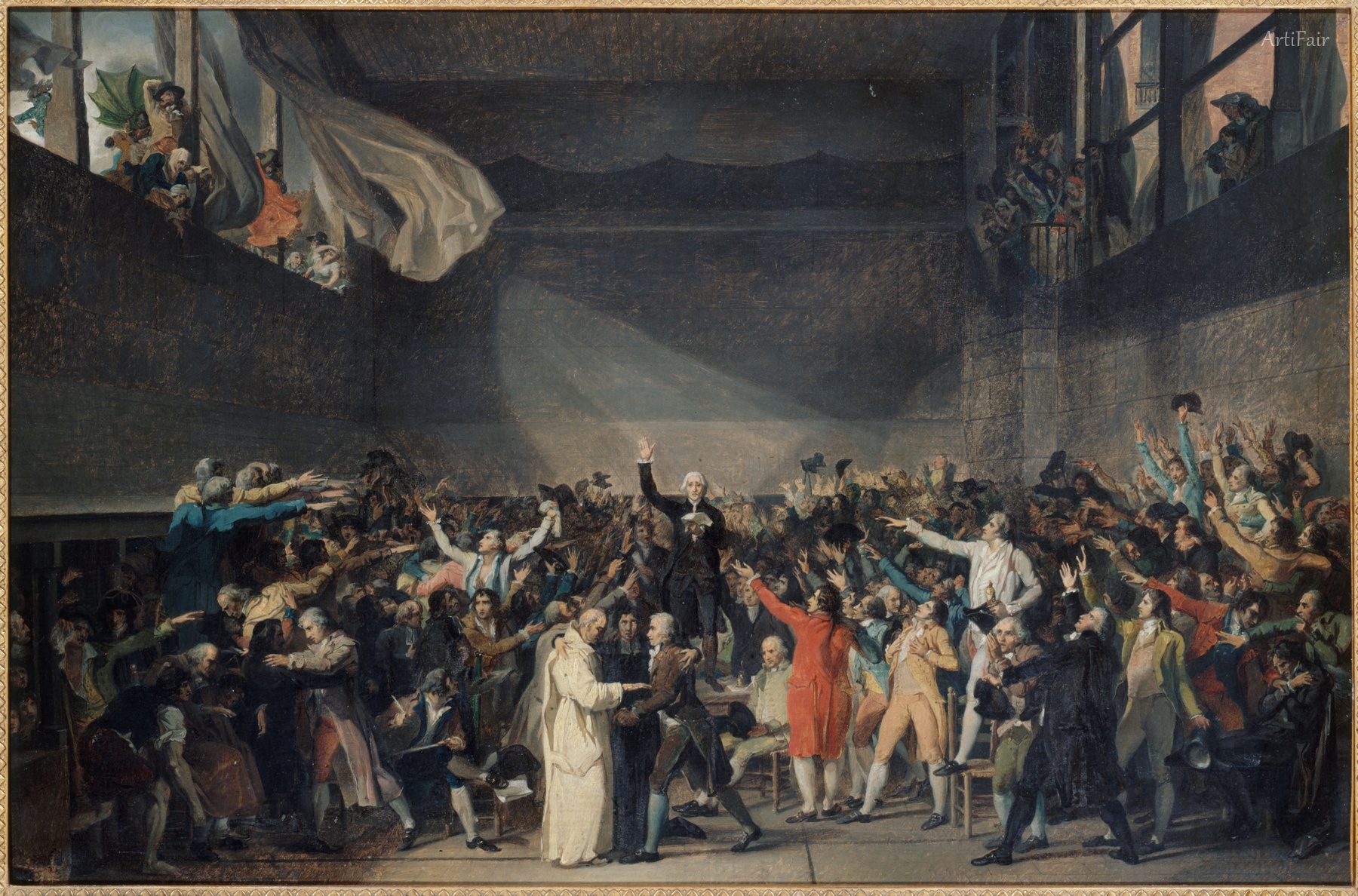
The Tennis Court Oath
Category:
Created:
1790
Likes:
0
Dimensions:
Download:
New users get 4 free credits. 2K costs 1 credit; 4K and Ultra HD are priced by resolution. Public domain artworks can be used commercially.
Dominant colors
Public domain download summary
This artwork is provided as a public domain image resource. The 2K file costs 1 credit for everyday creative work, while 4K and Ultra HD files are priced by resolution.
Art Appreciation
This Tennis Court Oath, 20 June 1789 is an oil on canvas after the composition by Jacques-Louis David, painted some time after 1791 and measuring 65 × 88.7 cm; it has belonged to the Musée Carnavalet, the museum of the history of Paris, since 1884 (P67). The museum lists David as author of the design rather than as the painter.
The event it shows took place at Versailles: locked out of their meeting hall, the deputies of the Third Estate, who had proclaimed themselves the National Assembly, gathered in an indoor tennis court nearby and took a collective oath, an event later seen as a founding moment of the Revolution. In 1790 David persuaded the Jacobin Club to launch a national subscription for a huge painting of the scene, and he showed a pen and ink drawing of his design at the Salon of 1791. The subscription raised too little, political events overtook the project, and the giant canvas, 400 × 660 cm, was left unfinished; it is now at Versailles.
The Carnavalet's notes identify the main figures. At the centre, standing on a table, Bailly takes the oath with raised hand, and all eyes turn towards him. In front of him three clerics embrace as a symbol of the union of the orders: the Carthusian Dom Gerle, the abbé Grégoire and the Protestant pastor Rabaut Saint-Étienne. Sieyès sits at the foot of the table, Barère writes at the left, and at the right Robespierre presses his hands to his chest beside Dubois-Crancé, with Mirabeau and Barnave in front. At the far right Martin Dauch, the one deputy who refused the oath, sits with arms folded. Spectators crowd the high windows, and the wind lifting the curtains has been read as the wind of revolution sweeping through France.