
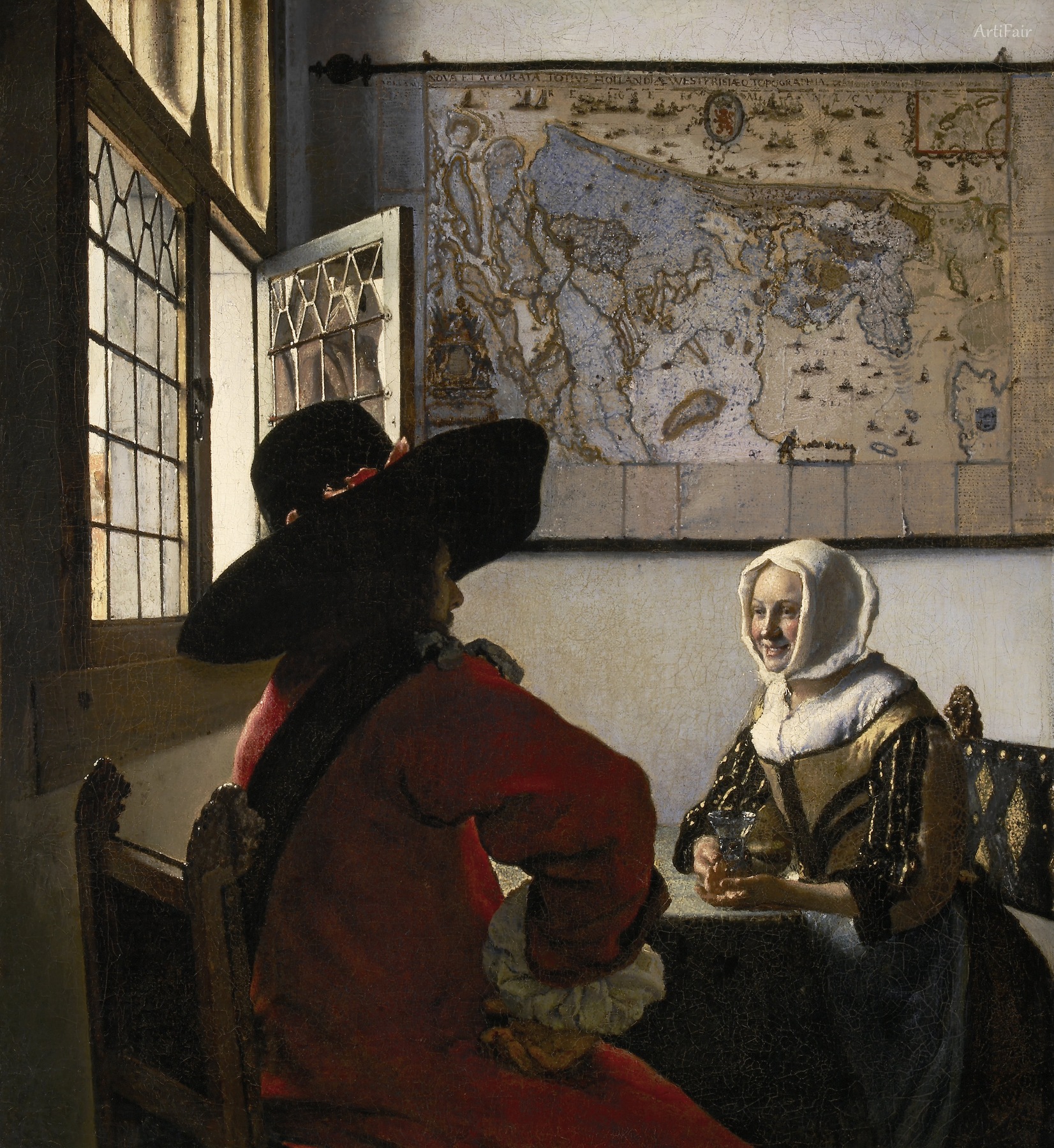
Officer and Laughing Girl
Category:
Created:
1657
Likes:
0
Dimensions:
Download:
New users get 4 free credits. 2K costs 1 credit; 4K and Ultra HD are priced by resolution. Public domain artworks can be used commercially.
Dominant colors
Public domain download summary
This artwork is provided as a public domain image resource. The 2K file costs 1 credit for everyday creative work, while 4K and Ultra HD files are priced by resolution.
Art Appreciation
Officer and Laughing Girl is an oil painting on canvas by Johannes Vermeer, made around 1657 and now in the Frick Collection, New York, which also owns his Girl Interrupted at Her Music and Mistress and Maid.
The small canvas, 50.5 × 46 cm, sets a cavalier and a young woman at a table beside an open window. The officer, his back to us in a red coat, black sash and wide-brimmed beaver hat, looms large in the foreground, a repoussoir device Vermeer probably learned from the Dutch followers of Caravaggio; art historians also see the influence of a painting by Gerard van Honthorst. The woman, lit full in the face, wears a yellow bodice and a blue apron and holds a wine glass in her open hand. X-rays show that Vermeer first gave her a large white collar and later extended her cap to cover her hair. Whether the scene shows honourable courtship or a hint of something less innocent is still debated.
On the wall hangs a map of Holland and West Friesland by Balthasar Florisz. van Berckenrode, published by Willem Blaeu in 1621, which Vermeer evidently owned since it appears in three of his paintings; Peter van der Krogt praised how exactly its design and geography are rendered. With Girl Reading a Letter at an Open Window, the picture contains the earliest known examples of the small dots of light, or pointillé, associated with Vermeer, and its sharp shifts of scale have fed speculation that he used a camera obscura, though there is no historical evidence for this.
The painting was sold in the Dissius sale in Amsterdam on 16 May 1696 for about 44 guilders. At a London sale in 1861 it was catalogued as a work by Pieter de Hooch; it later belonged to Léopold Double in Paris and to Prince Demidoff near Florence, and Henry Clay Frick bought it through Knoedler in 1911.