
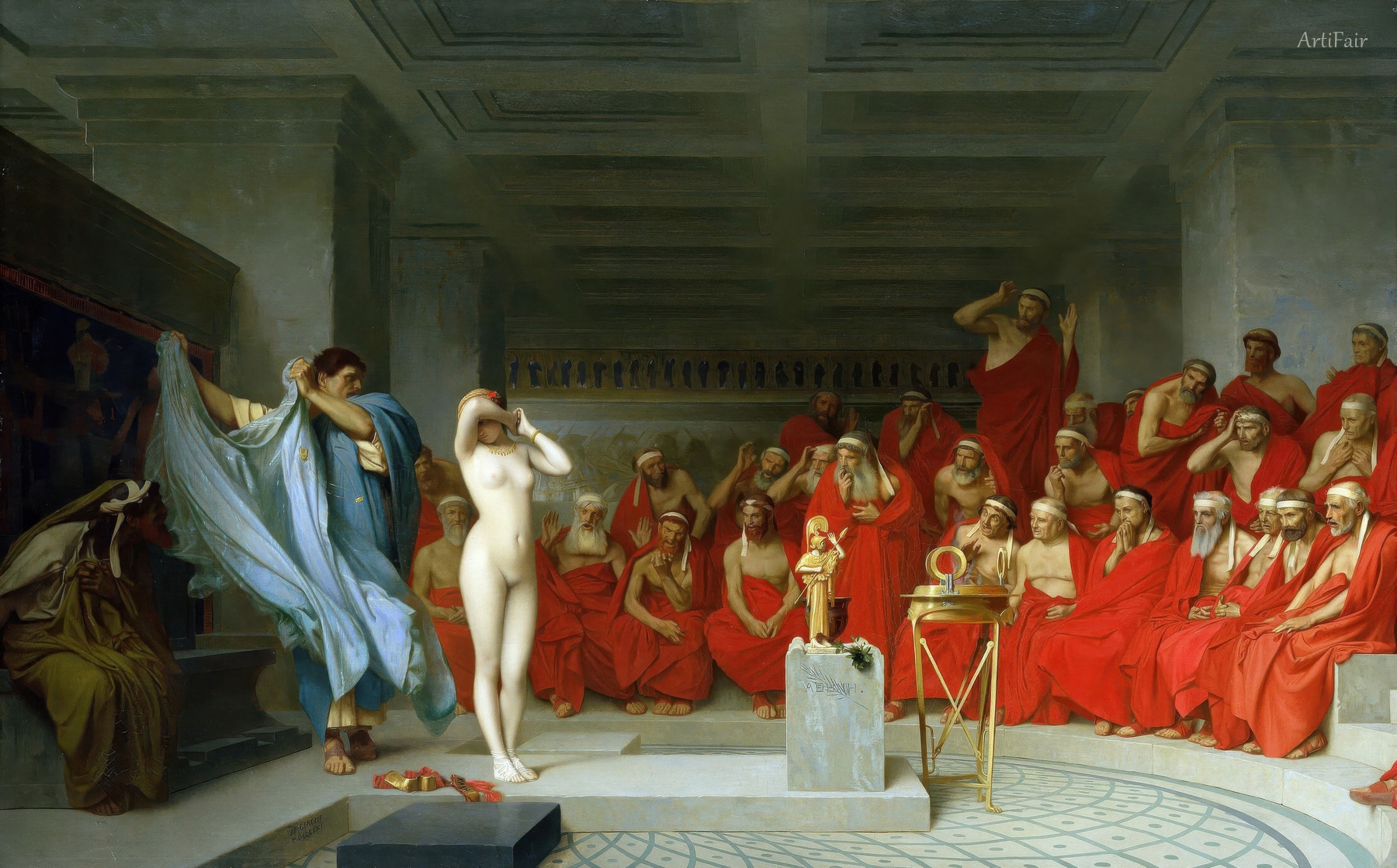
Phryne before the Areopagus
Category:
Created:
1861
Likes:
1
Dimensions:
Download:
New users get 4 free credits. 2K costs 1 credit; 4K and Ultra HD are priced by resolution. Public domain artworks can be used commercially.
Dominant colors
Public domain download summary
This artwork is provided as a public domain image resource. The 2K file costs 1 credit for everyday creative work, while 4K and Ultra HD files are priced by resolution.
Art Appreciation
Phryne before the Areopagus (Phryné devant l'Aréopage) is an oil painting on canvas by Jean-Léon Gérôme, signed and dated 1861, shown at the Paris Salon that year and now in the Hamburger Kunsthalle, Hamburg.
The subject is the trial of Phryne, a famous Athenian courtesan accused of impiety, reportedly for profaning the Eleusinian Mysteries. According to the story told by Athenaeus, when the verdict seemed to be going against her, her advocate Hypereides, said to be one of her lovers, pulled off her robe so that her beauty would move the judges, and she was acquitted. The ancient sources place the trial in the Heliaia rather than the Areopagus named in Gérôme's title. Phryne had been a popular theme in French art since the eighteenth century, and Gérôme's version followed recent treatments by his former teacher Charles Gleyre and by Victor Mottez.
The canvas, 80 × 128 cm, shows Phryne standing naked with her arms raised over her face, while Hypereides, at the left, holds up her blue robe. On the right the judges in red cloaks lean forward in rows. At the centre stands an altar inscribed with the Greek name of Athena and topped by a gilded statuette of the goddess. Gérôme worked from photographs of the model Marie-Christine Leroux taken for him by Nadar.
At the 1861 Salon many found the picture indecent; Edgar Degas called it pornographic. Critics also objected that Phryne hides her face in the same pose Gérôme used for slaves in his Oriental market scenes. The controversy made the image widely known through engravings, caricatures, a sculpture by Alexandre Falguière and a drawing by Paul Cézanne. The painting belonged to John Henry William Schröder and was given to the Hamburger Kunsthalle in 1910.